When Is an Object Furthest from the Origin Given Its Position Vector?

Click For Summary
To determine when an object is furthest from the origin using its position vector, it's essential to calculate the maximum and minimum of the magnitude of the position vector, ||r(t)||, over a specified interval. The discussion emphasizes using the squared magnitude, ||r(t)||², to simplify calculations, as the extrema will occur at the same points for both functions. Participants clarify that the answers for parts (a) and (b) should be expressed as vectors, while speed is a scalar. The process involves identifying critical points and endpoints within the given interval, and graphing the magnitude can aid in visualizing these extrema. Understanding the derivative and applying calculus concepts is crucial for solving the problem effectively.
danpiz23
Messages
13
Reaction score
0
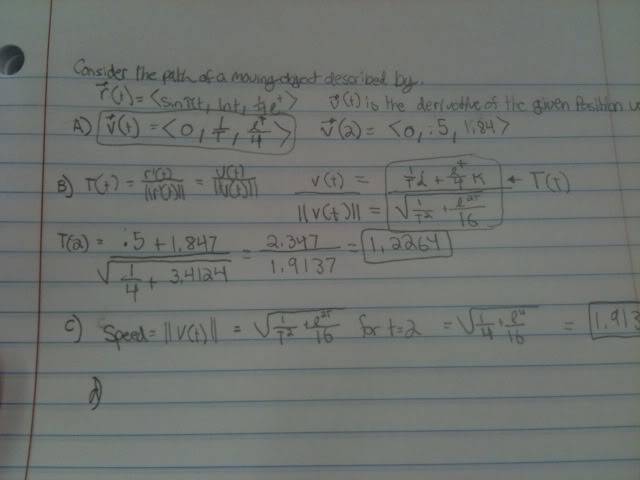
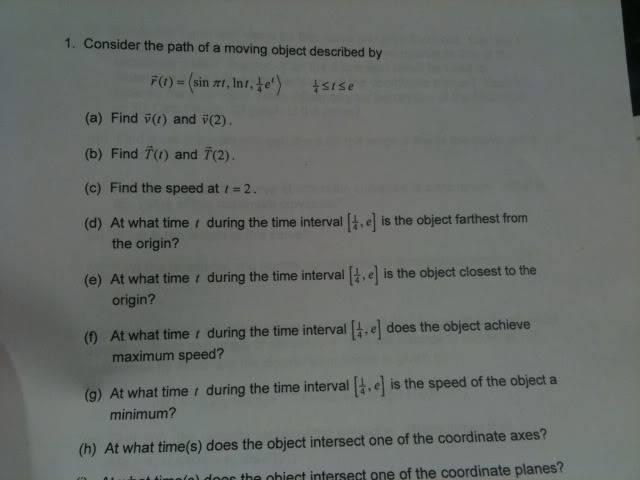
Hi guys I posted a picture of the problem set and my work so far. I am on letter (d) of the problem set and I am stuck. I am 90% sure I have the formulas to solve (d) through (g) but I am not clear how. Can anyone give me a basic idea on what step I should take next?

Problem set
279C1FCF-orig.jpg


my work so far
598130AD-orig.jpg


Thanks in advance for the help
 
Physics news on Phys.org
For (d) you just need to calculate when ||r(t)|| is min and max on the interval. It might be easier to work with ||r(t)||2 and remember that the max and min of a function on a closed interval might occur at a critical point or an end point.
 
LCKurtz said:
For (d) you just need to calculate when ||r(t)|| is min and max on the interval. It might be easier to work with ||r(t)||2 and remember that the max and min of a function on a closed interval might occur at a critical point or an end point.


Thanks for the quick response. I understand the concept of finding the mix and max of the position vector within the given interval. Does this mean I can graph the position vector and just find the max and min between the given (t) interval?

Also I think I messed up on my work for part (b). Should the answer be written as a vector like this?
81F3CFFA-orig.jpg


or a scalar quantity like I did in the first image I posted of the work I did??
 
Your solution picture is difficult to read on my computer. All the answers for (a) and (b) are vectors, and the first component of v(t) and v(2) shouldn't be 0.

And presumably you aren't graphing the position vector. You are graphing its magnitude which is a scalar function of t.
 
I got zero for the first component because I took the derivative of the position vector r(t)

the derivative of the first component sin(pi)t = 0? not correct?
[PLAIN]http://www4c.wolframalpha.com/Calculate/MSP/MSP432419h9a63ehe63d19g00002afc315424ied1f7?MSPStoreType=image/gif&s=51&w=106&h=36

so answers for (a) and (b) should be in i,j,k vector format and Speed should be a single answer scalar format??

as far as finding the min and max, I think I understand the concept or what needs to be done. I just am not understand what to do with the position vector? Plug in the intervals given for t?
 
Last edited by a moderator:
danpiz23 said:
I got zero for the first component because I took the derivative of the position vector r(t)

the derivative of the first component sin(pi)t = 0? not correct?
[PLAIN]http://www4c.wolframalpha.com/Calculate/MSP/MSP432419h9a63ehe63d19g00002afc315424ied1f7?MSPStoreType=image/gif&s=51&w=106&h=36

No. Wherever did you get that idea? The derivative of the sine function is the cosine function, and you need the chain rule.
so answers for (a) and (b) should be in i,j,k vector format and Speed should be a single answer scalar format??
Yes. Vectors are vectors and scalars are scalars.
as far as finding the min and max, I think I understand the concept or what needs to be done. I just am not understand what to do with the position vector? Plug in the intervals given for t?

You aren't maximizing or minimizing the position vector. You are working with its magnitude which is a scalar. Use normal calculus methods to find the max/min. See post #2.
 
Last edited by a moderator:
Wow, Cannot believe I made such a big mistake finding the derivative of sin(pi)t. I typed it into wolfram alpha and just used that answer no questions.

This is the answer I came up with doing it with the chain rule...
derivative[sin(pi*x)] = cos(pi*T) * derivative[pi*T] = pi*cos(pi*T)

I understand that I need to use the magnitude of the position vector (||r(t)||), not quite sure how to find the max/min. I am looking up examples
 
I am still stumped on part (d), I am using Derive 6 to derive,simplify the problems. This is the work I have so far. Double checked all my work and looked online for examples, but I am not finding anything??

Is there a simple formula?? Do I just need to use limits or integration ??
Work-1.jpg
 
LCKurtz said:
For (d) you just need to calculate when ||r(t)|| is min and max on the interval. It might be easier to work with ||r(t)||2 and remember that the max and min of a function on a closed interval might occur at a critical point or an end point.

danpiz23 said:
I am still stumped on part (d), I am using Derive 6 to derive,simplify the problems.

Where are you stuck?

F(t) =||r(t)||^2 =\sin^2 \pi t+ \ln^2(t) +\frac 1 {16} e^{2t},\ <br /> \frac 1 4 \leq t \leq e

Don't you know how to use max/min problems in calculus? The possible values of t are critical points and end points.
 
  • #10
No, not sure if that was something we went over in calc 1, but calc 2 was all derivatives and integration. Calc 3 just started and so far it's been vector calc and distance between point/plane, plane/plane and point/line.
I was able to get
F(t) =||r(t)||^2 =\sin^2 \pi t+ \ln^2(t) +\frac 1 {16} e^{2t},\ <br /> \frac 1 4 \leq t \leq e

Do I just plug in (1/4) and then e for t? What do I do with those values?
 
Last edited:
  • #11
danpiz23 said:
No, not sure if that was something we went over in calc 1, but calc 2 was all derivatives and integration. Calc 3 just started and so far it's been vector calc and distance between point/plane, plane/plane and point/line.
I was able to get
F(t) =||r(t)||^2 =\sin^2 \pi t+ \ln^2(t) +\frac 1 {16} e^{2t},\ <br /> \frac 1 4 \leq t \leq e

Do I just plug in (1/4) and then e for t? What do I do with those values?

Why don't you start by drawing a graph of that? I presume your software will do that. It will show you where your max and min points are. Then look in your Calc I or II book and review where it talks about critical points and finding the relative extrema of functions.
 
  • #12
Why did you use ||r(t)||^2 instead of ||r(t)||?

Can I use the graph of ||r(t)|| to find the max and min?
 
  • #13
danpiz23 said:
Why did you use ||r(t)||^2 instead of ||r(t)||?

Can I use the graph of ||r(t)|| to find the max and min?

Because it is easier to work with without the square root. Both the function and its square will have maximum or minimum for the same value of t. You will see when you find the critical point. If you are doing it all with software, it probably makes no difference.
 

Similar threads

  • · Replies 21 ·
Replies
21
Views
5K
  • · Replies 17 ·
Replies
17
Views
4K
  • · Replies 2 ·
Replies
2
Views
3K
Replies
2
Views
2K
  • · Replies 3 ·
Replies
3
Views
2K
  • · Replies 17 ·
Replies
17
Views
1K
Replies
3
Views
4K
  • · Replies 1 ·
Replies
1
Views
1K
  • · Replies 7 ·
Replies
7
Views
2K
  • · Replies 16 ·
Replies
16
Views
3K