When to apply conservation of angular momentum?

Click For Summary

Discussion Overview

The discussion revolves around the application of conservation of angular momentum in a scenario involving a mass moving in a circular path while attached to a string. Participants explore the conditions under which angular momentum can be considered conserved, particularly in the presence of external forces such as tension in the string.

Discussion Character

  • Conceptual clarification
  • Debate/contested
  • Mathematical reasoning

Main Points Raised

  • Some participants assert that conservation of angular momentum applies when there is no external torque, suggesting that tension does not produce torque about the axis of rotation.
  • Others argue that tension, being the only force acting on the mass, does not exert torque because it acts radially and is parallel to the radius vector at the point of application.
  • A participant points out that while tension has a radial component, it does not exert torque since the angle between the tension and the radius vector is zero.
  • Another participant challenges the notion that tension can have both radial and tangential components, emphasizing that tension is purely radial in this context.
  • Some participants discuss the implications of gradually increasing tension, suggesting that it allows for the conservation of angular momentum as the mass moves in an approximately circular path.
  • There is a contention regarding the definition of torque and whether a single force can produce torque without a pair of forces.
  • Participants express differing views on the nature of motion, with some stating that the mass is spiraling inward, while others maintain it is moving in a circular path.

Areas of Agreement / Disagreement

The discussion remains unresolved, with multiple competing views on the role of tension and the conditions for applying conservation of angular momentum. Participants do not reach a consensus on whether tension can produce torque or if angular momentum can be conserved in this scenario.

Contextual Notes

Participants highlight the importance of the radial and tangential components of forces and their relationship to torque, but there is no agreement on how these components affect the conservation of angular momentum in this specific case.

gracy
Messages
2,486
Reaction score
83
So my question is when to apply conservation of angular momentum?When there is no external force ,right?But in the case below
A mass m moves in a circle on a smooth horizontal plane with velocity v0 at a radius R0. The mass is attached to a string which passes through a smooth hole in the plane as shown.
The tension in the string is increased gradually and finally m moves in a circle of radius R0/2 . The final value of the kinetic energy is
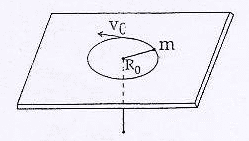
AIPMT_2015_11_alagu_3515_22_56_3_Ouput.png

A) mv20
B) 1/4 mv20
C) 2 mv20
D) 1/2 mv20
My teacher applied conservation of angular momentum.But I don't know why?As tension force is external force the angular momentum should not be conserved.
Note:I am not posting this question in homework sectio because I know it's solution .I don't want method to solve rather I am having a conceptual doubt.
 
Physics news on Phys.org
gracy said:
So my question is when to apply conservation of angular momentum?When there is no external force ,right?
You can apply conservation of angular momentum whenever there is no external torque. The tension produces no torque about the axis.
 
DaleSpam said:
The tension produces no torque about the axis.
Because tension force is the only force,and for torque we require a pair of force separated by perpendicular distance,right?
 
right?Sir,please answer.
 
Torque requires you to choose an origin
gracy said:
Because tension force is the only force,and for torque we require a pair of force separated by perpendicular distance,right?
Nop.

In magnitude the torque of a given force about certain point is given by
##
\mathbf{\tau}=rFsin\theta##

where r measured to point in question. In this case choose to measure r about the center of the circle, I mean choose the center of the circle as the origin of the coordinates.

In this case r is the radius of the circle, note that the tension and r are parallel, so the angle is 0 so the sin(theta)=0. Then, the torque associated to the tension is null, therefore the angular momentum is conserved.
 
  • Like
Likes   Reactions: gracy
gracy said:
Because tension force is the only force,and for torque we require a pair of force separated by perpendicular distance,right?

The force of tension in the string always points perpendicular to the direction the object is moving, so its component in the tangential direction is zero, and thus it does no torque. In order for a force to exert torque on an object, the component of the force in the tangential direction has to be non-zero.
 
Drakkith said:
The force of tension in the string always points perpendicular to the direction the object is moving,

This is not true, in this example the motion have a tangential and a radial component.

Drakkith said:
... so its component in the tangential direction is zero.

This is true and is the reason there is no torque.
 
andresB said:
This is not true, in this example the motion have a tangential and a radial component.

Yes, but the force from tension only has a radial component, right?
 
Drakkith said:
Yes, but the force from tension only has a radial component, right?
Yes this is correct. But the object also has a radial component of speed (it is not moving in a circle, it is spiraling inward) and so the tension is not perpendicular to the motion.
This is why the energy is larger at the end of the problem: the tension did some work.
 
  • #10
Roger.
 
  • #11
gracy said:
we require a pair of force separated by perpendicular distance
This pair of force is called "couple",I think it is required in calculation of moment.
andresB said:
In magnitude the torque of a given force about certain point is given by
τ=rFsinθ \mathbf{\tau}=rFsin\theta
So,torque doesn't need two forces.It just needs a force and some angle theta with r which is distance between point of application of force and axis of rotation.
 
  • #12
gracy said:
Because tension force is the only force,and for torque we require a pair of force separated by perpendicular distance,right?
A torque requires a force that has a component perpendicular to the axis of rotation some distance from the axis of rotation. In this case, the tension force is through the axis of rotation and therefore it's torque is 0.
 
  • #13
The important information given in the question is that tension is increased gradually . The increasing tension causes the block to move closer to axis of rotation.

The block then moves towards the center in a spiral path , such that tension has both radial and tangential components , of which the radial component can produce a torque making conservation of angular momentum invalid .

But because tension increases gradually the block moves towards the center in an approximately circular path and tension will have only a tangential component . Tension doesn't produce torque .

You can now conserve angular momentum .
 
  • #14
Qwertywerty said:
The block then moves towards the center in a spiral path , such that tension has both radial and tangential components ,
The tension in the string is always purely radial, towards the center. You might mean normal and tangential components, perpendicular and parallel to the blocks velocity.

Qwertywerty said:
of which the radial component can produce a torque
The string tension cannot produce any torque around the center, no matter how you decompose it into components. The torques from the two components will simply cancel.

Qwertywerty said:
But because tension increases gradually the block moves towards the center in an approximately circular path and tension will have only a tangential component .
Now you seem to confuse tangential with radial.

Qwertywerty said:
Tension doesn't produce torque .
Yes, because it is only radial. No matter how quickly you increase it.
 
  • Like
Likes   Reactions: gracy

Similar threads

  • · Replies 16 ·
Replies
16
Views
1K
  • · Replies 10 ·
Replies
10
Views
2K
  • · Replies 6 ·
Replies
6
Views
1K
  • · Replies 3 ·
Replies
3
Views
3K
  • · Replies 5 ·
Replies
5
Views
2K
  • · Replies 4 ·
Replies
4
Views
3K
  • · Replies 9 ·
Replies
9
Views
2K
  • · Replies 3 ·
Replies
3
Views
2K
  • · Replies 40 ·
2
Replies
40
Views
5K
  • · Replies 2 ·
Replies
2
Views
3K