Where's my mistake? (Lorentz Transformation for a moving spaceship)

Click For Summary
SUMMARY

The discussion focuses on the application of the Lorentz transformation to a moving spaceship, specifically addressing the calculation of velocity components in different frames of reference. The correct formula for the angle of the beam's velocity is established as arctan(sinθ*sqrt(1-v^2/c^2)/(cosθ+v/c)). Key insights include the distinction between the effects of Lorentz contraction and time dilation on the velocity components in the x and y directions. The discussion emphasizes the importance of correctly applying Einstein's addition rule to derive the transformed velocities.

PREREQUISITES
  • Understanding of Lorentz transformations
  • Familiarity with Einstein's addition of velocities
  • Knowledge of trigonometric functions in physics
  • Basic concepts of time dilation and Lorentz contraction
NEXT STEPS
  • Study the derivation of Lorentz transformations in detail
  • Learn about Einstein's addition of velocities in different inertial frames
  • Explore the implications of time dilation on moving objects
  • Investigate practical applications of Lorentz transformations in modern physics
USEFUL FOR

Students of physics, particularly those studying special relativity, as well as educators and researchers looking to deepen their understanding of relativistic effects on moving objects.

Efeguleroglu
Messages
24
Reaction score
2
Homework Statement
There is a spaceship moving in the +x direction gets a signal from a source on xy plane. From the reference frame of stable stars, the speed of the spaceship is v and the angle that signal creates between x axis and its direction when reached the spaceship is θ. Get help from lorentz transformations and find out the angle θ in the reference frame of spaceship.
Relevant Equations
x'=(x-vt)/sqrt(1-v^2/c^2)
I didn't use but maybe: t'=(t-(vx)/c^2)/sqrt(1-v^2/c^2)
That's what I found. But the answer is arctan(sinθ*sqrt(1-v^2/c^2)/(cosθ+v/c))
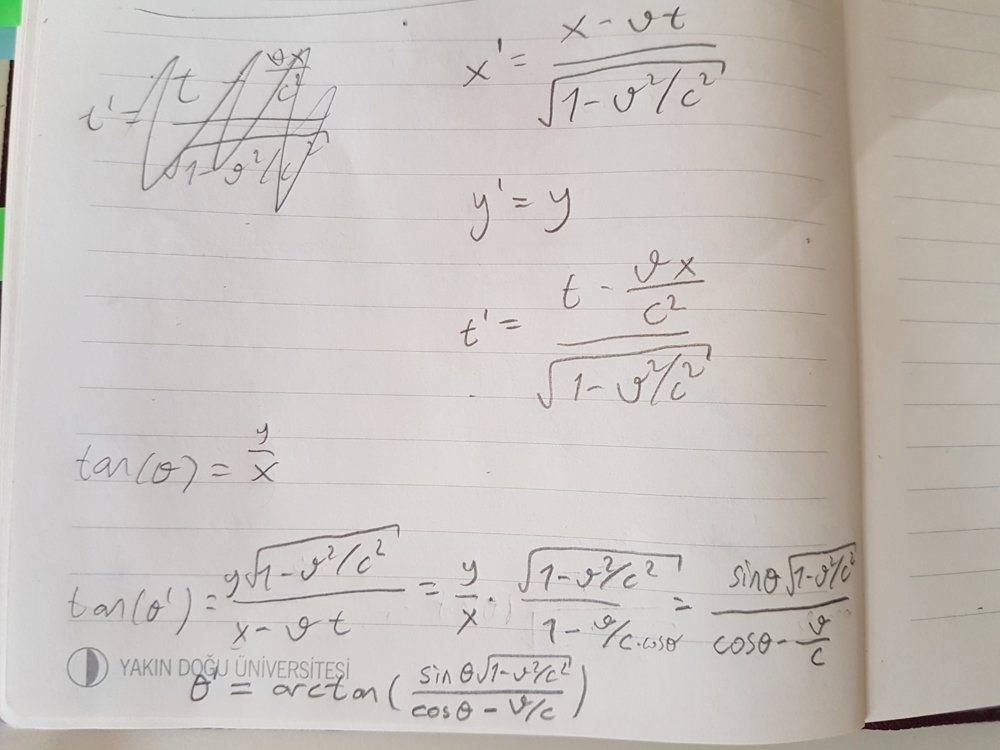
20190620_164005.jpg
 
Last edited by a moderator:
Physics news on Phys.org
Rough sketch:
Screenshot (660).png

$$tan \theta = \frac{y}{x}$$

It is correct but then you don't seem to be using Einstein addition rule correctly. Also note that ##y## and ##x## correspond to the components of the beam's velocity in the ##y## and ##x## directions.

I have labeled the stable star as the rest frame ##S## and the (rectangular) spaceship as the moving frame ##\bar S##.

The key here is noticing that the velocity changes relative to a moving frame not only due to distances (Lorentz contraction) but due to time (time dilation) as well.

The velocity in the ##y## (vertical) direction changes as follows (from ##S## to ##\bar S##):

$$\bar u_y = \frac{d \bar y}{d \bar t} = \frac{d y}{\gamma (dt -v/c^2 dx)} = \frac{u_y}{\gamma (1 -v/c^2 u_x)}$$

Note that there's no Lorentz contraction along ##y## because the spaceship moves along ##x##.

The velocity in the ##x## (horizontal) direction changes as follows (from ##S## to ##\bar S##):

$$\bar u_x = \frac{d \bar x}{d \bar t} = \frac{\gamma(d x - v dt)}{\gamma (dt -v/c^2 dx)} = \frac{u_x -v}{\gamma (1 -v/c^2 u_x)}$$

Knowing that:

$$tan \bar \theta = \frac{\bar u_y}{\bar u_x} = \frac{u_y}{\gamma(u_x -v)}$$

And ##cos\theta = \frac{u_x}{c}## and ##sin\theta = \frac{u_y}{c}##... What do you get? ;)

Please let me know if something is unclear.
 
Last edited:
Shouldn't dt's are equal?
 
Typo indeed. Let me fix it.
 

Similar threads

Replies
6
Views
2K
  • · Replies 40 ·
2
Replies
40
Views
2K
  • · Replies 2 ·
Replies
2
Views
878
  • · Replies 19 ·
Replies
19
Views
3K
Replies
7
Views
2K
  • · Replies 25 ·
Replies
25
Views
2K
  • · Replies 1 ·
Replies
1
Views
2K
  • · Replies 2 ·
Replies
2
Views
2K
Replies
6
Views
2K
  • · Replies 24 ·
Replies
24
Views
2K