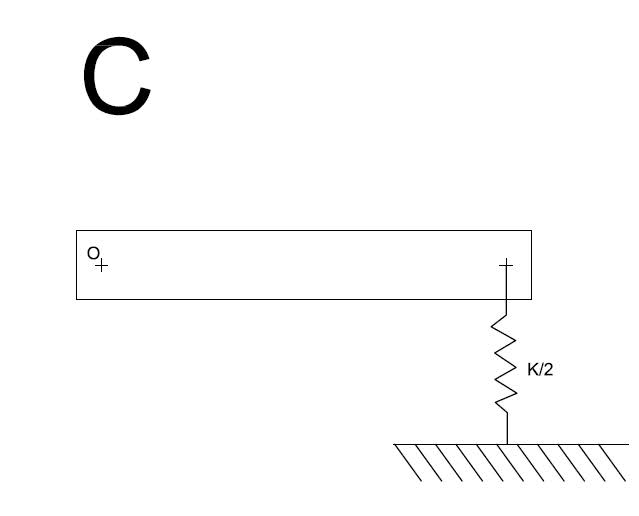
Which of these spring systems is equivalent?

Click For Summary
SUMMARY

The discussion centers on determining the equivalent stiffness (K) of a system involving two springs in a vibration problem. The user, Mark, initially believes that the equivalent stiffness for two springs in series should yield K/2, referencing System C. However, another participant clarifies that the configuration is not a simple series arrangement, suggesting that the effective spring constant should be derived based on the displacement of the rod, leading to a potential value of 2K as indicated in System B.

PREREQUISITES
  • Understanding of spring mechanics and stiffness calculations
  • Familiarity with the concept of effective spring constants
  • Knowledge of vibration analysis principles
  • Ability to visualize mechanical systems and forces
NEXT STEPS
  • Study the derivation of effective spring constants in mechanical systems
  • Learn about the principles of vibrations and natural frequency calculations
  • Explore the differences between springs in series and parallel configurations
  • Investigate the impact of displacement on force in mechanical systems
USEFUL FOR

Mechanical engineers, physics students, and anyone involved in vibration analysis or mechanical system design will benefit from this discussion.

MarkH748
Messages
8
Reaction score
0
Hi guys. I looking at a vibrations problem with 2 springs in it (System A). I need to find an overall value for the stiffness K to find the natural frequency of the system. I know that normally when 2 springs are in series I should get the sum of (I/Ki)^-1 which would give me an equivilant stiffness of K/2 in this case (System C). But when I take moments about the pivot point og the rod O it makes more sense to me for it to be 2K (System B). Here are some sketches I made.
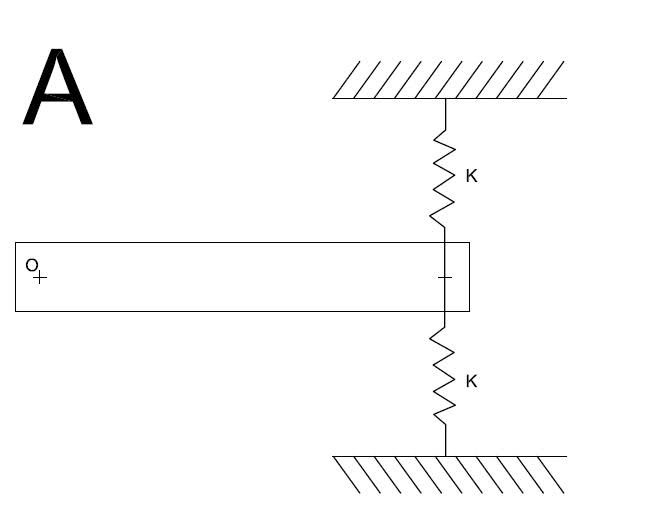
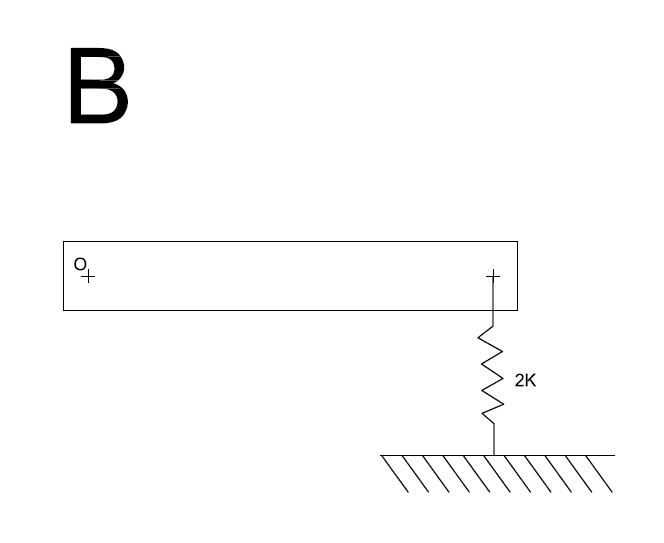
ngq16x.jpg

110c3fq.jpg

242igj8.jpg


Can anyone shed some light on this as I'm unsure of which system is correct.

Any help would be greatly appreciated.

Mark.
 
Physics news on Phys.org
MarkH748 said:
I know that normally when 2 springs are in series I should get the sum of (I/Ki)^-1 which would give me an equivilant stiffness of K/2 in this case (System C).
Ah... but you don't really have two springs in series, you have one above and one below. Why not derive the effective spring constant for yourself? (Imagine the rod displaced by some Δx. What's the net force on it?)
 

Similar threads

  • · Replies 8 ·
Replies
8
Views
2K
Replies
17
Views
2K
Replies
3
Views
2K
  • · Replies 17 ·
Replies
17
Views
2K
Replies
2
Views
3K
Replies
7
Views
1K
  • · Replies 8 ·
Replies
8
Views
2K
Replies
24
Views
4K
  • · Replies 14 ·
Replies
14
Views
2K
  • · Replies 3 ·
Replies
3
Views
2K