Which part of the light wave do we take? (quick question)

  • Context: High School 
  • Thread starter Thread starter sameeralord
  • Start date Start date
  • Tags Tags
    Light Wave
Click For Summary

Discussion Overview

The discussion revolves around the representation of light waves, specifically the relationship between electric and magnetic fields in electromagnetic (EM) waves. Participants explore the graphical depiction of these waves and the implications of showing one field over the other, as well as the nature of their interaction.

Discussion Character

  • Exploratory
  • Technical explanation
  • Debate/contested

Main Points Raised

  • One participant questions why a specific graph of a light wave does not include a perpendicular graph, seeking clarification on whether it pertains to the electric or magnetic field, or both.
  • Another participant suggests that the second diagram may depict the force on a charged particle, indicating uncertainty about its representation.
  • It is noted that while light waves consist of both electric and magnetic fields at right angles to each other, it is not always necessary to depict both in diagrams.
  • A participant expresses the belief that when light has a particular frequency, both electric and magnetic waves travel at that frequency, proposing a relationship between the two.
  • Another participant asserts that electric and magnetic fields in EM waves do not "create each other," arguing that both fields are generated by the source of the waves, specifically moving charges.

Areas of Agreement / Disagreement

Participants express differing views on the relationship between electric and magnetic fields in light waves, with some proposing a connection between the two, while others contest this notion. The discussion remains unresolved regarding the implications of their interaction and representation in diagrams.

Contextual Notes

There are unresolved assumptions regarding the interpretation of the diagrams and the nature of the relationship between electric and magnetic fields in light waves. The discussion reflects varying interpretations of established concepts in electromagnetism.

sameeralord
Messages
659
Reaction score
3
Hello,

Quick question. This is a light wave
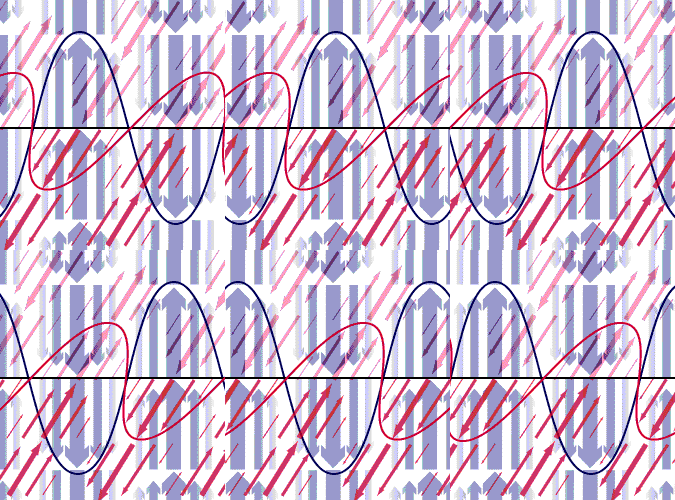
ems.gif


This is another light wave

http://www.chem.yale.edu/~chem125/125/xray/DiffractionMasks/sinpositiont1.JPG

Why doesn't this graph have another perpendicular graph. Are they talking about the particles in the magnetic field or electric field here or both.

Simply how do they make one wave out of a light wave that has two waves.
 

Attachments

  • ems.gif
    ems.gif
    82.2 KB · Views: 535
  • ems.gif
    ems.gif
    82.2 KB · Views: 412
  • ems.gif
    ems.gif
    82.2 KB · Views: 441
  • ems.gif
    ems.gif
    82.2 KB · Views: 386
Last edited by a moderator:
Science news on Phys.org
sameeralord said:
Why doesn't this graph have another perpendicular graph. Are they talking about the particles in the magnetic field or electric field here or both.
While your first diagram seems like the usual depiction of an EM wave (which is what light is, classically), it's not clear what that second diagram is supposed to show. (It looks like it's meant to depict the force on some charged particle.)
Simply how do they make one wave out of a light wave that has two waves.
A light wave has both electric and magnetic fields, which are at right angles to each other. But that doesn't mean you always have to show both in a diagram.
 
Doc Al said:
While your first diagram seems like the usual depiction of an EM wave (which is what light is, classically), it's not clear what that second diagram is supposed to show.

A light wave has both electric and magnetic fields, which are at right angles to each other. But that doesn't mean you always have to show both in a diagram.

Thanks Doc Al! :smile: So most of the time I think they show the electric field. When light has a particular freuqency would both electric and magnetic waves travel at that frequency. I think they do because one is created from the other.
 
sameeralord said:
When light has a particular freuqency would both electric and magnetic waves travel at that frequency.
Yes.
 
Doc Al said:
Yes.

Thanks Doc Al :smile: Topic closed unless someone wants to start the topic if light is a wave or particle :smile:
 
sameeralord said:
Thanks Doc Al! :smile: So most of the time I think they show the electric field. When light has a particular freuqency would both electric and magnetic waves travel at that frequency. I think they do because one is created from the other.

Wrong. Electric and Magnetic fields in EM waves DO NOT "create each other". Sorry Wikipedia is wrong on that. (and they won't correct it, because they are determined to keep it wrong) Electric and Magnetic fields of waves are both created by the source of the waves (moving charges) not each other.
 

Similar threads

  • · Replies 6 ·
Replies
6
Views
14K
  • · Replies 20 ·
Replies
20
Views
3K
  • · Replies 8 ·
Replies
8
Views
4K
  • · Replies 2 ·
Replies
2
Views
3K
  • · Replies 4 ·
Replies
4
Views
2K
Replies
3
Views
2K
  • · Replies 1 ·
Replies
1
Views
2K
  • · Replies 7 ·
Replies
7
Views
3K
  • · Replies 12 ·
Replies
12
Views
2K
  • · Replies 21 ·
Replies
21
Views
3K