Why Are Absorption Cross Sections Larger for Atoms Than for Molecules?

  • Context: Graduate 
  • Thread starter Thread starter Plane Wave
  • Start date Start date
  • Tags Tags
    Absorption Cross
Click For Summary
SUMMARY

The absorption cross sections for atoms are significantly larger than those for molecules due to the inherent differences in their electronic and vibrational states. For instance, the absorption cross section for the D2 line in Rubidium is approximately 1E-9 cm², while that for I2 is around 10E-18 cm² to 10E-19 cm². This disparity arises because molecules possess multiple ground states and a greater number of thermally populated states, which diminishes the probability of excitation compared to isolated atoms. Additionally, the lifetime of excited states in molecules is considerably shorter than that of atomic electronic levels, further contributing to the reduced absorption cross sections.

PREREQUISITES
  • Understanding of atomic and molecular spectroscopy
  • Familiarity with absorption cross section concepts
  • Knowledge of vibrational and rotational states in molecules
  • Basic principles of quantum mechanics related to electronic transitions
NEXT STEPS
  • Research the relationship between absorption cross sections and vibrational states in molecules
  • Study the differences in electronic state lifetimes between atoms and molecules
  • Explore the effects of environmental factors, such as air presence, on molecular absorption
  • Learn about the quantum mechanical principles governing atomic and molecular transitions
USEFUL FOR

Researchers in physical chemistry, spectroscopists, and anyone studying the differences in absorption properties between atomic and molecular species.

Plane Wave
Messages
8
Reaction score
0
Why are absorption cross sections for atoms so much larger than that of molecules.

For example, the absorption cross section for the D2 line in Rubidium is ~1E-9 cm^2. Specifically, the cross section is basically σ~λ^2

The absorption cross sections for say, I2, is 9 orders of magnitude smaller! Briefly looking through many of the molecular spectra, all of the cross sections are on order of 10E-18 cm^2 to 10E-19 cm^2.
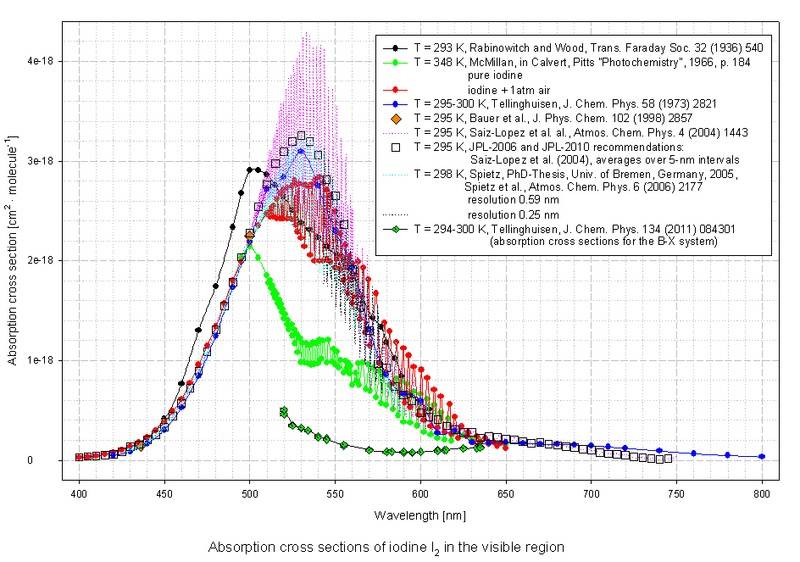
I2_400-800nm_lin.jpg

http://joseba.mpch-mainz.mpg.de/spe.../Halogens+mixed halogens/I2_400-800nm_lin.jpg

Does anyone know why the absorption cross section for molecular transitions are so much smaller than the atomic absorption cross section?
 
Physics news on Phys.org
Consider what "absorption" entails. What actually happens at the atomic level in each case you are considering?
What is the essential difference between an atom in a molecule and an atom by itself with regard to the process?
 
My best answer, which I didn't want to put in the original post to corrupt future responses, was the molecule has many possible ground states and the absorption cross section includes the probability the excitation electron happens to be in that vibrational and rotational state.

Is that what your questions are implying?
 
I forgot to add that I think there should be something else. There maybe 100 or so discrete thermally populated states from which the molecule can be excited. That's only 2 orders of magnitude instead of 9.
 
The questions are guiding for you and formative for me - I was hoping to focus your attention on the physical effects behind the equations while learning more about how you think ;)

Note: if you want to compare crossections between atoms and molecules - you should compare like with like: i.e. H vs H2 rather than Ru with I2. I expect you'd get different results for Iodine crystals too.

Did you notice that the crossections increased for pure iodine when there was air in the sample (red)? Apart from that your graph shows only measured spectra for I2.
 
The lifetime of the excited state (usually a high order vibrational state which relaxes by non-radiative transfer) is orders of magnitude smaller than the radiative lifetime of atomic electronic levels which accounts for the difference in absorption cross section.
 

Similar threads

  • · Replies 3 ·
Replies
3
Views
3K
  • · Replies 3 ·
Replies
3
Views
2K
  • · Replies 6 ·
Replies
6
Views
2K
  • · Replies 2 ·
Replies
2
Views
2K
  • · Replies 2 ·
Replies
2
Views
2K
  • · Replies 1 ·
Replies
1
Views
2K
Replies
1
Views
2K
  • · Replies 1 ·
Replies
1
Views
3K
Replies
1
Views
2K
  • · Replies 1 ·
Replies
1
Views
2K