Why can't I saturate this transistor?

  • Thread starter Thread starter amenhotep
  • Start date Start date
  • Tags Tags
    Transistor
Click For Summary
SUMMARY

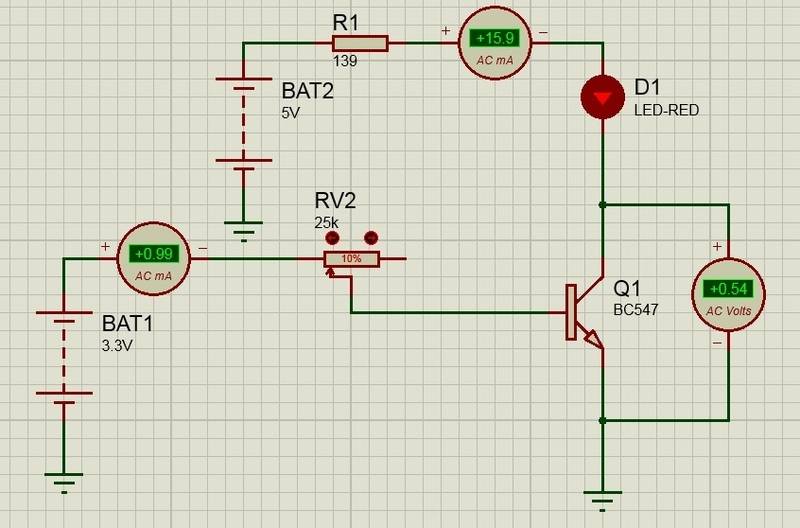
The forum discussion centers on troubleshooting a transistor circuit designed using Proteus Isis, specifically with a BC547 transistor. The user is unable to achieve saturation, as indicated by a collector-emitter voltage (VCE) that remains above 0.2V despite varying base currents. Participants suggest checking meter settings, adjusting resistance values, and experimenting with different transistor models, such as the BC548 and BC546, to better understand the simulation's limitations and the transistor's characteristics.

PREREQUISITES
  • Understanding of transistor operation, specifically saturation in BJTs.
  • Familiarity with circuit simulation software, particularly Proteus Isis.
  • Knowledge of resistor calculations for current limiting in LED circuits.
  • Basic comprehension of transistor datasheets and parameters like VCE and VBE.
NEXT STEPS
  • Explore the characteristics of the BC547, BC548, and BC546 transistors in detail.
  • Learn about the impact of base current on collector current in BJTs.
  • Investigate the limitations of Proteus Isis and its components library.
  • Study real-world transistor circuit design and testing to compare with simulation results.
USEFUL FOR

Electronics enthusiasts, circuit designers, and students working with transistor circuits and simulations, particularly those using Proteus Isis for design and analysis.

amenhotep
Messages
29
Reaction score
1
Hi,
I started using Proteus Isis and was playing around just to get used to it. I designed a simple transistor circuit that should work in the saturated region. The LED needs 2.3V. For saturation, the collector and emitter terminals should be shorted or have a tiny voltage drop across it. So, since the LED requires 20mA, I calculated that the series resistance should be around 139. The BC547 transistor has a dc gain around 110 at that current. This means that a base current of 0.2mA or more should should be enough to saturate the transistor. The circuit is shown below. Whatever base current I used, ##V_{CE}## didn't get below 0.2V which indicates a transistor is near saturation. I've cross-checked values from the datasheet. Surely, something is terribly wrong !
2zsa051.jpg
 
Engineering news on Phys.org
hi you
welcome to PF

why have you got all your meters in AC mode when they are in a DC circuit
Im not familiar with the inner working of Proteus, but maybe that's why you are getting oddball readings ?

Dave
 
davenn said:
hi you
welcome to PF

why have you got all your meters in AC mode when they are in a DC circuit
Im not familiar with the inner working of Proteus, but maybe that's why you are getting oddball readings ?

Dave

Thanks for the welcoming. I actually didn't notice that I was using the meters in the AC mode. I changed them to DC and the values were the same. Is something wrong with the circuit ?

23jg5xe.png
 
Try increasing R1 to about 1kohm
 
I've done all that. The current becomes so small that the LED turns OFF.
 
Try increasing the collector supply to 12 volts
 
amenhotep said:
I've done all that. The current becomes so small that the LED turns OFF.

yup that sounds about right for a 5V supply and ~ 20mA through the LED with a ~ 2V drop
200 Ohms give or take a bit is ok

the BC547 is going to turn on at ~ 0.6 - 0.7V and the 0.54 Vdrop across the C-E is indicating that its currently turned on.


the definition of saturation as in your common emitter case is ...

As base current increases the collector current increases to a point where any more base current will not increases the collector current at that point the transistor is saturated whereby current may flow in both direction and the two diodes will essentially be in a parallel mode and the voltage drop from emitter to collector will reflect the status as a low voltage drop.

as far as I can see, that's what is happening in your circuit
 
Last edited:
You also need to understand that the C-E Vdrop is not a fixed value at saturation ie. is isn't 0.2V and only 0.2V
it is dependent on the base drive, the higher the drive the higher the C-E Vdrop value at onset of saturation

cheers
Dave
 
I'd suggest building one from real parts. Your simulation's accuracy is at the mercy of a programmer someplace.

I looked for information on Proteus' parts library, to no avail.
However the BC547 is allowed (per a Fairchild datasheet at http://www.elektronik-kompendium.de/public/schaerer/FILES/bc550.pdf )
Vce as much as 600 millivolts at 100ma and 250 millivolts at 10 ma .
You're operating it in an area between those limits.

BC547 is a high voltage version of that transistor, 50 volt, so probably has a stout collector.
Try swapping it for a 30 volt BC548 and see if the program calculates any differently.
Then try a 65 volt BC546.

It's really educational to poke at things and learn their nuances..

old jim
 
Last edited:
  • #10
jim hardy said:
I'd suggest building one from real parts. Your simulation's accuracy is at the mercy of a programmer someplace.

I looked for information on Proteus' parts library, to no avail.
However the BC547 is allowed (per a Fairchild datasheet at http://www.elektronik-kompendium.de/public/schaerer/FILES/bc550.pdf )
Vce as much as 600 millivolts at 100ma and 250 millivolts at 10 ma .
You're operating it in an area between those limits.

BC547 is a high voltage version of that transistor, 50 volt, so probably has a stout collector.
Try swapping it for a 30 volt BC548 and see if the program calculates any differently.
Then try a 65 volt BC546.

It's really educational to poke at things and learn their nuances..

old jim

Thanks Jim. Tried different NPNs but can't bring VCE down enough.
 
  • #11
amenhotep said:
Thanks Jim. Tried different NPNs but can't bring VCE down enough.

Hmmmm ... one wonders what the Proteus program assumes about that transistor. Any details provided about that ?

I do notice Fairchild specifies Vcesat with Ic = 20Ib.
Fairchild's graph, figure 3 specifies Ic = 10Ib .
You're at 15.
Oughta work just fine.
How's your Vbe look compared to the datasheet ?

Poke at that simulation program a bit more... find its limits.
 

Similar threads

  • · Replies 5 ·
Replies
5
Views
4K
Replies
68
Views
7K
Replies
10
Views
2K
  • · Replies 5 ·
Replies
5
Views
4K
  • · Replies 10 ·
Replies
10
Views
2K
Replies
2
Views
2K
  • · Replies 4 ·
Replies
4
Views
8K
  • · Replies 5 ·
Replies
5
Views
3K
  • · Replies 62 ·
3
Replies
62
Views
10K
  • · Replies 7 ·
Replies
7
Views
4K