Why Cherenkov light leave rings instead of full circles?

Click For Summary

Discussion Overview

The discussion revolves around the nature of Cherenkov light and the reasons why it manifests as rings rather than full circles in detector images. Participants explore the implications of wave front projections, detector configurations, and the conditions under which Cherenkov radiation is produced.

Discussion Character

  • Exploratory
  • Technical explanation
  • Debate/contested

Main Points Raised

  • One participant questions why Cherenkov light appears as a ring instead of a full circle, suggesting it may be due to the brief period of light production as the particle enters the medium and slows down.
  • Another participant challenges the distinction between a ring and a full circle, noting that the image may appear circular but has fluctuations due to detector limitations.
  • A different participant explains that the ring formation is due to only border detectors being activated, while inner and outer detectors remain off, raising further questions about the continuous nature of the wave front.
  • Some participants propose two scenarios for the observed phenomenon: one involving a short slab of material for radiation emission followed by a long distance to the detector, and another involving curved mirrors that direct emitted light to a specific position.
  • There is a suggestion that if the detector is in direct contact with the material, the resulting image could be a full circle, leading to a later agreement that it would appear as a filled circle or disk.

Areas of Agreement / Disagreement

Participants express differing views on the reasons behind the ring formation, with some proposing that detector configuration plays a crucial role, while others suggest the nature of Cherenkov radiation itself is a factor. The discussion remains unresolved regarding the definitive explanation for the observed phenomenon.

Contextual Notes

Participants acknowledge limitations in their understanding of the detector mechanisms and the conditions under which Cherenkov light is produced, indicating that assumptions about the continuous wave front and detector activation may not fully account for the observed results.

A.R.
Messages
10
Reaction score
1
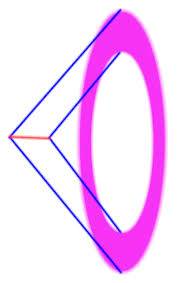
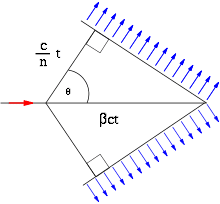
If the image we obtain from Cherenkov light is actually the projection of a continuous wave front (Fig. 1) on a vertical plane, orthogonal respect to the direction of propagation of the incident particle, why we just see a ring (Fig. 2), instead of a full circle? Is it because Cherenkov light is produced only during a brief period, between the entrance of the incident particle in the radiator medium and the instant when its velocity drops below the threshold (Fig. 3)?
Fig. 1
220px-Cherenkov.svg.png
Fig. 2
ring_10mu_y0cm.png
Fig. 3
images?q=tbn:ANd9GcTjRQ-gutOmTaFYJvmx5qOygHv6S_sRXn3ffi70_8JCvQB6goJH.jpg
 
Physics news on Phys.org
What is the difference between a ring and a full-circle?
To me fig.2 looks pretty much as a full-circle...however you can find its fluctuation around the circle by trying a fit and looking at the point differences...However that would be too crude, because your events are of course pixels and not points, and your machine (itself) has some offset signals (the points which are very far away from the circle)
 
Do you know how light/particle detectors work?
Fig. 2 is a ring, because only border detectors are activated, while inner detectors are off as well as outer ones. I'm asking, if the wave front is continuous, from the axis of the cone, to the maximum radius of the projection, why the image is not a full ring? I.e., why Fig. 2 is not a full orange circle? My answer is Fig. 3, where the red segment is the path the particle makes between the entrance in the medium and the drop of its velocity under the threshold for Cherenkov production, with the stop of light production and introduction of the discontinuity. But, is it really in this way?
 
There are two options:

(1) the one you mentioned, a short slab of material where the radiation is emitted and then a long distance to the detector.
(2) (curved) mirrors that reflect all light emitted in a specific direction to the same position

Both are used.
 
mfb said:
There are two options:

(1) the one you mentioned, a short slab of material where the radiation is emitted and then a long distance to the detector.
(2) (curved) mirrors that reflect all light emitted in a specific direction to the same position

Both are used.

So, if the detector is in contact with the material, the particle radiates until it reaches the detector, and the detector is just a plain sheet of PMs, what we'll see is actually a full circle, right?
 
It would be a filled circle (a disk), yes.
 

Similar threads

  • · Replies 7 ·
Replies
7
Views
2K
  • · Replies 6 ·
Replies
6
Views
3K
  • · Replies 16 ·
Replies
16
Views
8K
  • · Replies 1 ·
Replies
1
Views
6K
  • · Replies 28 ·
Replies
28
Views
3K
  • · Replies 46 ·
2
Replies
46
Views
6K
  • · Replies 5 ·
Replies
5
Views
2K
  • · Replies 20 ·
Replies
20
Views
5K
  • · Replies 11 ·
Replies
11
Views
4K
  • · Replies 42 ·
2
Replies
42
Views
8K