SUMMARY
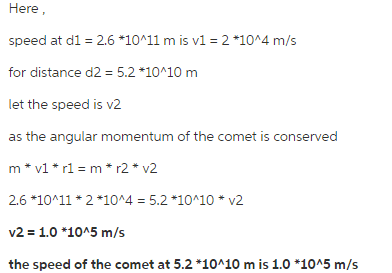
The discussion centers on the application of conservation of angular momentum to a comet's elliptical orbit around the sun. A comet traveling at 2.0×10⁴ m/s at a distance of 2.6×10¹¹ m from the sun's center is analyzed for its speed at a distance of 5.2×10¹⁰ m. The participants clarify that angular momentum cannot be directly applied due to the radial and tangential components of velocity in elliptical orbits. The correct approach involves using the definition of angular momentum, specifically the equation 𝓛 = 𝓻 × 𝓹, where 𝓻 is the position vector and 𝓹 is the momentum vector.
PREREQUISITES
- Understanding of elliptical orbits in celestial mechanics
- Familiarity with angular momentum concepts and calculations
- Knowledge of vector mathematics, particularly cross products
- Basic principles of gravitational physics
NEXT STEPS
- Study the conservation of angular momentum in non-circular orbits
- Learn about the dynamics of celestial bodies using Kepler's laws
- Explore the relationship between kinetic and potential energy in gravitational fields
- Investigate the implications of mass ratios in celestial mechanics
USEFUL FOR
Students of physics, astrophysicists, and educators looking to deepen their understanding of angular momentum in celestial mechanics, particularly in the context of elliptical orbits.