Why conservation of angular momentum is not applicable here

Click For Summary

Discussion Overview

The discussion revolves around the application of conservation of angular momentum to a comet's motion in an elliptical orbit around the sun. Participants explore the implications of the comet's velocity at different distances from the sun and the challenges in applying angular momentum principles in this context.

Discussion Character

  • Exploratory, Technical explanation, Debate/contested

Main Points Raised

  • One participant questions the validity of using conservation of angular momentum, noting that the comet's velocity has both radial and perpendicular components that complicate the analysis.
  • Another participant suggests that while potential versus kinetic energy could be used, the mass of the sun is necessary for calculations, which is not provided in the problem statement.
  • A third participant points out that the equation for angular momentum used may rely on an assumption about the relationship between the velocity vector and the radial vector, proposing the general definition of angular momentum as a vector cross product.
  • Some participants express uncertainty about how to determine angular momentum in this specific situation.

Areas of Agreement / Disagreement

Participants do not reach a consensus on the applicability of conservation of angular momentum in this scenario, with multiple competing views on how to approach the problem and the necessary considerations.

Contextual Notes

Limitations include the lack of information regarding the mass of the sun, which is critical for applying energy conservation principles, and the assumptions underlying the angular momentum calculations.

Mohammed Shoaib
Messages
17
Reaction score
0
Comets travel around the sun in elliptical orbits with large eccentricities. If a comet has speed 2.0×10⁴ m/s when at a distance of 2.6×10¹¹ m from the center of the sun, what is its speed when at a distance of 5.2×10¹⁰ m .
Express your answer using two significant figures

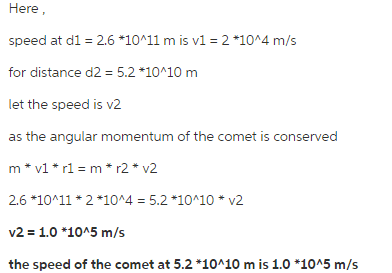
I applied conservation of angular momentum. But my answer goes wrong. Why?
my working
upload_2016-10-7_11-40-24.png
 
Physics news on Phys.org
Since the orbit is elliptical, the comet's velocity has a component in the direction of the sun (radial line) as well as a component perpendicular to a radial line to the sun. I'm not sure how you would determine angular momentum in this situation. You could use potential versus kinetic energy, but you'd have to know the mass of the sun (the comets mass, being much smaller than the sun's mass, could be ignored), and the problem statement doesn't include the mass of the sun.
 
Last edited:
The equation for angular momentum you used includes an assumption about the relationship between the velocity vector and the radial vector.
The relation you should use is ##\vec L = \vec r \times \vec p##
[edit: beat me to it...]
 
Thanks for help.
 

Similar threads

  • · Replies 10 ·
Replies
10
Views
2K
  • · Replies 16 ·
Replies
16
Views
1K
  • · Replies 40 ·
2
Replies
40
Views
5K
  • · Replies 5 ·
Replies
5
Views
2K
  • · Replies 3 ·
Replies
3
Views
3K
  • · Replies 4 ·
Replies
4
Views
3K
  • · Replies 6 ·
Replies
6
Views
2K
  • · Replies 9 ·
Replies
9
Views
2K
  • · Replies 2 ·
Replies
2
Views
3K
  • · Replies 36 ·
2
Replies
36
Views
16K