Undergrad Why Do Different Primitive Unit Cells for Diamond Look So Different?

Click For Summary
The discussion centers on the construction of primitive unit cells for diamond, which consists of a face-centered cubic (fcc) lattice with a basis of two carbon atoms. The user notes that two variants of the primitive unit cell appear drastically different, occupying different volumes of the conventional cell. Despite both versions containing two whole atoms, one occupies 1/4 and the other 1/8 of the conventional cell volume, leading to confusion. The user seeks clarification on why these variations exist and how they fulfill the definition of a primitive unit cell, particularly regarding the inclusion of lattice points. The conversation highlights the complexities in defining and visualizing primitive unit cells in crystallography.
Porkaborg
Messages
3
Reaction score
0
TL;DR
Primitive unit cell of diamond, great confusion.
Hi guys , I want to construct a primitive unit cell for diamond, which is made of a fcc lattice and a basis of 2 carbons atoms. I know that a primitive unit cell isn't unique but the two variants I get are drastically different . As far as I can see they both include 2 whole atoms/points in the lattice, however one of them occupies 1/4 of the conventional-cell volume, and the other occupies 1/8 of the conventional-cell volume.

When I couldn't get further in reasoning, I tried googling it and found both versions listed as primitive unit cells for diamond. But I am still confused why they look so very different.
(The left picture doesn't include rest of the atoms for some reason but they are there before creating the primitive unit cell)
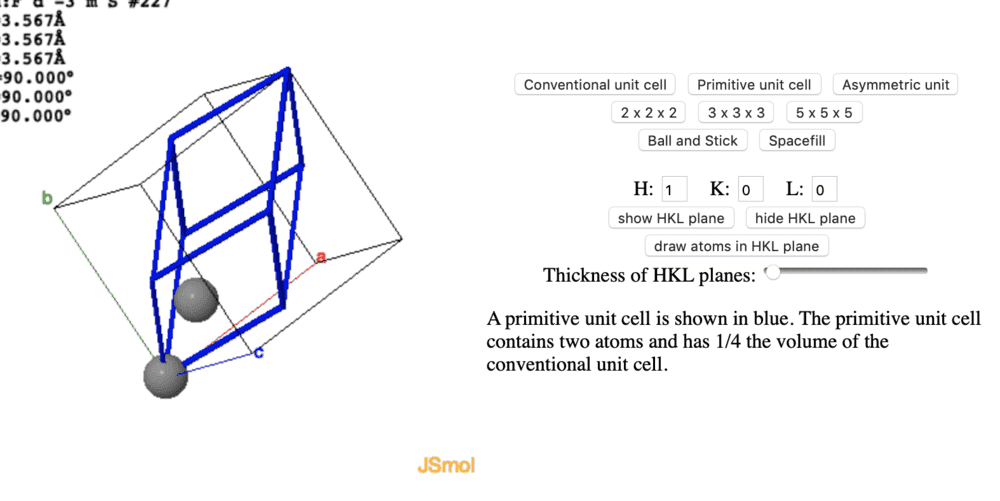
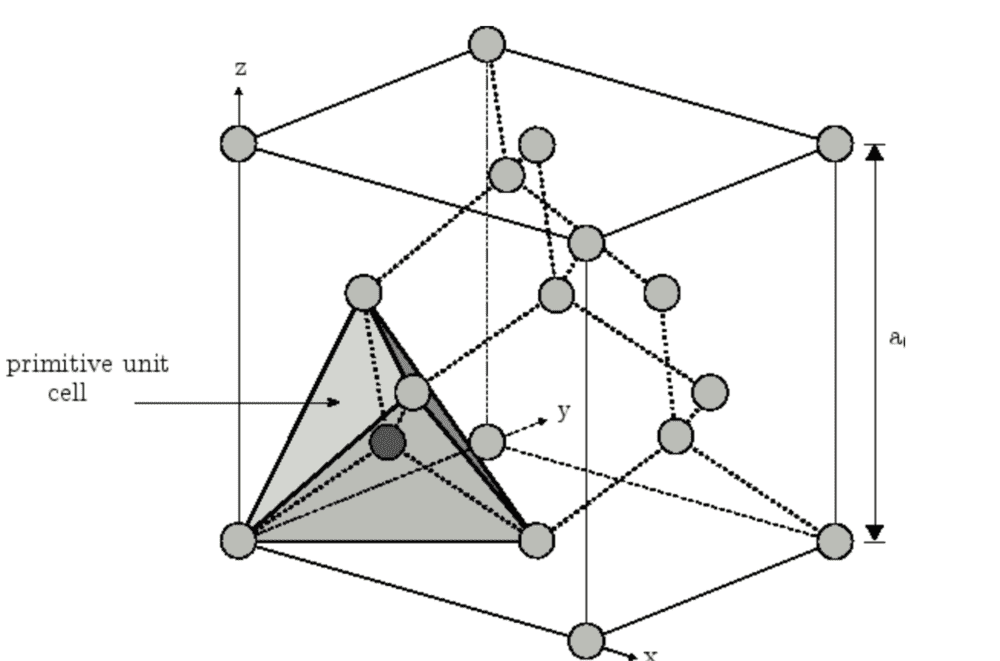
Skærmbillede 2019-10-04 kl. 22.48.17.png
Skærmbillede 2019-10-04 kl. 22.45.25.png


I hope someone can point out the difference , or pinpoint why I may be confused, please comment if I need to add some additional info.
 
Physics news on Phys.org
How do you want to fill space with only translated copies of a tetrahedron?
 
  • Like
Likes Porkaborg
I guess I can't , which is needed to fulfill the definition of a unitcell. Thanks a lot DrDu!. Upon looking some more at it , the tetrahedron also doesn't include a single lattice point which it is supposed to do to be a primitive unit cell.
 
Thread 'Unexpected irregular reflection signal from a high-finesse cavity'
I am observing an irregular, aperiodic noise pattern in the reflection signal of a high-finesse optical cavity (finesse ≈ 20,000). The cavity is normally operated using a standard Pound–Drever–Hall (PDH) locking configuration, where an EOM provides phase modulation. The signals shown in the attached figures were recorded with the modulation turned off. Under these conditions, when scanning the laser frequency across a cavity resonance, I expected to observe a simple reflection dip. Instead...

Similar threads

  • · Replies 4 ·
Replies
4
Views
4K
  • · Replies 4 ·
Replies
4
Views
3K
Replies
18
Views
71K
  • · Replies 7 ·
Replies
7
Views
31K
Replies
1
Views
31K
  • · Replies 4 ·
Replies
4
Views
17K
Replies
5
Views
8K
Replies
1
Views
4K
  • · Replies 5 ·
Replies
5
Views
3K
Replies
3
Views
6K