Why Does a Yd1 Transformer Connection Cause a -30 Degree Phase Shift?

Click For Summary
SUMMARY

The Yd1 transformer connection introduces a definitive -30 degree phase shift due to the alignment of the primary and secondary windings to the same phase angle. The phase angle of C1-A1 relative to N-A1 demonstrates this shift. Proper vector alignment is crucial; for instance, in a Delta configuration, the c1-a1 vector must be vertical to maintain phase consistency. The connection scheme for Yd1 is specified as a1_6, b1_4, c1_5, and detailed in IEC 60076-1 Annex D.

PREREQUISITES
  • Understanding of transformer vector groups
  • Familiarity with phase shift concepts in electrical engineering
  • Knowledge of IEC 60076-1 standards
  • Basic principles of Delta and Wye transformer configurations
NEXT STEPS
  • Study transformer vector group calculations
  • Learn about IEC 60076-1 Annex D connections
  • Explore the implications of phase shifts in power systems
  • Investigate the differences between Yd1 and Yd11 transformer connections
USEFUL FOR

Electrical engineers, power system designers, and anyone involved in transformer design and analysis will benefit from this discussion.

OliskaP
Messages
38
Reaction score
7
Hi,

I have problems understanding why, for example, a Yd1 connection introduces a -30 degree phase shift, see image below.

How should I think when I want to produce vector groups like that, and derive myself what the phase shift should be?

Thanks..
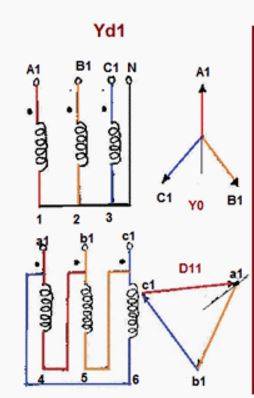
Yd1.JPG
 
Engineering news on Phys.org
First - just consider the actual phase angle of C1-A1 relative to N-A1 - there will be a 30deg Shift there. So it is not really any magic in the transformer - each winding Primary and Secondary are aligned to the same phase angle.

If you keep the vectors properly aligned - you will see... for example in the bottom Delta configuration, c1-a1 vector should be vertical because it is in the same phase as N-A1 above.
Now using the same Vector angle for N-B1 and N-B2 - connect the "tail" of a1-b1 to the head of the c1-a1, and then the same for b1-c1 - this should close the triangle of the delta.

I proper transformer nameplate will maintain this same arrangement. EXAMPLE
 
  • Like
Likes   Reactions: OliskaP
As windadct said A1_N is same phase as a1_4 , B1_N is same phase as b1_5, C1_N is same phase as c1_6 since the same magnetic flux will pass through both windings.
The connection will be as per attached sketch- for Yd11 : 5 with a1 ,6 with b1 and 4 with c1 and
for Yd1 a1_6, b1_4, c1_5.
The convention states an imaginary neutral point in the intersection of all three medians of the equilateral triangle , and an imaginary voltage to this neutral from each point of triangle. The a1 to neutral n is the first phase and the angle from HV A1_N is the considered angle which divided by 30 degrees gets the symbol of the connection[in Yd11 case 330/30=11].
You may find in IEC 60076-1 Annex D all the connections.
upload_2016-10-13_21-31-35.png

upload_2016-10-13_21-32-10.png
 
  • Like
Likes   Reactions: OliskaP
Very nice explanation, thanks, both of you.
 

Similar threads

  • · Replies 2 ·
Replies
2
Views
4K
  • · Replies 10 ·
Replies
10
Views
5K
  • · Replies 27 ·
Replies
27
Views
3K
  • · Replies 8 ·
Replies
8
Views
6K
  • · Replies 3 ·
Replies
3
Views
2K
  • · Replies 41 ·
2
Replies
41
Views
7K
Replies
2
Views
9K
  • · Replies 15 ·
Replies
15
Views
4K
  • · Replies 7 ·
Replies
7
Views
3K
Replies
7
Views
12K