Why Does Angular Velocity Appear Opposite to Linear Velocity?

Join the discussion
Registration is free. Ask a follow-up in this thread, or start your own.
5 replies · 2K views
Fascheue
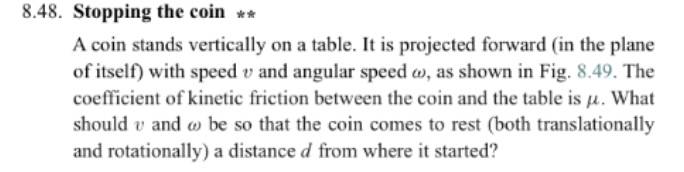
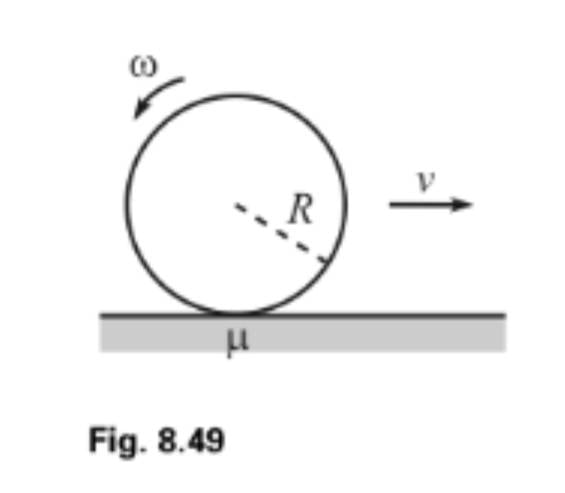
I’m not quite sure where to put this post so forgive me if it’s misplaced, but can somebody explain why the angular velocity in the picture here appears to be in the opposite direction as I would expect if the velocity is in the direction that is is.

I’m not looking to solve this problem (that’s why I didn’t post this in the homework thread), I’m just wondering why the angular velocity is counter-clockwise and the velocity is to the right.
460E967E-1185-4CD9-9434-E0C147B448B0.jpeg
16E69410-D612-4452-8E23-6A75F7FC2809.jpeg
 

Attachments

  • 460E967E-1185-4CD9-9434-E0C147B448B0.jpeg
    460E967E-1185-4CD9-9434-E0C147B448B0.jpeg
    8.2 KB · Views: 831
  • 16E69410-D612-4452-8E23-6A75F7FC2809.jpeg
    16E69410-D612-4452-8E23-6A75F7FC2809.jpeg
    17.1 KB · Views: 636
Physics news on Phys.org
The problem statement talks about the coin coming to rest (both translationally and rotationally). That can only work out if the coin is launched with back-spin. The diagram shows back-spin.

It is amusing to launch a hula hoop, giving it a backward flick of the wrist at release so that it spins backward. With a little practice one can arrange for the forward progress and the backward spin to cancel out at nearly the same time, whereupon the hoop falls to the ground.

Video:
 
Last edited:
  • Like
Likes   Reactions: Fascheue
The coin is sliding relative to the surface of the table while it's moving to the right. This is the case when ω > V/R and the coin is given an impulse to the right. The situation is analogous to striking a cue ball with "backward english" meaning that the ball is struck sharply below center at the six o' clock position.
 
  • Like
Likes   Reactions: Fascheue
jbriggs444 said:
The problem statement talks about the coin coming to rest (both translationally and rotationally). That can only work out if the coin is launched with back-spin. The diagram shows back-spin.

It is amusing to launch a hula hoop, giving it a backward flick of the wrist at release so that it spins backward. With a little practice one can arrange for the forward progress and the backward spin to cancel out at nearly the same time, whereupon the hoop falls to the ground.

Video:

Okay I thought that might be it, it just seems a bit unusual.

Why is it the case that the coin can only come to rest translationally and rotationally if it is launched with backspin? If you roll a coin forward does it not have forward velocity and clockwise spin that simultaneousley come to rest?
 
Fascheue said:
Why is it the case that the coin can only come to rest translationally and rotationally if it is launched with backspin?
Because the question implicitly only considers kinetic friction.

Fascheue said:
If you roll a coin forward does it not have forward velocity and clockwise spin that simultaneousley come to rest?
That requires rolling resistance and/or air drag, which are to be neglected here, as no parameters on them are given.
 
Last edited:
  • Like
Likes   Reactions: Fascheue, jbriggs444 and sophiecentaur
Fascheue said:
it just seems a bit unusual.
Yes. it is an unusual problem, which is what makes it interesting. It is actually easier to solve than a problem in which the coin is rolling naturally because the kinetic friction is an easier concept than 'rolling' resistance.
One can worry too much about the motives of the people who set problems. The motives are often questionable and it's often best to get on and just answer the problem as stated. :wink:
 
  • Like
Likes   Reactions: Fascheue