Why Does Frame Choice Matter in Velocity Addition Problems?

  • Context: Graduate 
  • Thread starter Thread starter VortexLattice
  • Start date Start date
  • Tags Tags
    Work
Click For Summary

Discussion Overview

The discussion revolves around the implications of frame choice in velocity addition problems, particularly in the context of a package being launched from one rocket to another. Participants explore the differences in calculations and reasoning when using different reference frames (S and S1) and the effects of simultaneity on the problem's solution.

Discussion Character

  • Exploratory
  • Technical explanation
  • Debate/contested
  • Mathematical reasoning

Main Points Raised

  • One participant describes their approach using the velocity addition rule in the frame of rocket 1 (S1) but questions why the book's solution uses the S frame instead.
  • Another participant suggests working in the S frame, providing equations for the trajectories of the package and the second ship, and notes that it is easier to solve in this frame due to known parameters.
  • Concerns are raised about the validity of using the normal velocity addition formula for non-colinear velocities, with a suggestion to derive a more general formula or to solve entirely in one frame before transforming.
  • Several participants emphasize the importance of accounting for the differences in simultaneity between frames S and S1, which may affect the timing of events in the problem.
  • One participant provides a hypothetical example to illustrate the limitations of applying the simple velocity addition formula to non-colinear components, highlighting potential absurdities in the results.

Areas of Agreement / Disagreement

Participants express differing views on the appropriate frame for solving the problem, with some advocating for the S frame and others for the S1 frame. There is no consensus on which approach is definitively correct, and the discussion remains unresolved regarding the best method to apply.

Contextual Notes

Participants note that the problem involves complexities related to simultaneity and the application of velocity addition in different frames, which may not be straightforward. The discussion highlights the need for careful consideration of these factors when analyzing the problem.

VortexLattice
Messages
140
Reaction score
0
Hi all,

I'm doing a practice problem and I thought I had a good solution, but it turns out I'm wrong and I'd like to know exactly why. The book seems to do it in different way, but I don't see why theirs is the right way.

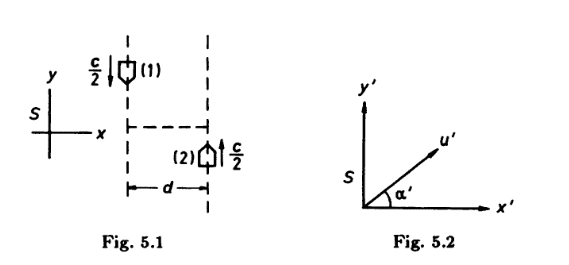
The problem is this:
1vXRr.png


LrD10.png


So, here's the process I tried doing:

-Find what the y component of the package velocity with respect to S1 (S1 is rocket 1's frame), using the velocity addition rule since we have the velocity of S with respect to S1 and the velocity of the package with respect to S

-Find the velocity of rocket 2 with respect to S1, using the velocity addition rule since we have the velocity of S with respect to S1 and the velocity of rocket 2 with respect to S

-Then, to make it so the package hits rocket 2 as it goes across the gap, we set these two velocities equal.

This is where the solution and I seem to disagree, the solution says that the y component of the package velocity and the velocity of rocket 2 should match in frame S, not rocket 1's frame! I guess I don't actually see why one is preferable over the other, but theirs must be right. If I had to guess I'd say it's something involving proper time or proper velocity, but I don't see what exactly.

Any help would be great, thanks!
 
Physics news on Phys.org
Working in the S frame:

You have two trajectories for the package (P) and the second ship (2), which are

[itex]s_p = \frac{4}{\sqrt{5}} \lambda \left(e_t + \frac{3}{4} [e_x \cos \alpha + e_y \sin \alpha ] \right) \\<br /> s_{(2)} = \frac{2}{\sqrt{3}} \tau \left(e_t + \frac{1}{2} e_y \right)\tau + d e_x[/itex]

where [itex]\lambda, \alpha, \tau[/itex] are scalars. Perhaps by setting all 3 components equal you can solve this problem in the S frame and then take the package's four-velocity and boost it into ship (1)'s frame?

It's easier to work in the S frame because you already know [itex]\beta = 3/4[/itex] for the package in the S frame.
 
Muphrid said:
Working in the S frame:

You have two trajectories for the package (P) and the second ship (2), which are

[itex]s_p = \frac{4}{\sqrt{5}} \lambda \left(e_t + \frac{3}{4} [e_x \cos \alpha + e_y \sin \alpha ] \right) \\<br /> s_{(2)} = \frac{2}{\sqrt{3}} \tau \left(e_t + \frac{1}{2} e_y \right)\tau + d e_x[/itex]

where [itex]\lambda, \alpha, \tau[/itex] are scalars. Perhaps by setting all 3 components equal you can solve this problem in the S frame and then take the package's four-velocity and boost it into ship (1)'s frame?

It's easier to work in the S frame because you already know [itex]\beta = 3/4[/itex] for the package in the S frame.

Thanks, but I see how they did it in the solution. I just don't know why theirs gives the right answer and mine doesn't.
 
When you did this:

-Find what the y component of the package velocity with respect to S1 (S1 is rocket 1's frame), using the velocity addition rule since we have the velocity of S with respect to S1 and the velocity of the package with respect to S

I suspect this is the problem. Boosting four-velocities that have out-of-plane components can be tricky with the velocity addition formula. Could you show what you did for this part?
 
VortexLattice said:
Hi all,

I'm doing a practice problem and I thought I had a good solution, but it turns out I'm wrong and I'd like to know exactly why.

Did you take into account that "simultaneous in frame S" is not the same as "simultaneous in the frame of rocket 1"?

If you look at the problem in rocket 1's frame, the one that's launching the package, you need to account for both the relative velocity of rocket 2 changing (which you did), and the definition of simultaneity being different in frame S and frame R1 - which as far as I can tell, you did not,.
 
VortexLattice said:
-Find what the y component of the package velocity with respect to S1 (S1 is rocket 1's frame), using the velocity addition rule since we have the velocity of S with respect to S1 and the velocity of the package with respect to S

I see a big problem right here. The package is moving at an angle to x-axis in S to get from rocket 1 to rocket 2. The normal velocity addition formula is only valid for colinear velocities. You can derive a more general formula, but it is easier to solve a problem like this all in one frame (e.g. S), then Lorentz transform to S'.

I used different symbols than Muphrid, but the same general idea. You derive α in S, then Lorentz transform the package trajectory equation, and compute α' in the rocket(1) frame.

[edit: I thought it would be good to give a simple example of why the simple velocity addition formula cannot be used on components of non-colinear velocities. Suppose frame F1 is moving at .99c in the x direction relative to F0. Suppose some object is moving at .99c at 45 degree angle to x in F1. You propose to apply velocity addition to x components (and I assume believe y component is unaffected). So you get that x component of object velocity in F0 is nearly c and y component is .99c/√2. This is absurd since the result is a speed way over c.]
 
Last edited:
pervect said:
Did you take into account that "simultaneous in frame S" is not the same as "simultaneous in the frame of rocket 1"?

If you look at the problem in rocket 1's frame, the one that's launching the package, you need to account for both the relative velocity of rocket 2 changing (which you did), and the definition of simultaneity being different in frame S and frame R1 - which as far as I can tell, you did not,.

Damn, that makes sense. I forgot that even though the package is launched at the passing point in S, it's not the same time in R1... Thanks!
 
PAllen said:
I see a big problem right here. The package is moving at an angle to x-axis in S to get from rocket 1 to rocket 2. The normal velocity addition formula is only valid for colinear velocities. You can derive a more general formula, but it is easier to solve a problem like this all in one frame (e.g. S), then Lorentz transform to S'.

I used different symbols than Muphrid, but the same general idea. You derive α in S, then Lorentz transform the package trajectory equation, and compute α' in the rocket(1) frame.

[edit: I thought it would be good to give a simple example of why the simple velocity addition formula cannot be used on components of non-colinear velocities. Suppose frame F1 is moving at .99c in the x direction relative to F0. Suppose some object is moving at .99c at 45 degree angle to x in F1. You propose to apply velocity addition to x components (and I assume believe y component is unaffected). So you get that x component of object velocity in F0 is nearly c and y component is .99c/√2. This is absurd since the result is a speed way over c.]

Yeah, damn... I vaguely realized this afterwards. I think I just set it up in a way that makes it miserable to solve, and I didn't solve it right clearly. Thanks!
 

Similar threads

  • · Replies 4 ·
Replies
4
Views
2K
  • · Replies 28 ·
Replies
28
Views
2K
  • · Replies 14 ·
Replies
14
Views
2K
  • · Replies 10 ·
Replies
10
Views
2K
  • · Replies 20 ·
Replies
20
Views
2K
  • · Replies 33 ·
2
Replies
33
Views
3K
  • · Replies 3 ·
Replies
3
Views
2K
  • · Replies 8 ·
Replies
8
Views
3K
  • · Replies 4 ·
Replies
4
Views
2K
  • · Replies 20 ·
Replies
20
Views
3K