Why does pressure decrease inside a fluid parcel with a pressure gradient?

3 replies · 2K views · last reply
Timtam
Messages
40
Reaction score
0
The more I learn about Bernoulli's the less I feel I understand it

The problem statement

If I had a ball (balloon) filled with fluid at pressure P being acted on by two opposing forces F+ and F-
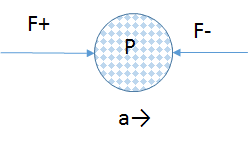
Free-body diagram of a circle labelled P with arrow F+ pointing right into its left side, arrow F- pointing left into its right side, and an arrow labelled a pointing right below it.

F+ being larger than F- there would be a net force accelerating the ball to the right but the pressure P would remain the same.

Now if I was to examine the ball as a parcel of fluid in a continuum and have a higher pressure (HP+) ~ F+ acting on one side and a lower pressure (HP-)~ F- on the other side.

Diagram of a fluid parcel shown as a circle with arrows from left and right labelled HP and LP, the left arrow longer, with P decreasing arrow inside and acceleration arrow a below.
Then I would also see the whole ball of fluid being accelerated to the right but the pressure inside the ball would also decrease from HP on the left side to LP on the right side
My question.
What action caused by the unbalanced external forces , is causing the internal pressure of the ball to decrease ?
 
Attachments
  • Free-body diagram of a circle with arrows labelled F+ pointing in from the left and F- pointing in from the right, with a is labelled below the circle pointing to the right.
    upload_2016-10-21_10-40-21.png
    1.2 KB · Views: 681
Timtam said:
The more I learn about Bernoulli's the less I feel I understand it

The problem statement

If I had a ball (balloon) filled with fluid at pressure P being acted on by two opposing forces F+ and F-
View attachment 107778
F+ being larger than F- there would be a net force accelerating the ball to the right but the pressure P would remain the same.
Why would the pressure, P, be the same at all points of the ball? I don't believe that.
 
FactChecker said:
Why would the pressure, P, be the same at all points of the ball? I don't believe that.

Ah ok, I guess I was thinking I was thinking of external forces acting on a rigid incompressible ball not considering what's happening as the rigid ball acts on the internal fluid.

So even inside such a ball as it accelerates from the external forces - the force applied internally (on the initially stationary fluid) from the right is greater than the force on the left
Circle filled with a grid of small blue diamonds, with an arrow labelled a pointing right beneath it.

(Represented by my over-exaggerated diagram of the rigid ball being displaced before the fluid)

So the ball contains the same total internal energy but it has been redistributed into an internal pressure gradient reflecting the external forces acting on it ?

Plain light blue circle with a dark outline and a gradient shading, lighter on the left and darker toward the right edge.


is this correct ?
 
Attachments
  • Simple pale blue shaded circle with lighter tones on the left and darker tones on the right, suggesting a sphere or ball.
    upload_2016-10-21_11-45-30.png
    965 bytes · Views: 669
That is what I would think. Another comment I have is that I don't see any connection between the internal pressures and Bernoulli. Bernoulli's equation does apply to the external forces onto the surface of the sphere.