Why Does Relative Velocity of Approach Equal Zero at Minimum Distance?

  • Context: Undergrad 
  • Thread starter Thread starter hellophyscis
  • Start date Start date
  • Tags Tags
    Approach Relative
Click For Summary
SUMMARY

The discussion centers on the concept of relative velocity of approach between two moving particles, specifically addressing the equation V(Approach) = V1cosα + V2cosβ. It is established that at the minimum distance between two particles, the relative velocity of approach equals zero, indicating that the velocity vectors have no components pointing towards each other. The equation holds true under specific conditions, such as when both angles α and β are right angles, but can also apply in more general cases where one angle is acute and the other obtuse. The discussion clarifies that the particles must not be moving towards or away from each other at the point of closest approach.

PREREQUISITES
  • Understanding of relative velocity concepts
  • Familiarity with vector components in physics
  • Knowledge of trigonometric functions, specifically cosine
  • Basic principles of motion and particle dynamics
NEXT STEPS
  • Explore the implications of relative velocity in two-dimensional motion
  • Study vector decomposition and its applications in physics
  • Investigate scenarios involving varying angles in relative motion
  • Learn about collision dynamics and closest approach in particle physics
USEFUL FOR

Physics students, educators, and professionals interested in kinematics, particularly those studying motion dynamics and relative velocity concepts.

hellophyscis
Messages
1
Reaction score
0
Given in my book-
1."Velocity Of approach - It is the rate at which distance between two moving particle decreases.
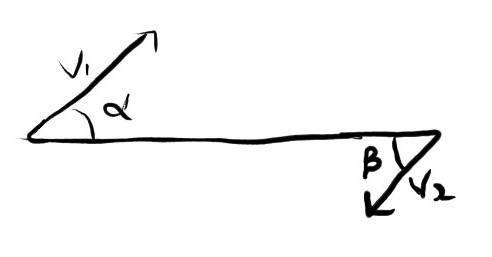
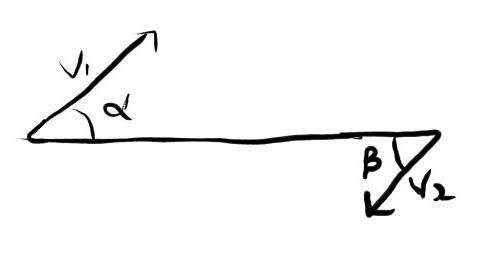
V(Approach) =V1cosα + V2cosβ "
2."When the distance between two particles is minimum, the relative veloctiy of approcah is 0"
attachment.php?attachmentid=63276&d=1382679140.jpg

3."V1cosα + V2cosβ = 0 ...when distance is minimum(diagram in attachment below)"
Please Explain Why?
And, the above equation will become 0 only if cosα = 0 and cosβ = 0 at same time, but if α and β are not equal, then cosα and cosβ cannot be 0 at same time. Thus the Equation is worng but giving correct answers.
Please Explain Why?
paint.jpg
 
Physics news on Phys.org
Welcome to PF;
the above equation will become 0 only if cosα = 0 and cosβ = 0 at same time,
What about when the situation: v1=v2=v, α = 0, and β=180deg.

For the two particles to be at the point f closest approach, they must be moving neither (1) towards each other nor (2) away from each other.

if (1) then they are getting closer,
if (2) then they have previously been closer,
thus, their velocity vectors must have no component pointing towards each other.

In your diagram, the two objects are not at closest approach - they are pictured getting closer together.
 
Your claim is that the equation is solved only when α and β are both right angles. Yes, that is one solution.

To make Simon's example more general (and less explicit), what if α is acute and β is obtuse?

What about cases where β > 180 degrees?
 

Similar threads

  • · Replies 3 ·
Replies
3
Views
2K
  • · Replies 11 ·
Replies
11
Views
4K
  • · Replies 1 ·
Replies
1
Views
2K
  • · Replies 6 ·
Replies
6
Views
2K
  • · Replies 27 ·
Replies
27
Views
4K
  • · Replies 11 ·
Replies
11
Views
2K
  • · Replies 11 ·
Replies
11
Views
2K
  • · Replies 13 ·
Replies
13
Views
2K
  • · Replies 2 ·
Replies
2
Views
1K
Replies
1
Views
1K