Why Does V1 Equal Zero in My KCL Thevenin Calculation?

  • Thread starter Thread starter Fjolvar
  • Start date Start date
Join the discussion
Ask a follow-up here, or get your own question answered by working scientists, mathematicians and engineers — people, not an autocomplete.
Real named experts · corrections over time · the nuance an AI answer skips
10 replies · 2K views
Fjolvar
Messages
156
Reaction score
0
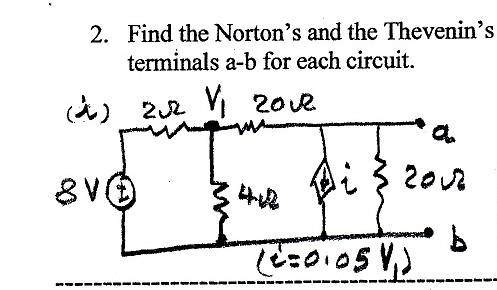
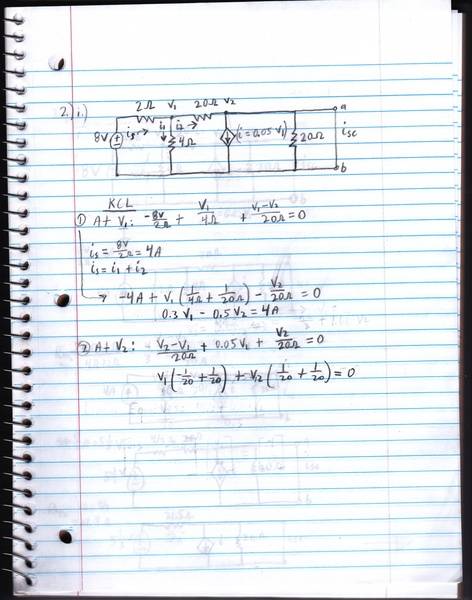
I tried solving this problem using KCL, but V1 keeps adding up to zero for my second set of equations. I'm not sure what I'm doing wrong. Any help is much appreciated.

1. Homework Statement

I need to find the Thevenin equivalent circuit. I chose to find the Isc and the Voc by using KCL, since I don't see another way.
o72d0w.jpg


Homework Equations


KCL

The Attempt at a Solution


[/B]
You can see for equation 2, my V1 equals zero due to the dependent current source relation. Not sure how to get around this.
2vltrf5.jpg
 
Physics news on Phys.org
NascentOxygen said:
Right at the start you write is = 8v/2Ω

Why do you say this?

My mistake. That should read (v1-8)/2.

I'm still stuck on the second equation however since v1 equals zero. Am I missing something obvious here?
 
My mistake. That should read (v1-8)/2.

I don't think that's right either.

Edit: Do you mean "Is = (v1-8)/2" or that term in equation should be (v1-8)/2 ? The latter is correct.
 
Last edited:
CWatters said:
I don't think that's right either.

Edit: Do you mean "Is = (v1-8)/2" or that term in equation should be (v1-8)/2

That's for the term in the first KCL equation. But V1 in the second equation equals zero which has me stuck. I can't set up my equations to find any of the unknowns.
 
CWatters said:
I think you mean V2 = 0 not V1.

I mean (-1/20 + 1/20) zeroes out V1 at node 2, since the dependent source is equal to 0.05V1
 
Fjolvar said:
You can see for equation 2, my V1 equals zero due to the dependent current source relation. Not sure how to get around this.
I see the problem. They cunningly have the current source always draining the entire current sourced through the 20Ω.

An alternative method to determine the impedance at ab is to apply a test voltage across ab and calculate how much current is drawn from that source. I guess that means the Thévenin equivalent will then be a simple resistance.
 
NascentOxygen said:
I see the problem. They cunningly have the current source always draining the entire current sourced through the 20Ω.

An alternative method to determine the impedance at ab is to apply a test voltage across ab and calculate how much current is drawn from that source. I guess that means the Thévenin equivalent will then be a simple resistance.

I'm not quite sure what you mean :/