Why Gauss's law works when charge enclosed is not uniform?

Click For Summary

Homework Help Overview

The discussion revolves around the application of Gauss's law in the context of a non-uniform charge distribution within a slab. Participants are exploring how it is possible to determine the electric field outside the slab despite the internal charge not being uniformly distributed.

Discussion Character

  • Conceptual clarification, Assumption checking

Approaches and Questions Raised

  • Participants question the implications of non-uniform charge distributions on the applicability of Gauss's law. There are inquiries about the nature of the electric field in relation to the slab's geometry and charge distribution.

Discussion Status

The conversation is ongoing, with participants seeking to clarify their understanding of Gauss's law and its application to non-uniform charge distributions. Some guidance has been provided regarding the nature of electric fields and flux, but there is no explicit consensus yet.

Contextual Notes

There are indications of confusion regarding the relationship between electric field uniformity and the application of Gauss's law, as well as the interpretation of specific terms used in the discussion.

Jae
Messages
10
Reaction score
0
This problem has charge that is not uniform in the inside, but it is still possible to find the electric field as a function of distance outside the slab using Gauss's law. How is this possible if the electric field is not uniform in the slab and plane? Wouldn't the electric field from the middle of the slab to the a x-distance d be different on both sides?

Once I did Gauss's law I got a correct solution of
(sigma + row_E) / 2(epsilon naught)
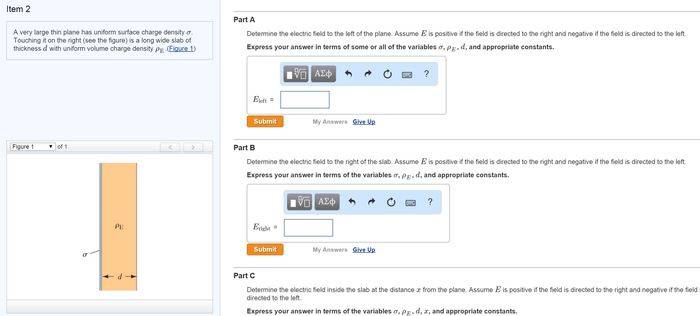
phyQuestion.JPG


Thank you for answering this question.

Mentor's Note: Thread moved to Advanced Physics Homework from another forum, hence the lack of a template.
 
Last edited by a moderator:
Physics news on Phys.org
This problem has charge that is not uniform in the inside, but it is still possible to find the electric field as a function of distance outside the slab using Gauss's law. How is this possible if the electric field is not uniform in the slab and plane?
Gauss law has no restriction to uniform charge distributions. The electric field found doesn't have to be uniform either. Why do you think it would have to be ?

Wouldn't the electric field from the middle of the slab to the a x-distance d be different on both sides?
What do you mean with "the electric field from the middle of the slab to the a x-distance d" ?
 
BvU said:
Gauss law has no restriction to uniform charge distributions. The electric field found doesn't have to be uniform either. Why do you think it would have to be ?

What do you mean with "the electric field from the middle of the slab to the a x-distance d" ?
If Gauss's law calculates the net electric flux. I don't understand how it's possible that calculating the electric field if the surface does not have a uniform field.
I made a typo. I mean to say the x-direction from the middle of the slab. Sorry.

Thank you for helping.
 
Jae said:
If Gauss's law calculates the net electric flux. I don't understand how it's possible that calculating the electric field if the surface does not have a uniform field.
I made a typo. I mean to say the x-direction from the middle of the slab. Sorry.

Thank you for helping.
Gauss's Law only finds the total flux through a closed surface.

If there is sufficient symmetry present, then it may be possible to determine the electric field on some portion of the surface.
 

Similar threads

  • · Replies 12 ·
Replies
12
Views
1K
  • · Replies 10 ·
Replies
10
Views
2K
Replies
9
Views
1K
  • · Replies 26 ·
Replies
26
Views
3K
  • · Replies 9 ·
Replies
9
Views
3K
Replies
1
Views
2K
Replies
6
Views
2K
  • · Replies 10 ·
Replies
10
Views
2K
  • · Replies 3 ·
Replies
3
Views
2K