Why is diffused light captured through V-shaped grooves?

Click For Summary

Discussion Overview

The discussion revolves around the phenomenon of light capture through V-shaped grooves in an acrylic panel, particularly focusing on how diffused light is redirected or captured when the grooves are oriented in different directions. Participants explore the implications of this setup for potential applications in building lighting, drawing comparisons to prismatic glass techniques.

Discussion Character

  • Exploratory
  • Technical explanation
  • Conceptual clarification
  • Debate/contested

Main Points Raised

  • One participant describes the experimental setup with V-shaped grooves and notes differences in luminescence based on the orientation of the grooves.
  • Another participant questions the specification of 'diffused light' and suggests that the orientation of the grooves may affect how light is bent away from the camera's line of sight.
  • A participant mentions the uniformity of diffused light from the sky and contrasts it with the non-uniformity of light from the ground, suggesting this affects brightness differences.
  • There is a request for a diagram of the groove profile, with one participant describing the grooves as resembling horizontal prisms.
  • One participant refers to Snell's law for refraction in their schematic and discusses the implications of total internal reflection (TIR) in the context of the grooves.
  • Another participant elaborates on how light interacts with the surfaces of the grooves, mentioning that light from below may be reflected while light from above passes through.
  • Concerns are raised about the suitability of plastic versus glass due to differences in refractive index, and the need for polished surfaces is emphasized for effective light manipulation.
  • Participants suggest experimenting with different prism shapes and conducting ray tracing to better understand light behavior in this setup.

Areas of Agreement / Disagreement

The discussion features multiple competing views regarding the mechanisms of light capture and redirection, particularly concerning the roles of refraction and total internal reflection. There is no consensus on the effectiveness of the current design or the best approach to optimize light capture.

Contextual Notes

Participants express uncertainty about the specific angles and conditions under which total internal reflection may occur, as well as the implications of using different materials for the grooves. The discussion remains open regarding the optimal design for achieving the desired light capture.

arthurmani
Messages
3
Reaction score
0
Hello, we routed V-shaped grooves in an acrylic panel using a CNC milling machine and placed the panel in front of my window, with no direct light hitting it.

The pictures below show two cases, in the top picture, the grooves are facing the window and on the bottom one the grooves are facing us. Note that when the grooves are facing us, the diffused light seems to have been captured.

I cannot explain how this is happening but would like to use this technique to harvest light in a building similarly to this old technique called "Prismatic Glass": http://files.umwblogs.org/blogs.dir/7608/files/glass/prismatic.pdf

How is the diffused light captured or redirected since it has no clear direction unlike direct light? How can you explain the differences in luminescence in the two picture below under diffused light?
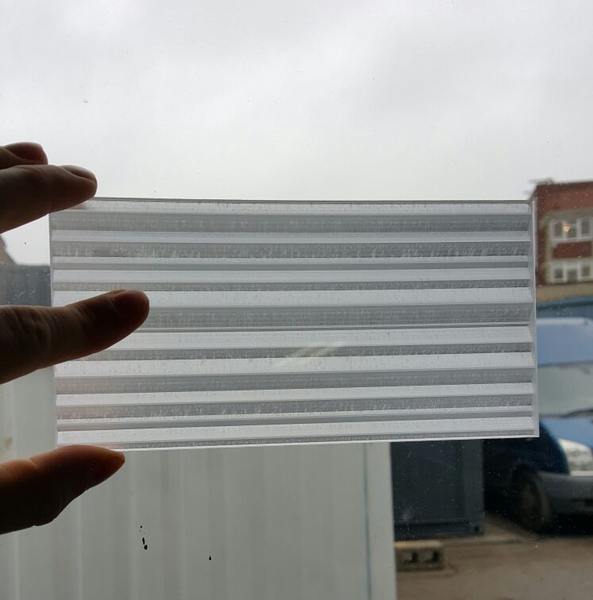
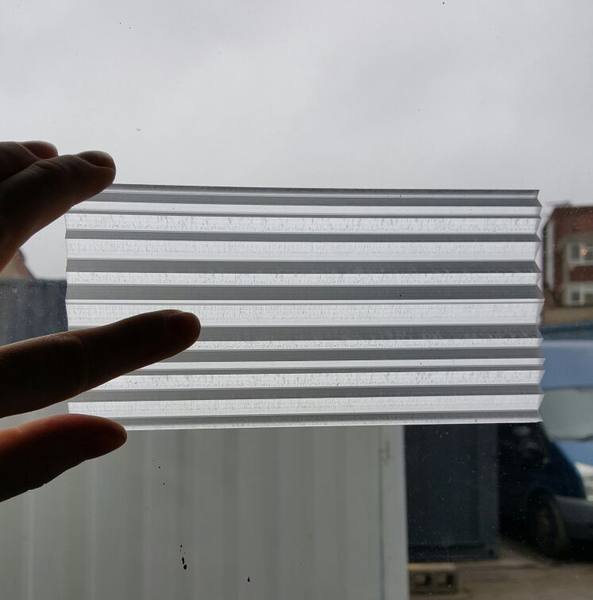
Smooth_Facing_Us.jpg
Smooth_Facing_Out.jpg
 
Science news on Phys.org
arthurmani said:
Note that when the grooves are facing us, the diffused light seems to have been captured.
Why had you specified the light involved in this observation to be diffused, i.e. why not just "light"?
arthurmani said:
How is the diffused light captured or redirected since it has no clear direction unlike direct light? How can you explain the differences in luminescence in the two picture below under diffused light?
I think it's just a matter of which orientation bends light more away from your camera's line of sight than the other one.
 

Attachments

  • Refraction.png
    Refraction.png
    2.5 KB · Views: 637
Thank you @blue_leaf77 I specified 'diffused light' as the sky was overcast and was not sure if the direction of the light rays are relevant since the light would have been scattered? Which formula did you use for the diagram? I would love to be able to predict the orientation for the refraction of light.
 
arthurmani said:
Thank you @blue_leaf77 I specified 'diffused light' as the sky was overcast and was not sure if the direction of the light rays are relevant since the light would have been scattered? Which formula did you use for the diagram? I would love to be able to predict the orientation for the refraction of light.
There are two parts to the scene outside.The top bit is light and the bottom bit is dark (the ground). More light from the sky is being directed in your direction for one set of faces and more light from the ground through the other set. The fact that the light is diffuse just means that it is fairly uniform, coming from the sky over a wide range of angles. The 'ground' portion of the scene is not so uniform and that shows itself in the difference in brightness from side to side on the dark bands.
Could you give a photo or diagram of the profile of the sheet? It looks like a set of horizontal prisms.
 
Hello @sophiecentaur thank you very much for your reply. The grooves are 45 degrees inwards. Please see diagram below.
upload_2015-12-22_18-44-43.png
 
arthurmani said:
Which formula did you use for the diagram?
Actually I didn't really do any calculations in drawing that schematic, I simply made use of Snell's law for refraction to decide which direction the refracted ray should bend to.
 
Thanks for that. I should say that light coming from below the horizontal is hitting. the upward facing surfaces and going almost straight through and being reflected (externally) off the outside of the downward facing surfaces. So you see light from the ground in the downward facing surfaces. Light that's arriving from a roughly horizontal direction will be totally internally reflected on the insides of the wedges and deflected right upwards at around 45° or downwards at around 45°. (Your photo doesn't show this because of the direction of the shot). Light arriving from the sky will be passing through the upward facing surfaces and reflected on the downward facing surfaces.
That argument more or less explains your picture. (I hope)
If you want to achieve what the 'prismatic glass' system uses then your V shapes would need to be asymmetrical (the rough picture in the link shows this - if you are expecting to find it). Afaics, light from above the horizontal will pass through the back flat side, hit the backs of the steeper sides (facing downwards) and be reflected in a horizontal direction, into the room. You could experiment with your panels and a laser pointer to see where rays actually go when passing through. If you have a machining facility, you could try a few different prism shapes on a small scale. The faces will need to be pretty well polished.
Plastic may not be a suitable as glass because of its lower refractive index. The system in the link will reflect light (internally and off the downward faces).
 
blue_leaf77 said:
Actually I didn't really do any calculations in drawing that schematic, I simply made use of Snell's law for refraction to decide which direction the refracted ray should bend to.
Ahh well - it's Total Internal Reflections that's probably involved here.
 
  • Like
Likes   Reactions: arthurmani
sophiecentaur said:
Ahh well - it's Total Internal Reflections that's probably involved here.
In which way can TIR be involved in this arrangement? Could you possibly mean in the left picture, there might be some rays which undergo TIR at the second interface?
 
  • Like
Likes   Reactions: arthurmani
  • #10
blue_leaf77 said:
In which way can TIR be involved in this arrangement? Could you possibly mean in the left picture, there might be some rays which undergo TIR at the second interface?
I don't think you are viewing from an angle where TIR could be occurring. The Critical angle for plastics is higher than for glass. It wouldn't be hard for you to draw some prism sections and do a 'ray trace', using snells law and the critical angle to see what will happen for a range of rays. Otoh, a real life model could be interesting. If you start with an isosceles triangle and then shave off the back section so it's at a different angle, you could have fun. Actually,you may find there's a suitable simulation somewhere on the net.
BTW, This is a very interesting project and it could solve your lighting problem.
 
  • Like
Likes   Reactions: arthurmani

Similar threads

  • · Replies 15 ·
Replies
15
Views
6K