Undergrad Why is T+f=Ma in Cylinder Roll Without Gliding?

Click For Summary
SUMMARY

The discussion centers on the equation T + f = Ma, which describes the forces acting on a cylinder rolling without gliding. The participants clarify that tension (T) and friction (f) do not oppose each other; instead, they act in the same direction to prevent slipping. The confusion arises from misinterpreting the relationship between forces and torques, where the latter can indeed oppose each other due to their positions relative to the axis of rotation. Additionally, it is noted that angular acceleration should be used in equation (3) instead of linear acceleration.

PREREQUISITES
  • Understanding of Newton's laws of motion
  • Familiarity with torque and angular acceleration concepts
  • Knowledge of friction and its role in motion
  • Basic grasp of forces acting on rigid bodies
NEXT STEPS
  • Study the relationship between linear and angular motion in rigid bodies
  • Learn about the role of friction in preventing slipping in rolling motion
  • Explore the derivation and application of torque equations in mechanics
  • Investigate the differences between linear and angular acceleration in rotational dynamics
USEFUL FOR

Students of physics, mechanical engineers, and anyone interested in understanding the dynamics of rolling motion and the interplay of forces and torques.

Exath
Messages
7
Reaction score
0
So I'm looking at a problem that involves a situation that looks like this
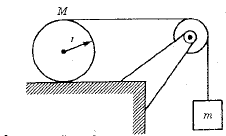
upload_2018-8-31_0-20-14.png

the cylinder rolls without gliding.
And there are these following equations that apply to it
(1) mg - T = ma (for the block hanging vertically)
(2) T + f = Ma (for the cylinder f = friction force, T = String force)
(3) Tr - fr = Ia (I = inertia, r = radius)

I'm only concerned about equation (2) where it's T + f = Ma, shouldn't it be T - f = Ma? Because the tension from the string and friction force are opposite to each other. It is apparently acknowledged that they are opposite in equation (3) where the torques are opposite, but why not in equation (2)?
 

Attachments

  • upload_2018-8-31_0-20-14.png
    upload_2018-8-31_0-20-14.png
    2.1 KB · Views: 978
Physics news on Phys.org
Exath said:
I'm only concerned about equation (2) where it's T + f = Ma, shouldn't it be T - f = Ma? Because the tension from the string and friction force are opposite to each other.
Careful! The tension and friction forced are not opposite. The friction opposes slipping between surfaces, thus it acts to the right to prevent slipping of the cylinder on the table.

Exath said:
It is apparently acknowledged that they are opposite in equation (3) where the torques are opposite, but why not in equation (2)?
Since one force is above the axis and the other below, their torques are opposite. But the forces themselves act in the same direction.
 
  • Like
Likes vanhees71 and Exath
Doc Al said:
Since one force is above the axis and the other below, their torques are opposite. But the forces themselves act in the same direction.

Ah, that's what i was looking for, i was looking at the forces the same way i was looking at torques, that's obviously wrong lol
 
Incidentally in (3) you need angular acceleration not linear acceleration.
 

Similar threads

  • · Replies 21 ·
Replies
21
Views
1K
  • · Replies 13 ·
Replies
13
Views
1K
  • · Replies 1 ·
Replies
1
Views
1K
  • · Replies 4 ·
Replies
4
Views
2K
Replies
4
Views
1K
  • · Replies 6 ·
Replies
6
Views
2K
  • · Replies 7 ·
Replies
7
Views
4K
  • · Replies 4 ·
Replies
4
Views
2K
  • · Replies 21 ·
Replies
21
Views
5K
  • · Replies 3 ·
Replies
3
Views
2K