Why Is the 0.7 Volts Diode Drop Used in Calculating R2 Current?

Click For Summary

Homework Help Overview

The discussion revolves around understanding the application of a 0.7 volts voltage drop across a diode in the context of calculating current through resistor R2 in a circuit. The subject area pertains to electrical circuits and the behavior of components in parallel.

Discussion Character

  • Conceptual clarification, Assumption checking

Approaches and Questions Raised

  • Participants explore the relationship between the voltage drop across the diode and R2, questioning whether they can be considered the same due to their parallel configuration. Some express confusion about the reasoning behind this assumption.

Discussion Status

The discussion is active, with participants providing insights into the nature of voltage drops in parallel circuits. Some guidance has been offered regarding the shared potential drop across parallel components, although not all participants agree on the reasoning.

Contextual Notes

There is a mention of a diagram and specific voltage values, but the exact details of the circuit configuration are not provided. The discussion reflects varying levels of understanding regarding the principles of voltage in parallel circuits.

Eisen
Messages
14
Reaction score
0
This isn't a homework question but it is a formula from a book I have been using to study, so I'm posting it here.

Here is the circuit and formula -
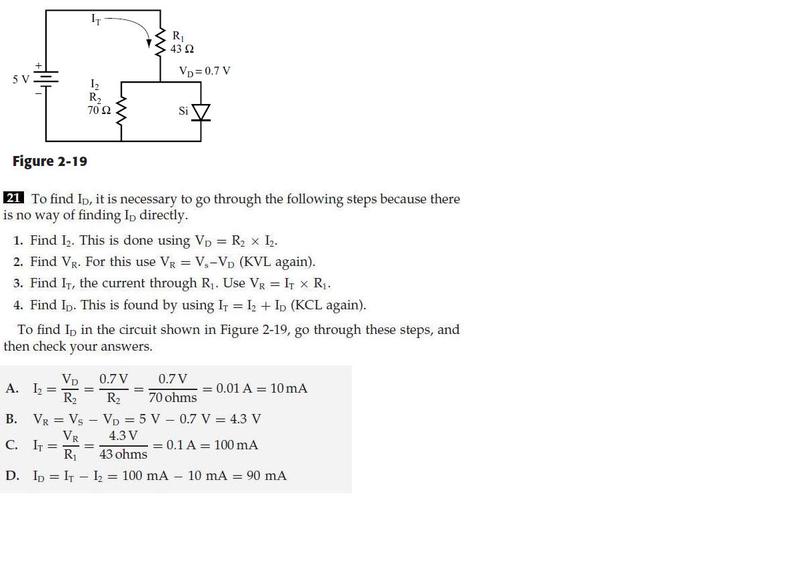

diode resistor.JPG


I don't understand why the voltage drop of 0.7 volts across the diode is being used as part of the formula to work out the current across R2 when R2 has it's own voltage drop across it. Can someone explain this to me please?
 
Physics news on Phys.org
I think that since the diode and resistor are in parallel, the voltage drop across them has to be the same. So since you know the voltage drop across the diode you can just extend that to R2.
 
I don't see why the voltage drop across R2 and the diode would be the same.
 
Eisen said:
I don't see why the voltage drop across R2 and the diode would be the same.

Well, the diode and the resistor are connected. The voltage at the pink point I added to your diagram can only be one value.

diode resistor.JPG
 
So the voltage drop through resistor 2 is the same as in the diode because they are in parallel?
 
Eisen said:
So the voltage drop through resistor 2 is the same as in the diode because they are in parallel?

Yes. ANY components that are in parallel all share the same potential drop.
 
Thanks, well that clears things up for me.
 

Similar threads

  • · Replies 4 ·
Replies
4
Views
2K
Replies
1
Views
2K
Replies
3
Views
3K
  • · Replies 3 ·
Replies
3
Views
2K
Replies
4
Views
2K
  • · Replies 6 ·
Replies
6
Views
3K
  • · Replies 3 ·
Replies
3
Views
5K
  • · Replies 10 ·
Replies
10
Views
3K
Replies
4
Views
2K
  • · Replies 20 ·
Replies
20
Views
5K