Why is the Electric Field outside this wire not zero?

Click For Summary
The discussion centers on understanding the electric field around a charged wire and the application of Gauss's law. Participants clarify that while the electric field inside a conductor is zero at equilibrium, the presence of current can create an electric field. The confusion arises from the assumption that the net charge is zero, leading to the belief that the electric field outside the wire should also be zero. It is emphasized that there are distinct electric fields at the surface and within the conductor, particularly when current flows. The conversation concludes with a recognition that the scenario involves a non-homogeneous conductor, allowing for the existence of an electric field under certain conditions.
bryanso
Messages
28
Reaction score
7
Homework Statement
Not a homework. Just want to understand a (should be simple) example.
Relevant Equations
Why is E not zero?
Not a homework. Just self-studying electromagnetism.

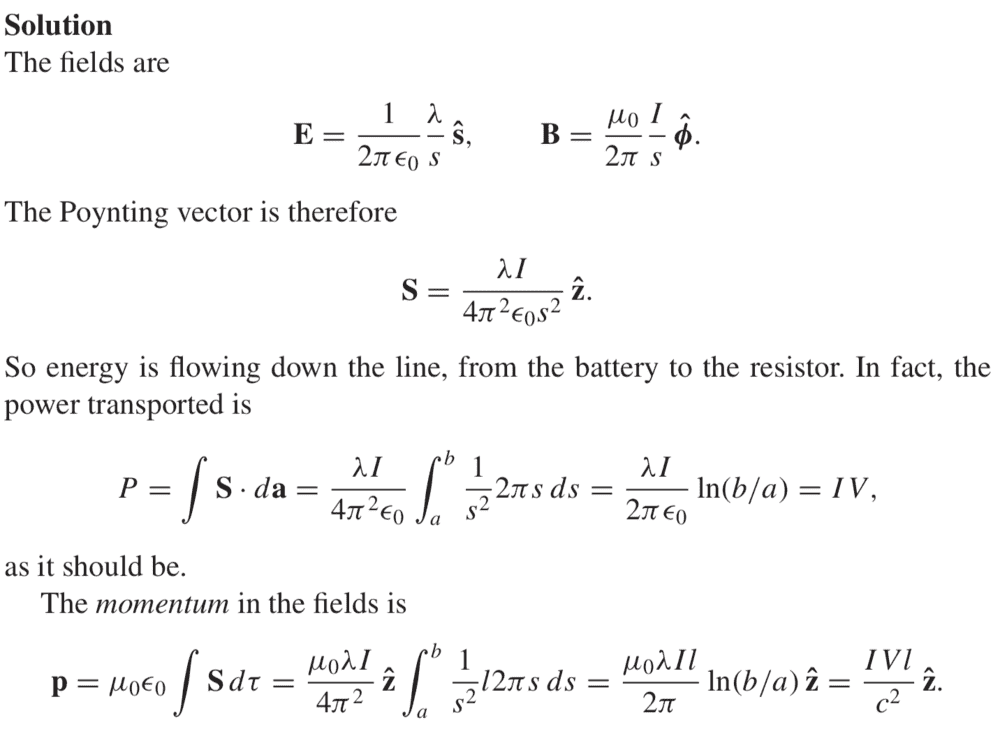
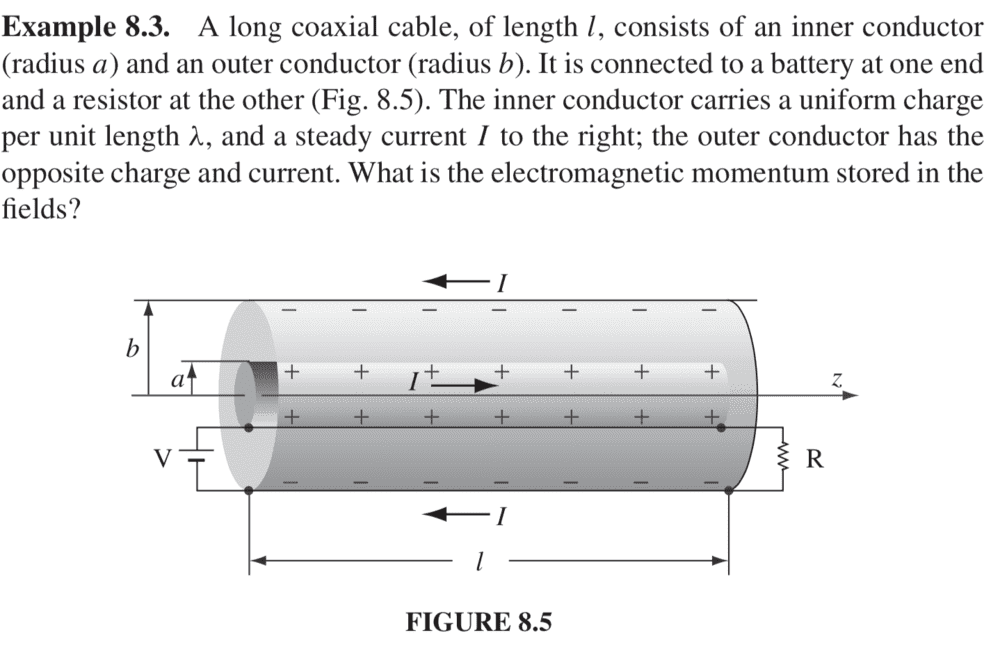
I am stuck at understanding the very beginning of the solution steps in this example:

The E as given in the solution is the field away from a long straight line with charge Lambda. That's clearly not the current configuration.

E should be zero by Gauss law, shouldn't it? ... Net charge is 0.

David Griffiths Electrodynamics 4th Edition, p. 368
Griffiths001.png
Griffiths002.png
 
Last edited by a moderator:
Physics news on Phys.org
bryanso said:
E should be zero by Gauss law, shouldn't it? ... Net charge is 0.
Ask yourself: The field where?
 
> Ask yourself: The field where?

Outside is 0 from Gauss Law.

Inside conductor is 0 (after equilibrium).

So there are two fields, one on the outer surface and one on the inside contacting surface?

Am I in the right direction?
 
The fields are only at the surface?? Please be a little more complete in your description. Electric field lines start on a positive charge and end on a negative charge.
 
  • Like
Likes bryanso
bryanso said:
> Ask yourself: The field where?

Outside is 0 from Gauss Law.

Inside conductor is 0 (after equilibrium).

So there are two fields, one on the outer surface and one on the inside contacting surface?

Am I in the right direction?
What about E field between a and b? By Gauss' law?
 
  • Like
Likes bryanso
Thank you all. Got it. I knew I missed something very simple. I got misled by the general rule of thumb that there is no E inside a conductor. But this is not a homogenous conductor here. I can proceed now.

Thanks
 
bryanso said:
Thank you all. Got it. I knew I missed something very simple. I got misled by the general rule of thumb that there is no E inside a conductor. But this is not a homogenous conductor here. I can proceed now.

Thanks
Right. There can be no E field inside a conductor.
In fact, unless it's a perfect NON-conductor there can be no E field in the steady-state.

UNLESS there is current flow, in which case you have E = ρι where ρ is resistivity and ι is current density.
(Vector equation.)


Similar threads

Replies
4
Views
3K
Replies
2
Views
3K
Replies
10
Views
2K
Replies
14
Views
5K
  • · Replies 2 ·
Replies
2
Views
2K
Replies
23
Views
4K
Replies
14
Views
3K
  • · Replies 26 ·
Replies
26
Views
3K
Replies
1
Views
2K