Discussion Overview
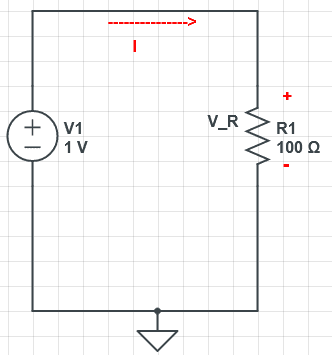
The discussion revolves around the concept of voltage drop across a resistor in a circuit, particularly focusing on the polarity of voltage in relation to conventional current flow. Participants explore the definitions and implications of voltage polarity for resistors, capacitors, and inductors, as well as historical perspectives on electrical conventions.
Discussion Character
- Exploratory
- Technical explanation
- Conceptual clarification
- Debate/contested
Main Points Raised
- Some participants assert that resistors do not have innate polarity; rather, the voltage is higher where current enters than where it exits.
- It is noted that current flows from higher voltage to lower voltage, which aligns with the conventional current direction.
- Questions arise regarding whether capacitors and inductors also lack innate polarity and if their polarity should be assigned based on current direction.
- One participant mentions that while capacitors do not have innate polarity in an ideal case, real-world applications may require specific voltage assignments due to construction techniques.
- Electrolytic capacitors are highlighted as having polarity, raising questions about their relevance in a discussion focused on circuits without capacitors.
- A participant explains the passive and active conventions in circuit analysis, emphasizing the importance of reference directions for current and voltage.
- Historical context is provided regarding the development of electrical concepts, including the confusion between conventional current flow and electron flow.
- Kirchhoff's Law is mentioned, indicating that the voltages around a loop must sum to zero, which relates to the discussion on voltage drop across resistors.
Areas of Agreement / Disagreement
Participants express varying views on the assignment of polarity for different circuit elements, with some agreeing on the lack of innate polarity for resistors, while others highlight exceptions for capacitors. The discussion remains unresolved regarding the implications of these conventions and their applications.
Contextual Notes
Limitations include the potential confusion arising from historical conventions in electrical theory and the differing definitions of current flow. The discussion does not resolve the complexities surrounding the assignment of polarity in various circuit components.