Why is this decay allowed and another not?

Join the discussion
Ask a follow-up here, or get your own question answered by working scientists, mathematicians and engineers — people, not an autocomplete.
Real named experts · corrections over time · the nuance an AI answer skips
4 replies · 2K views
unscientific
Messages
1,728
Reaction score
13
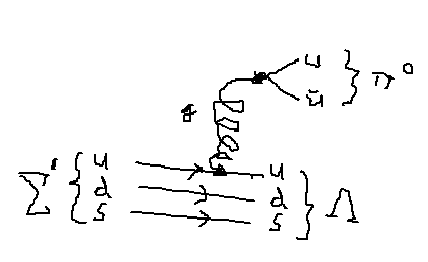
Consider ##\Sigma^0 \rightarrow \Lambda + \pi^0##. (Not Allowed)
vertex1.png


According to griffiths, this strong interaction is not allowed by 'Conservation of Energy'. I'm not sure why, as this simply shows an up and anti-up quark coming together, producing a gluon, where mass of gluon is mass of up and anti-up quark combined.

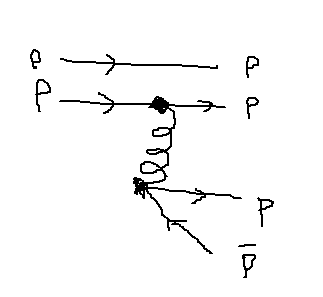
Consider ##p + p \rightarrow p + p + p + \bar p##. (Allowed)

Why is this possible by the strong interaction then?
vertex2.png
 
Physics news on Phys.org
unscientific said:
Consider ##\Sigma^0 \rightarrow \Lambda + \pi^0##. (Not Allowed)

According to griffiths, this strong interaction is not allowed by 'Conservation of Energy'. I'm not sure why

Consider this process in the rest from of the initial ##\Sigma^0## particle. What is the total energy of the initial ##\Sigma^0## particle? What is the minimum possible total energy of a final state containing a ##\Lambda^0## particle and a ##\pi^0## particle?

unscientific said:
Consider ##p + p \rightarrow p + p + p + \bar p##. (Allowed)

Why is this possible by the strong interaction then?

vertex2.png

This is not a diagram that contributes to ##p + p \to p + p + p + \bar p##. In your diagram, one of the protons is unaffected and might as well not be there. So effectively the process you have drawn is ##p \to p + p + \bar p##, which like your first example is not allowed because of energy conservation. (Also there is a more technical reason why this diagram is not allowed, which is that a single gluon cannot produce a proton-antiproton pair because of color conservation. You need at least two gluons).

Here is a possible diagram for ##p + p \to p + p + p + \bar p##:
pp_to_pppp.png
 
  • Like
Likes   Reactions: unscientific and Naeem Anwar
Also, the reason a proton-proton collision can create an additional proton-antiproton pair is that the pp system is not a bound system and the protons can have a significant kinetic energy in the CoM frame (if they do not have enough, the process is forbidden).
 
  • Like
Likes   Reactions: unscientific
Put simply, the first one is a (forbidden) decay, whereas the second one is a collision
 
  • Like
Likes   Reactions: unscientific
dukwon said:
Put simply, the first one is a (forbidden) decay, whereas the second one is a collision
That totally clears it up. Thanks!