Why is this equation about adding pure substances correct?

  • Thread starter Thread starter HAF
  • Start date Start date
  • Tags Tags
    Pure
Click For Summary

Discussion Overview

The discussion revolves around the validity of an equation related to adding pure substances to a solution, specifically addressing the conditions under which this equation holds true. Participants explore the implications of volume changes when adding solutes to solutions, focusing on dilute versus concentrated solutions.

Discussion Character

  • Technical explanation
  • Conceptual clarification
  • Debate/contested

Main Points Raised

  • One participant questions the correctness of an equation and seeks clarification on the disappearance of a term in the equation.
  • Another participant suggests that if V2 is much lower than V1, the term (1+V2/V1) can be approximated as 1, indicating a potential simplification in the equation.
  • A participant clarifies that the equation in question pertains to adding pure B to a solution, where the assumption is that the volume of the solution does not change significantly when adding a small amount of solute.
  • Further inquiry arises about why the volume does not change when adding pure B, prompting a discussion on the effects of dilution.
  • It is noted that while the volume does change, it may be negligible in dilute solutions, and that for precise calculations, volume changes should be considered, especially in concentrated solutions.

Areas of Agreement / Disagreement

Participants express differing views on the significance of volume changes when adding solutes, with some agreeing that the change can be negligible in dilute solutions, while others emphasize the importance of accounting for volume changes in more concentrated scenarios. The discussion remains unresolved regarding the specific conditions under which the original equation is valid.

Contextual Notes

Limitations include the assumption that the volume change is negligible in dilute solutions, which may not hold true for concentrated solutions. The discussion also reflects varying interpretations of the equation's applicability based on the concentration of the solutions involved.

HAF
Messages
58
Reaction score
6
Hello,
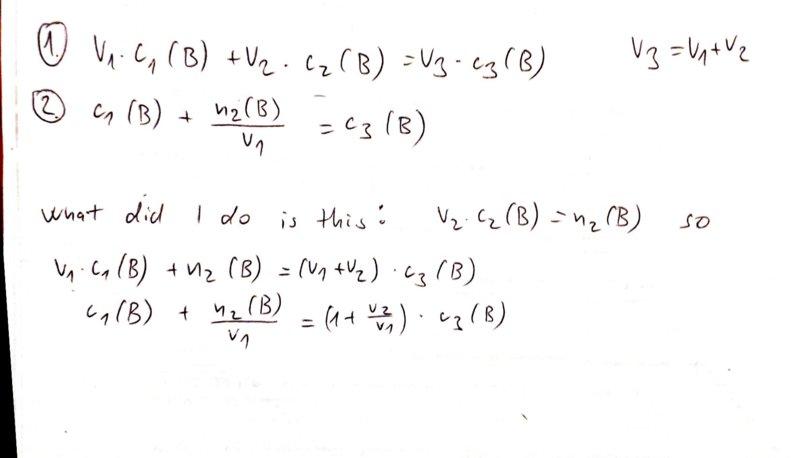
I have a little problem. I try to find out why the second equation in the picture is correct. How can I get it? Down on the paper is what I did.

Where did the (1+V2/V1) disappear from the right side of equation?

Thank You for every help.
Document 13_4.jpg
 

Attachments

  • Document 13_4.jpg
    Document 13_4.jpg
    22.8 KB · Views: 775
Last edited:
Chemistry news on Phys.org
In general you are right, something is wrong. Perhaps V2 is much lower than V1, then 1+V2/V1 is approximately 1.
 
Borek said:
In general you are right, something is wrong. Perhaps V2 is much lower than V1, then 1+V2/V1 is approximately 1.
Thank You sir. I really appreciate your help.
 
The clue is in the title of the post. Equation 1 is about mixing two solutions; Equation 2 is about adding pure B to a solution. There is no V2 and c2; n2 moles of pure B are added to solution 1. The assumption is that this does not result in any change to the volume V1 of the solution, which is a good approximation if c1 and c3 are both dilute.
 
  • Like
Likes   Reactions: Borek
mjc123 said:
The clue is in the title of the post. Equation 1 is about mixing two solutions; Equation 2 is about adding pure B to a solution. There is no V2 and c2; n2 moles of pure B are added to solution 1. The assumption is that this does not result in any change to the volume V1 of the solution, which is a good approximation if c1 and c3 are both dilute.
I understand what you want to tell me but can I ask something?

Why by adding pure B the volume does not change?
 
It does change, but not by very much if the solutions are dilute. If the volume of solute is much smaller than the volume of solvent, it can often be practically ignored, and we can say with minimal error that concentration = moles of solute/volume of solvent. For highly accurate work we need to take volume changes into account, and of course the assumption breaks down for concentrated solutions.
 

Similar threads

  • · Replies 2 ·
Replies
2
Views
3K
Replies
3
Views
2K
  • · Replies 9 ·
Replies
9
Views
4K
  • · Replies 21 ·
Replies
21
Views
2K
  • · Replies 23 ·
Replies
23
Views
6K
  • · Replies 7 ·
Replies
7
Views
6K
  • · Replies 16 ·
Replies
16
Views
3K
  • · Replies 13 ·
Replies
13
Views
2K
  • · Replies 49 ·
2
Replies
49
Views
4K