Why multiply vector field by normal vector in surface integrals

4 replies · 2K views · last reply
Hamiltonian
Messages
296
Reaction score
193
TL;DR
doubt in the derivation of the expression for calculating the surface integral for a function F.
this method of derivation is approximating the function using a polyhedron.
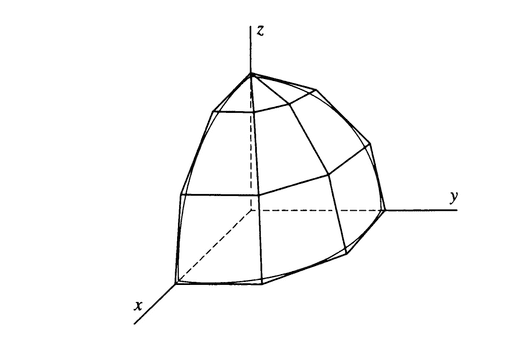
Three-dimensional sketch of a curved surface in the positive octant, drawn as a polyhedral mesh of quadrilateral faces with the x, y and z axes labelled and dashed lines marking the base.

concentrating on one of the surfaces(say the L'th surface which has an area ##\Delta S_l## and let ##(x_l,y_l,z_l)## be the coordinate of the point at which the face is tangent to the surface and let ##\hat n## be the unit normal vector)
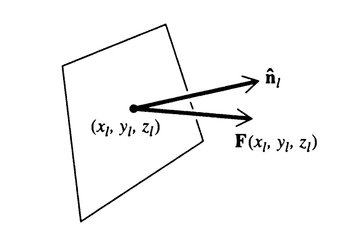
Diagram of a tilted flat patch with a dot marking point (x_l, y_l, z_l) on it, an arrow for unit normal n-hat_l pointing outward, and a second arrow for vector field F(x_l, y_l, z_l) at an angle to it.

the area of this surface is given by ##F(x_l, y_l, z_l).\hat n_l \Delta S_l##
on adding all of these we get,

Surface integral formula: double integral over S of F dot n-hat dS equals the limit as N goes to infinity, each delta S_i goes to 0, of the sum from l=1 to N of F(x_l, y_l, z_l) dot n-hat_l times delta S_l.

my doubt in this derivation is why is there a dot product being taken between the vectors and then multiplied by the area(basically I don't understand why this equation, ##F(x_l, y_l, z_l).\hat n_l \Delta S_l## give the area as shouldn't the summation of all the ##\Delta S_l## simply be equal to the surface area of the function??)
 
Hamiltonian299792458 said:
the area of this surface is given by ##F(x_l, y_l, z_l).\hat n_l \Delta S_l##
on adding all of these we get,

No - the area of that little piece is just ##\Delta S_l##, whilst the (so-called) vector area of that little piece is ##\hat{n} \Delta S_l ##. The term ##\vec{F} \cdot \hat{n} \Delta S_l## is the "flux" of the vector field through that little piece, and by extension$$\Phi = \int_{\Sigma} \vec{F} \cdot \hat{n} dS$$is the flux out of the surface ##\Sigma##. For example, consider some fluid with velocity field ##\vec{v}(\vec{r})##. The volume of fluid that passes through the little piece of area ##dS## per time ##dt## is ##\vec{v} \cdot \hat{n} dS = (v\cos{\theta}) dS##. Note that this is the volume of an oblique prism of base area ##dS##, slant length ##v## and height ##v\cos{\theta}## between the faces at either end, which contains the fluid that has flown through the element per ##dt##.

The area of a surface is also ##\int_S dS##, whilst the vector area of a surface is ##\int_S \hat{n} dS##. N.B. that the vector area of a closed surface is zero.

[P.S. In many general cases, for a current density ##\vec{J} = \rho \vec{v}## associated with an extensive quantity ##Q## where ##\rho = \frac{\partial Q}{\partial V}##, if ´##Q## isn't being 'generated' or 'destroyed' inside the surface, you can say$$\frac{dQ_{\Omega}}{dt} = -\int_{\partial \Omega} \rho \vec{v} \cdot \hat{n} dS$$
 
  • Informative
Likes   Reactions: Hamiltonian
etotheipi said:
No - the area of that little piece is just ##\Delta S_l##, whilst the (so-called) vector area of that little piece is ##\hat{n} \Delta S_l ##. The term ##\vec{F} \cdot \hat{n} \Delta S_l## is the "flux" of the vector field through that little piece, and by extension$$\Phi = \int_{\Sigma} \vec{F} \cdot \hat{n} dS$$is the flux out of the surface ##\Sigma##.
I still don't understand how
Equation for surface flux integral: double integral over S of F dot n-hat dS equals the limit as N goes to infinity, each delta S_l goes to 0, of the sum from l=1 to N of F(x_l, y_l, z_l) dot n-hat_l times delta S_l.
this is derived.
(I understand the mistake in my previous post. how exactly do you get the surface area from the flux?)
 
Nothing's really been derived here, I think that's sort of the definition of the flux of a vector field through a surface. But I tried to give some motivation by looking at volumetric flow rates, maybe have a look at this figure:

Diagram of a flat disc-shaped surface element dS with unit normal n pointing up, and a velocity vector u delta t tilted obliquely from it, sweeping out an oblique cylinder; labels S, V and dS also shown.


You'll notice that the volume inside that oblique cylinder is ##\vec{u} \delta t \cdot \hat{n} \delta S##, from which you might deduce the volumetric flow rate through a surface is ##\dot{V} = \int_{\Sigma} \vec{u} \cdot \hat{n} dS##.

Surface area is a simpler concept than flux, since the surface area of a surface is just ##\int_{\Sigma} dS##. If you want the vector surface area instead, then you can just consider ##\int_{\Sigma} \hat{n} dS##.
 
Last edited by a moderator:
  • Like
Likes   Reactions: LCSphysicist and Hamiltonian
Hamiltonian299792458 said:
(I understand the mistake in my previous post. how exactly do you get the surface area from the flux?)

The main purpose of a surface integral is not to find a surface area. A surface integral computes the flux of a vector field through a surface.

Imagine we have pipe with a uniform cross section and water is flowing through it at a constant velocity. The flux of the water is measured in units like (liters per second)/ (square cm) and we would (theoretically) measure the flux by measuring the rate at which water flows through a surface that is a cross section of the pipe - i.e. a surface perpendicular to the sides of the pipe. Suppose we cannot measure the flow through a surface perpendicular to the sides of the pipe, but instead must measure it through a planar surface that is not perpedicular to the sides of the pipe. The dot product in a surface integral is used to correct for the fact we are not measuring the flow through a surface perpendicular to the sides of the pipe - or, as another way of looking at it, that we are not measuring flow in a direction perpendicular to the surface.
 
  • Informative
Likes   Reactions: Hamiltonian