Will this dipole rotate or change position?

Click For Summary
SUMMARY

The discussion centers on the behavior of a dipole in an external electric field, specifically analyzing its net force and torque. It is established that when the dipole moment is aligned with the electric field, the dipole is in an unstable equilibrium, resulting in a net force and torque of zero. However, any perturbation will cause the dipole to rotate towards a stable equilibrium position, where the charges are separated further apart. The conversation emphasizes the dynamics of dipole alignment and the effects of external electric fields on dipole stability.

PREREQUISITES
  • Understanding of dipole moment and its significance in electric fields
  • Knowledge of Coulomb's law and electric forces
  • Familiarity with concepts of torque and equilibrium in physics
  • Basic principles of electric fields and their effects on charged particles
NEXT STEPS
  • Explore the mathematical formulation of dipole moment and its applications
  • Study the behavior of dipoles in varying electric field strengths
  • Investigate the concept of stable vs. unstable equilibrium in physical systems
  • Learn about oscillations and damping effects on dipole motion
USEFUL FOR

Students of physics, educators teaching electromagnetism, and researchers exploring electric field interactions with dipoles will benefit from this discussion.

annamal
Messages
393
Reaction score
33
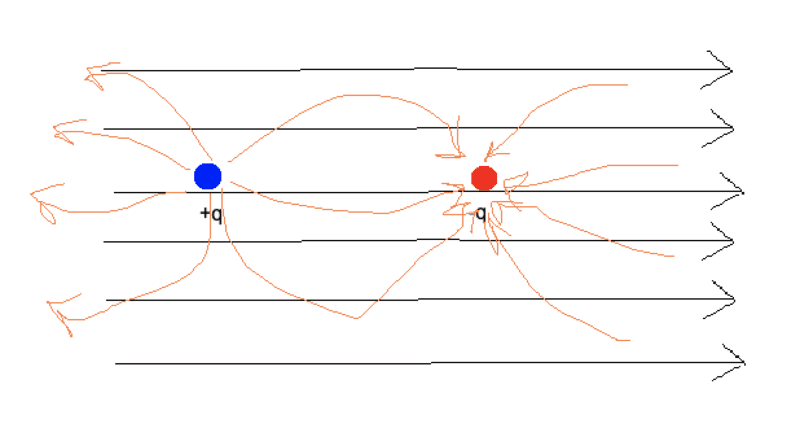
Will this dipole rotate or change position? The external electric field is in black. Two charges with their electric fields are drawn in orange.
Screen Shot 2022-04-20 at 11.48.38 PM.png
 
Physics news on Phys.org
Calculate the net force on the dipole and the net torque (with respect to the center of the dipole) , you will find them both zero.

Another way to solve this, is via the concept of dipole moment. If the dipole moment is parallel to the external Electric Field then the dipole is in stable position.
 
So, the e-field arrows go from + charges (potential, really) towards minus. This will exert a coulomb force to push/pull the charges. But, it's stable like a pencil standing on it's point (really, an unstable equilibrium) any perturbation in alignment, which will always happen somehow, will create a rotational force to make them switch positions. Then it really will be stable (a stable equilibrium, once things settle down), but with the charges separated a bit more than if there was no field. The concept is simple, the + charge wants to move with the arrows, the minus charge wants to move the other way.
 
  • Like
Likes   Reactions: berkeman
This confuses me a bit because the external electric field in black is as though we placed a positive charge to the very left of the image, right next to the blue +q, which means, the blue +q should be repelled and move away with the red -q moving forward.
 
annamal said:
which means, the blue +q should be repelled and move away with the red -q moving forward.
That's what @DaveE just said. And if the two charges are held rigidly at their current separation (hence, a diople), they will be rotated by those forces until they align with the field. But since the E field is constant in magnitude in the area that you show, what is the "Net" force on the two charges overall?
 
berkeman said:
That's what @DaveE just said. And if the two charges are held rigidly at their current separation (hence, a diople), they will be rotated by those forces until they align with the field. But since the E field is constant in magnitude in the area that you show, what is the "Net" force on the two charges overall?
Shouldn't it be 0 in this unstable equilibrium position?
 
Shouldn't what be zero? The net force and torque? I suppose so, but it's a very unstable equilibrium as drawn, and will experience a torque fairly soon that flips it into the stable equilibrium position (after a period of oscillations that will depend on any damping that is present).
 
  • Like
Likes   Reactions: DaveE
berkeman said:
Shouldn't what be zero? The net force and torque? I suppose so, but it's a very unstable equilibrium as drawn, and will experience a torque fairly soon that flips it into the stable equilibrium position (after a period of oscillations that will depend on any damping that is present).
You asked about the net force. The net force should be 0.
 
annamal said:
You asked about the net force. The net force should be 0.
Correct, but not the net torque. You were asking about how the dipole would move in this situation.
 

Similar threads

  • · Replies 21 ·
Replies
21
Views
2K
  • · Replies 1 ·
Replies
1
Views
2K
  • · Replies 22 ·
Replies
22
Views
2K
  • · Replies 2 ·
Replies
2
Views
2K
  • · Replies 10 ·
Replies
10
Views
2K
  • · Replies 10 ·
Replies
10
Views
3K
  • · Replies 1 ·
Replies
1
Views
2K
  • · Replies 19 ·
Replies
19
Views
9K
  • · Replies 5 ·
Replies
5
Views
2K
  • · Replies 4 ·
Replies
4
Views
2K