Work Done by Spring on a Body Sliding down a rod

Click For Summary

Homework Help Overview

The discussion revolves around calculating the work done by a spring on an object sliding down a rod, with a focus on the implications of changing angles and force components. The subject area includes concepts from mechanics and spring dynamics.

Discussion Character

  • Exploratory, Assumption checking, Conceptual clarification

Approaches and Questions Raised

  • Participants explore the validity of the standard work done formula for springs in the context of changing angles and positions. Some suggest integration as a potential method, while others propose using conservation of energy to relate potential energy changes to work done.

Discussion Status

The discussion is ongoing, with various methods being considered. Some participants have offered corrections to formulas, while others are questioning the assumptions behind the standard approach. There is no explicit consensus yet, but guidance towards using conservation of energy has been suggested.

Contextual Notes

Participants are grappling with the implications of changing spring angles and the nature of conservative forces in this context. There is mention of previous solutions that may influence current understanding, and some participants express uncertainty about the correctness of their approaches.

Simon Goster
Messages
4
Reaction score
0
1. The Question
Unable to find the work done by spring on the object sliding down the rod as shown below:
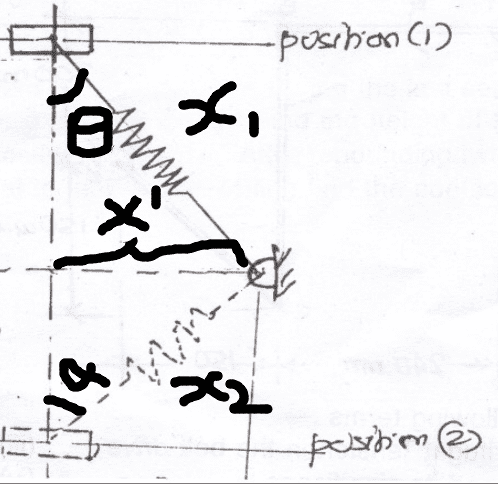
6KCzFSc.png


Homework Equations


Work Done by Spring Force : -1/2 * KΔx2 --(1)
where k = Spring Constant
Δx = Change in Spring Length[/B]

3. Where the problem occurred
While seeing the solution of the problem, it was mentioned that we can simply take
WSpring = -1/2 * K(X22-X12) --(2)
But my problem is that if the position of ring on rod is changing, the angle of spring with the rod is changing and thus the force components on rod is changing, then how the usual formula
Work Done by Spring Force : -1/2 * KΔx2
is also valid for the given condition.
PS: I also tried to understand this using concept of conservative force, but couldn't get it.
Thanks!
 
Last edited:
Physics news on Phys.org
Your formula for work done by a spring is wrong. Its X2. Not x.
 
UncertaintyAjay said:
Your formula for work done by a spring is wrong. Its X2. Not x.
Sorry for this.
Corrected the Formulas
Thanks!
 
Okay so , ignore the fact that you've seen the solution for a moment. Assume you don't know what the answer is. How would you approach the sum?
 
UncertaintyAjay said:
Okay so , ignore the fact that you've seen the solution for a moment. Assume you don't know what the answer is. How would you approach the sum?

1. Integration =>∫(force of spring along rod)*dx or ∫(force of spring along rod as function of angle)*dθ
2. As Work Done = - Change in Potential Energy
Find Potential Energy due spring for both the positions and use the above relation

Are these meathods right.
Wont consider using integration method
Can we use other concepts like conservative forces or just like that?
 
The second method is easier. When in doubt use conservation of energy. Now try it with that and see what answer you get.
 

Similar threads

  • · Replies 58 ·
2
Replies
58
Views
3K
Replies
20
Views
3K
  • · Replies 2 ·
Replies
2
Views
2K
Replies
17
Views
2K
  • · Replies 12 ·
Replies
12
Views
2K
  • · Replies 5 ·
Replies
5
Views
1K
  • · Replies 9 ·
Replies
9
Views
2K
  • · Replies 14 ·
Replies
14
Views
2K
  • · Replies 5 ·
Replies
5
Views
2K
  • · Replies 4 ·
Replies
4
Views
2K