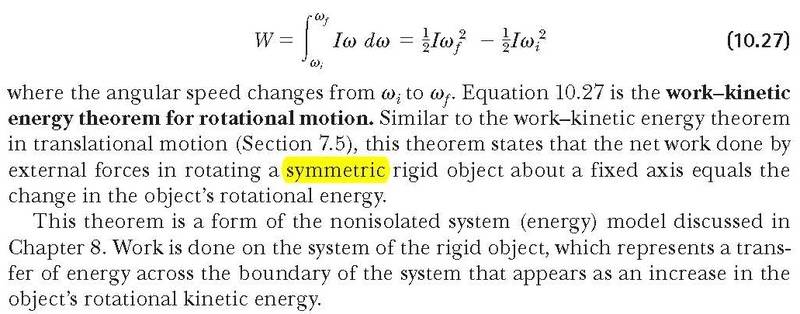
Work–kinetic energy theorem for rotational motion. need to be symetri?

Click For Summary
SUMMARY

The work–kinetic energy theorem for rotational motion requires symmetry in objects to simplify calculations for freshman physics students. According to "Physics" by Serway, 9th edition, page 313, the moment of inertia is treated as a scalar for symmetric objects, making the concept more accessible. This simplification is necessary as students at this level lack the mathematical background to understand the complexities of moment of inertia as a second-order tensor. The discussion emphasizes the importance of clarity in educational materials regarding these foundational concepts.

PREREQUISITES
  • Understanding of basic physics concepts, particularly rotational motion.
  • Familiarity with the work–kinetic energy theorem.
  • Knowledge of moment of inertia and its significance in physics.
  • Basic mathematical skills related to tensors (though not required for this discussion).
NEXT STEPS
  • Study the concept of moment of inertia in detail, focusing on its tensor properties.
  • Learn about the work–kinetic energy theorem in both linear and rotational contexts.
  • Explore introductory materials on tensors and their applications in physics.
  • Review "Physics" by Serway, 9th edition, to understand the context of symmetry in rotational motion.
USEFUL FOR

This discussion is beneficial for physics students, educators teaching introductory physics, and anyone interested in the foundational principles of rotational dynamics.
07685gg
Messages
2
Reaction score
0
Why it need to be symetric
From the book Physics - Serway
Thanks

Edit:
I'm bringing just the statement from Serway's Physics 9th p 313
1133954057_Physics1.jpg
 
Last edited:
Physics news on Phys.org
That image was a bit too much. It's oversized for one thing, and for another that's verging on copyright violation.

Try again, with words rather than an image. Give a reference to the book (name, author, page number) and summarize the parts you don't understand. You can quote a paragraph or two, but an entire photocopied page is just too much.

I reopened the thread. Please try to summarize your concerns in words, not with a scanned image, and we'll do our best to try to answer your questions.
 
Last edited:
The next time you post a scanned image, please try to resize your images so they're a bit smaller than this -- 640 by 480 or so.


The reason it has to be symmetric in that freshman level physics text is that freshman do not yet have the mathematical skills to cover the full problem. The problem is that ultimately moment of inertia is not a scalar. It is instead a second order tensor. You haven't studied tensors. You might *start* studying them in a couple of years. There is nothing in that more advanced treatment that necessitates that an object be symmetric.

By making the object in question symmetric, moment of inertia can essentially be treated as if it was a scalar, just like mass. This simplifies the problem of rotational motion to something that is understandable at a freshman physics level.
 
cool. making sense

(I would expect from the author to be more clear about that)
 

Similar threads

  • · Replies 40 ·
2
Replies
40
Views
4K
  • · Replies 77 ·
3
Replies
77
Views
6K
  • · Replies 31 ·
2
Replies
31
Views
4K
  • · Replies 19 ·
Replies
19
Views
3K
  • · Replies 21 ·
Replies
21
Views
3K
  • · Replies 3 ·
Replies
3
Views
2K
  • · Replies 33 ·
2
Replies
33
Views
2K
  • · Replies 9 ·
Replies
9
Views
3K
  • · Replies 8 ·
Replies
8
Views
2K
  • · Replies 14 ·
Replies
14
Views
2K