Would like some more knowledge about the product of functions

  • Context: High School 
  • Thread starter Thread starter mcastillo356
  • Start date Start date
  • Tags Tags
    Precalculus
Click For Summary
SUMMARY

The discussion centers on the mathematical properties of the product of functions, specifically focusing on the intersection of their domains and the determination of their ranges. Participants clarify that the domain of the product of two functions is defined by the intersection of their individual domains, while the range is determined by the intersection of their ranges. An example involving the function $$y=\Bigg(2+\sin{\displaystyle\frac{x}{2}}\Bigg)^2\cos{\displaystyle\frac{x}{2}}$$ illustrates how to find the area under the curve between the lines $$x=0$$ and $$x=\pi$$, confirming that $$y \geq 0$$ in this interval.

PREREQUISITES
  • Understanding of function domains and ranges
  • Familiarity with integral calculus
  • Knowledge of trigonometric functions and their properties
  • Ability to manipulate and analyze inequalities
NEXT STEPS
  • Study the properties of function products and their domains
  • Learn about the integration techniques for finding areas under curves
  • Explore the implications of trigonometric identities in function analysis
  • Investigate the use of inequalities in proving function behavior
USEFUL FOR

Mathematicians, calculus students, educators, and anyone interested in understanding the properties of functions and their products in mathematical analysis.

mcastillo356
Gold Member
Messages
658
Reaction score
361
TL;DR
Texbook don't seem to regard on the range and domains of function product. A search on the net gives clues, but I'd wish some more learning.
Hi, PF

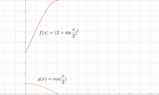
I only have a clue on the topic I present; the answer involves the ##\subset##, maybe ##\subseteq## concepts; I mean that the only answer I've obtained is that both range and domain of the product of two functions are the inclusion of both. I include a picture regarding the example of the textbook, which shows to functions between ##0## and ##\pi##.

Greetings Function product.png
 
Mathematics news on Phys.org
The domain of the product must be the intersection of the domains of the two functions, for the obvious reason.

The precise range of a product is more complicated, again for the obvious reason.
 
  • Informative
Likes   Reactions: mcastillo356
mcastillo356 said:
domain of the product of two functions are the inclusion of both

What does that mean?
 
  • Informative
Likes   Reactions: mcastillo356
Hi, PF, my question lacks of context and precision.
EXAMPLE 6 Find the area of the region bounded by ##y=\Bigg(2+\sin{\displaystyle\frac{x}{2}}\Bigg)^2\cos{\displaystyle\frac{x}{2}}##, the ##x##-axis, and the lines ##x=0## and ##x=\pi##
Solution Because ##y\leq 0## when ##0\leq x\leq \pi##, the required area is
##A=\displaystyle\int_0^{\pi}{\Bigg(2+\sin{\displaystyle\frac{x}{2}}\Bigg)^2\cos{\displaystyle\frac{x}{2}}}\,dx##
Let ##v=2+\sin{\displaystyle\frac{x}{2}}##.
Then ##dv=\displaystyle\frac{1}{2}\cos{\displaystyle\frac{x}{2}}\,dx##
##=2\displaystyle\int_2^3{\,v^2\,dv}=\displaystyle\frac{2}{3}\,v^3\Bigg|_2^3=\displaystyle\frac{2}{3}(27-8)=\displaystyle\frac{38}{3}## square units
weirdoguy said:
What does that mean?
Ups... Intersection. "The range of sum/difference/product/quotient of two functions is the intersection of the ranges of the individual functions" (quote from Stack Exchange).
Hope to have mended my previous post inconsistency. Greetings.
 
mcastillo356 said:
EXAMPLE 6 Find the area of the region bounded by ##y=\Bigg(2+\sin{\displaystyle\frac{x}{2}}\Bigg)^2\cos{\displaystyle\frac{x}{2}}##, the ##x##-axis, and the lines ##x=0## and ##x=\pi##
Solution Because ##y\leq 0## when ##0\leq x\leq \pi##,
The inequality after "Because" isn't true. Perhaps you have the inequality reversed?
For the interval ##[0, \pi]##, ##\cos(x/2)## and ##\sin(x/2)## both have values in the interval [0, 1].
 
Mark44 said:
Perhaps you have the inequality reversed?
Yes.
##y\geq 0## when ##0\leq x\leq \pi##

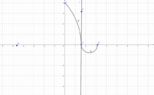
Failure.png

Hi @Mark44, thanks a lot. Greetings!
 
Hi, PF

I can draw
##y(x) = \begin{cases} y\geq 0 & \text{if }0\leq x \leq {\displaystyle\frac{\pi}{2}}
\\ y\leq 0 & \text{if }\displaystyle\frac{\pi}{2} x \leq{\pi} \end{cases}##

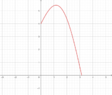
Counterexample.png

This is easy, and doesn't add news to this thread

The question is: how should I manage to prove that ##y\geq 0## when ##0\leq x\leq{\pi}## for $$y=\Bigg(2+\sin{\displaystyle\frac{x}{2}}\Bigg)^2\cos{\displaystyle\frac{x}{2}}$$
avoiding the use of graphs?

The only mathematical evidence I have is that is true for the endpoints.

Greetings
 
mcastillo356 said:
Hi, PF

I can draw
##y(x) = \begin{cases} y\geq 0 & \text{if }0\leq x \leq {\displaystyle\frac{\pi}{2}}
\\ y\leq 0 & \text{if }\displaystyle\frac{\pi}{2} x \leq{\pi} \end{cases}##

View attachment 331364

This is easy, and doesn't add news to this thread

The question is: how should I manage to prove that ##y\geq 0## when ##0\leq x\leq{\pi}## for $$y=\Bigg(2+\sin{\displaystyle\frac{x}{2}}\Bigg)^2\cos{\displaystyle\frac{x}{2}}$$
avoiding the use of graphs?

The only mathematical evidence I have is that is true for the endpoints.

Greetings

You know that (2 + \sin (x/2))^2 > 0 for any x. So y can only be negative when \cos(x/2) < 0, which is not the case for x \in [0, \pi].
 
  • Like
Likes   Reactions: mcastillo356

Similar threads

  • · Replies 2 ·
Replies
2
Views
1K
  • · Replies 3 ·
Replies
3
Views
3K
  • · Replies 6 ·
Replies
6
Views
3K
  • · Replies 80 ·
3
Replies
80
Views
10K
  • · Replies 21 ·
Replies
21
Views
2K
  • · Replies 51 ·
2
Replies
51
Views
5K
  • · Replies 8 ·
Replies
8
Views
5K
  • · Replies 4 ·
Replies
4
Views
3K
Replies
2
Views
3K
  • · Replies 6 ·
Replies
6
Views
2K