Would this design work? (rocket)

Click For Summary

Discussion Overview

The discussion centers around the feasibility of building a wooden rocket that utilizes water and compressed air as a propulsion mechanism. Participants explore various design considerations, materials, and safety concerns related to homemade rockets, particularly focusing on the use of wood versus other materials and the potential for chemical propulsion.

Discussion Character

  • Exploratory
  • Technical explanation
  • Debate/contested
  • Experimental/applied

Main Points Raised

  • One participant proposes carving a wooden rocket and using water and compressed air for propulsion, questioning the design's feasibility and potential flaws.
  • Another participant suggests that the design could work and emphasizes that water at the bottom is acceptable since pressurized air will force it out during launch.
  • Suggestions include using a fizzy drinks bottle for its pressure-holding capabilities and designing a launch pad to safely build up pressure before launch.
  • Concerns are raised about the safety of using chemical propulsion, with one participant warning against experimenting with combustibles without sufficient knowledge.
  • Another participant mentions historical methods of rocket construction using bamboo, highlighting its strength and hollow nature as advantageous.
  • Discussion includes a caution about the dangers of using saltpeter and sugar as rocket fuel, with emphasis on the need for proper containment and shaping of exhaust for effective propulsion.
  • Some participants share personal anecdotes about past experiments with homemade rockets and fuels, reflecting on the risks involved.

Areas of Agreement / Disagreement

Participants generally agree that the water and compressed air rocket design is feasible, but there is significant disagreement regarding the safety and viability of using chemical propulsion methods. The discussion remains unresolved on the best approach to rocket construction.

Contextual Notes

Limitations include varying levels of knowledge among participants regarding rocket propulsion principles and safety, as well as differing opinions on the effectiveness of materials and methods proposed.

Who May Find This Useful

Individuals interested in DIY projects, rocketry, physics education, and safety in experimental designs may find this discussion relevant.

vandorin
Messages
24
Reaction score
0
I've never had an interest in rockets, or pretty much anything physics/science related until I took a physics course over the summer, and ever since then I've hardly stopped thinking about it. The question I have is, can you build a wooden rocket that uses water and compressed air to fuel it, if only temporarily?

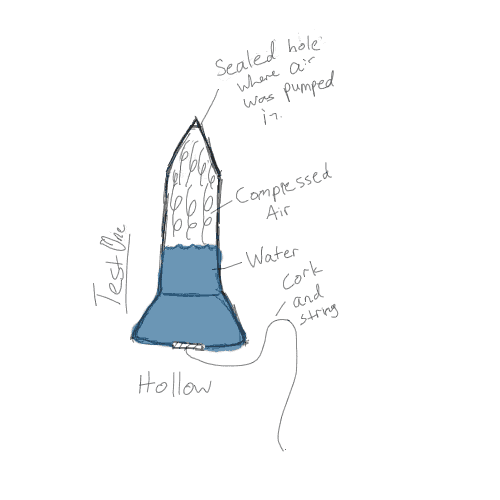
Here is a rough outline of what I hope to accomplish, if its even at all possible
6ztu1d.jpg


Basically what I want to do is carve/hollow out a piece of wood into this basic shape, and note: the line at the bottom was just so that I would get the shape right, and will not be there in the final design.

After I carved/hollowed it out, I would carve an appropriate sized hole in the bottom, fill it with water to a certain point, and then put a cork with a string attached to it, at and seal it up airtight. Then at the top of the rocket, I planned to get a basketball pump, the ones with the long thin needles, and basically make a tiny whole in it, put some putty like substance in it (so that the air does not pass through the whole) and after I had pumped all I could, I would cover It up quickly with the putty, and then attach the top part again, with something like gorilla glue.

But upon thinking about it, It might be easier to just pump the air through the bottom of the cork, and then just sealing that up if that would work. Then for the launch process, i would put it up on a raised height, and basically pull the cork out, letting the compressed air out and shooting the rocket up at least a little bit.

I've never been a wiz at science, and just wondered if anyone on here would know if my idea would work, or if it had any flaws that could prevent it from working? And also since air will always try to rise to the top of the water, I thought that it wouldn't matter if the water was on the bottom of the rocket, and the compressed air was at the top, or does it have to be the other way around?


Sorry for such a long post. :D
 
Physics news on Phys.org
That could certainly work. Home-made water rockets are a great way to learn various principles of physics, engineering, aerodynamics and workshop skills. There are no major flaws with your design; water at the bottom of the rocket will be just fine; since the pressurised air above will force the water out of the bottom anyway. It'd be pretty difficult to keep the water at the top, anyway!

My main modification to your idea would be to just have one hole (where the cork is) to introduce the compressed air. That way, you don't have to worry as much about sealing your chamber; and as you say, air will rise above the water anyway.

Other things to think about:

- How about making the rocket out of an old fizzy drinks bottle? These are ideal for home-made water rockets, since they are purposely designed to hold water at pressure. (A 2 litre Coke bottle will hold at least 10 bar, but be careful if you use such high pressures!). As a bonus, the rocket will be much lighter, and easily replacable if you lose/burst it.

- How about designing a 'launch pad' to hold the rocket down while you fill it with air. This would allow you to get much higher pressures, since the cork will not pop off until you're ready for blast-off.

- What about experimenting with different styles of fins?

- What about experimenting with different amounts of water in the bottle?

Finally, although you're only messing with air and water, be careful! As I mentioned, Coke bottles will easily take 10 bar, and a well-designed rocket at this pressure will easily cause you some injury if you get in its way.
 
brewnog said:
That could certainly work. Home-made water rockets are a great way to learn various principles of physics, engineering, aerodynamics and workshop skills. There are no major flaws with your design; water at the bottom of the rocket will be just fine; since the pressurised air above will force the water out of the bottom anyway. It'd be pretty difficult to keep the water at the top, anyway!

My main modification to your idea would be to just have one hole (where the cork is) to introduce the compressed air. That way, you don't have to worry as much about sealing your chamber; and as you say, air will rise above the water anyway.

Other things to think about:

- How about making the rocket out of an old fizzy drinks bottle? These are ideal for home-made water rockets, since they are purposely designed to hold water at pressure. (A 2 litre Coke bottle will hold at least 10 bar, but be careful if you use such high pressures!). As a bonus, the rocket will be much lighter, and easily replacable if you lose/burst it.

- How about designing a 'launch pad' to hold the rocket down while you fill it with air. This would allow you to get much higher pressures, since the cork will not pop off until you're ready for blast-off.

- What about experimenting with different styles of fins?

- What about experimenting with different amounts of water in the bottle?

Finally, although you're only messing with air and water, be careful! As I mentioned, Coke bottles will easily take 10 bar, and a well-designed rocket at this pressure will easily cause you some injury if you get in its way.


Thanks, and yes I've seen the 2-liter water rockets before, and I've even seen them explode, so I just wanted to make it more compact/agile, and my main concern is making the wood thin enough to go up, but strong enough to withstand the pressure.
 
You can save yourself a lot of carving by choosing the right wood. Remember, the very first rockets centuries ago in China were made of bamboo. It's already hollow, except for the septums that are easy to remove, and is very strong.
 
Danger said:
You can save yourself a lot of carving by choosing the right wood. Remember, the very first rockets centuries ago in China were made of bamboo. It's already hollow, except for the septums that are easy to remove, and is very strong.

I've actually just found out that "rocket fuel" is basically KNO3 (salt peter) and sugar. So I might make a metal rocket if I can get my hands on the supplies and find a safe place to launch.
 
That won't necesarilly work.
While salt peter will work as an oxidizer and allow you to burn the sugar easily, you won't get the pressure needed for take off, essentially you'll just burn your rocket down.

When burning youll either need to keep the fuel in a small space and have the explosion launch the rocket up, or you need to shape the exahust so that it is a shaped explosion. Look at pre made rocket engines, you'll notice a cone shape carved out of the bottom, this makes the burning gasses push down resulting in an upward force. I would stick with compressed air and water until you've taken more physics classes.

Also, be careful buyig salt peter, you can purchase it at service pharmacy and other small pharmacutical stores, but since you can use it to make a compound similar to dynamite if you try to purchase a large quantity, I believe they have to report you to the proper authorities!
 
Vandorin, please reconsider your idea of making a chemical rocket. With respect, you clearly haven't got much of a clue with regard to basic physical principles, and experimenting with combustibles with a little knowledge is a very quick way to end up maimed, blind, or dead.

Stick to your bike pump bottle rocket idea; it's much safer and the results will still be impressive.
 
haha, Don't worry, i won't be messing with combustibles for some time.
 
back in the late 50's when rockets were a hot do it yourself fad
we as preteen kids tryed a lot of fuels in our homemade rigs
we started with cap+match heads in al-foil tubes
but got our best results with a 50/50 salt p and powered sugar mix
in brass tubes
 
  • #10
I've got to back up Brewnog on this. Considering the things that I did with cars, motorcycles, guns, explosives and weasles when I was a kid, it's really remarkable that I'm still alive. Since there are safer ways to do things nowadays, I think that you should take that approach. We at PF really don't like it when our members self-destruct.
 
  • #11
I was actually also messing around some home-made rockets as well recently, nothing big just having some fun in my spare time. I was curious as to what size hole is the best and will give the most thrust. Say i use an average size rocket (the size of a soda bottle), i know a hole that is too small won't produce enough thrust and a hole too big will just let the water pour our too fast. Is there an equation that tells the "ideal size" for the hole that the water (fuel) rushes out of based on the dimensions/mass of the rocket itself?
 

Similar threads

Replies
27
Views
4K
Replies
2
Views
3K
  • · Replies 5 ·
Replies
5
Views
3K
Replies
8
Views
4K
  • · Replies 5 ·
Replies
5
Views
3K
  • · Replies 9 ·
Replies
9
Views
4K
  • · Replies 1 ·
Replies
1
Views
3K
  • · Replies 18 ·
Replies
18
Views
4K
  • · Replies 1 ·
Replies
1
Views
3K
Replies
4
Views
3K