Year 12: Cambridge Physics (Calculus in Specific heat capacity)

Click For Summary
SUMMARY

The discussion centers on calculating the fraction of liquid helium that evaporates when a small silver sphere, with a diameter of 4 cm and at a temperature of 20K, is placed in 25g of liquid helium at 4K. The specific heat capacity of silver is defined by the equation c/J/kg/K = 1.5x10^{-4}(T/K)^3 + 6.0x10^{-3} T/K. The correct answer to the problem is determined to be 1/210, with the key insight being the need to consider the combined thermal effects of the silver sphere and the helium liquid.

PREREQUISITES
  • Understanding of specific heat capacity and its temperature dependence
  • Knowledge of thermal dynamics and heat transfer principles
  • Familiarity with the properties of silver and helium, including density and latent heat
  • Basic calculus skills for manipulating equations involving temperature variables
NEXT STEPS
  • Study the principles of heat transfer in phase changes, particularly in cryogenics
  • Explore the mathematical modeling of specific heat capacities for various materials
  • Learn about the thermal properties of metals and their interactions with cryogenic liquids
  • Investigate the concept of thermal equilibrium and its applications in physics problems
USEFUL FOR

This discussion is beneficial for physics students, particularly those studying thermodynamics and materials science, as well as educators seeking to enhance their understanding of heat transfer in cryogenic contexts.

johnconnor
Messages
62
Reaction score
0
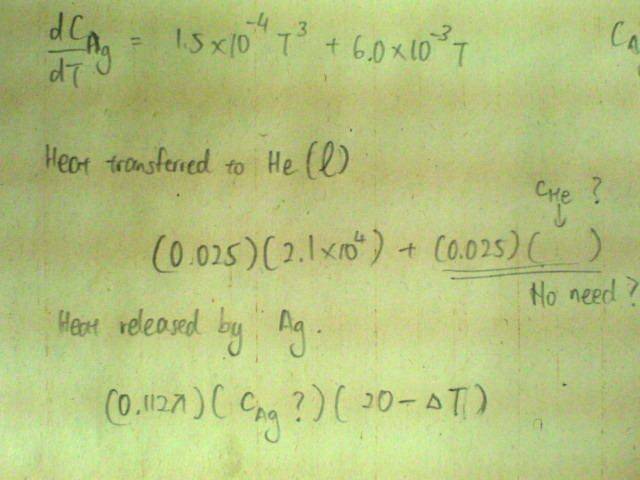
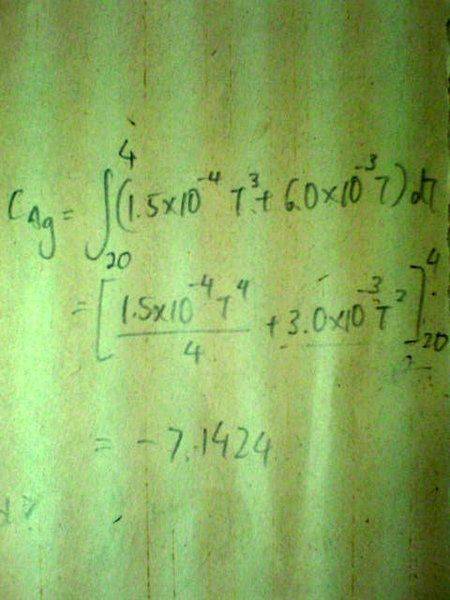
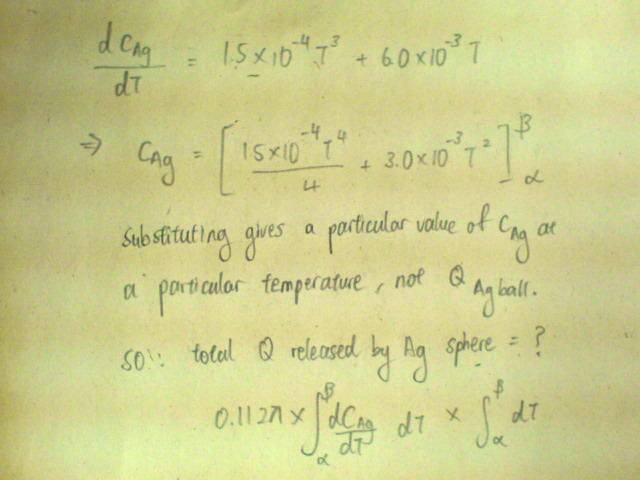
Below 20K, The specific heat capacity c of silver varies with temperature according to the equation[tex]c/\text{J /kg /K} = 1.5x10^{-4}(T/K)^3 + 6.0x10^{-3} T/K[/tex].
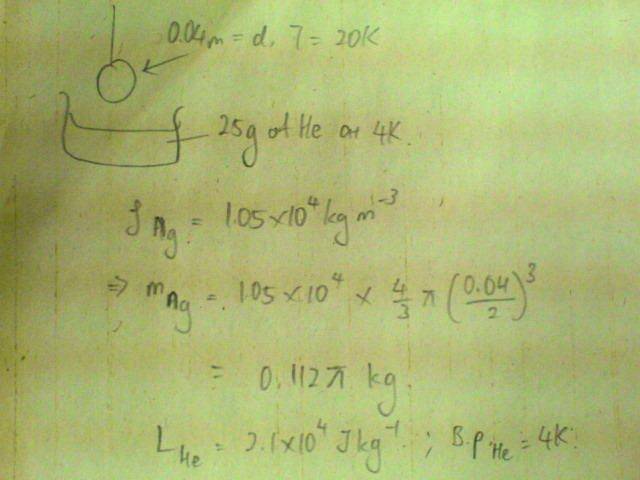
If a small silver sphere of diameter 4am and at 20K is placed in 25g of liquid helium at 4K, what fraction of the liquid will evaporate?
[Density of silver = 1.05E4 kg/m^3, specific latent heat of vaporisation of helium = 2.1E4 J/kg; boiling point of helium = 4K]

[expand=Attempt]
DSC02994.jpg

DSC02995.jpg

DSC02996.jpg

DSC02997.jpg
[/expand]
And I'm stuck. The answer is 1/210. I think my mistake is not considering the "combined effect" (if there's one?) of the silver sphere with the helium liquid, but I'm not very sure how do I express that in mathematical form.
Any help is appreciated. Thank you!
 
Physics news on Phys.org
Solved.
 

Similar threads

  • · Replies 9 ·
Replies
9
Views
2K
  • · Replies 6 ·
Replies
6
Views
2K
  • · Replies 3 ·
Replies
3
Views
2K
  • · Replies 7 ·
Replies
7
Views
2K
Replies
1
Views
3K
  • · Replies 5 ·
Replies
5
Views
2K
  • · Replies 7 ·
Replies
7
Views
3K
Replies
4
Views
2K
Replies
21
Views
4K
  • · Replies 3 ·
Replies
3
Views
5K