Yenka simulator to build an RS flip-flop

Click For Summary

Discussion Overview

The discussion revolves around building an RS flip-flop using a Yenka simulator, focusing on circuit design, component selection, and the distinction between RS latches and flip-flops. Participants provide feedback on the circuit diagram and suggest improvements while addressing the requirements of the task.

Discussion Character

  • Homework-related
  • Technical explanation
  • Debate/contested

Main Points Raised

  • One participant presents a circuit diagram for an RS flip-flop using NAND gates, switches, LEDs, and resistors.
  • Another participant questions the absence of an output in the circuit and suggests that the diagram is confusing and needs to be redrawn.
  • A mentor moves the thread to a homework forum and notes the lack of a specific question from the original poster.
  • Several participants point out that the resistor values and power supply voltage may need to be updated for proper operation.
  • One participant clarifies the difference between an RS latch and an RS flip-flop, explaining that a flip-flop is edge-triggered while a latch can change output based on input changes.
  • A participant suggests that the original poster or their tutor may have mistakenly referred to the latch as a flip-flop.
  • Another participant offers a suggestion for a clearer way to draw the circuit diagram, emphasizing standard conventions for voltage nodes.

Areas of Agreement / Disagreement

Participants express various concerns about the circuit design and terminology used, indicating a lack of consensus on the correctness of the original diagram and the definitions of the components involved.

Contextual Notes

There are unresolved issues regarding the appropriate resistor values, power supply specifications, and the distinction between RS latches and flip-flops, which may affect the circuit's functionality.

NYAME EPHRAIM
Messages
10
Reaction score
1
< Mentor Note -- thread moved to HH from the technical forums, so no HH Template is shown >

a) Using the Yenka (or similar) simulator, you are required to build an RS flip-flop using 2 NAND gates, switches, LEDs and 330Ω resistors. Test the circuit and prove its correct operation against the RS truth table, by print screening the 4 key modes and attaching a copy of your ‘RS flip-flop’ Yenka (or similar) file.

here is the diagram below i produced for the above task
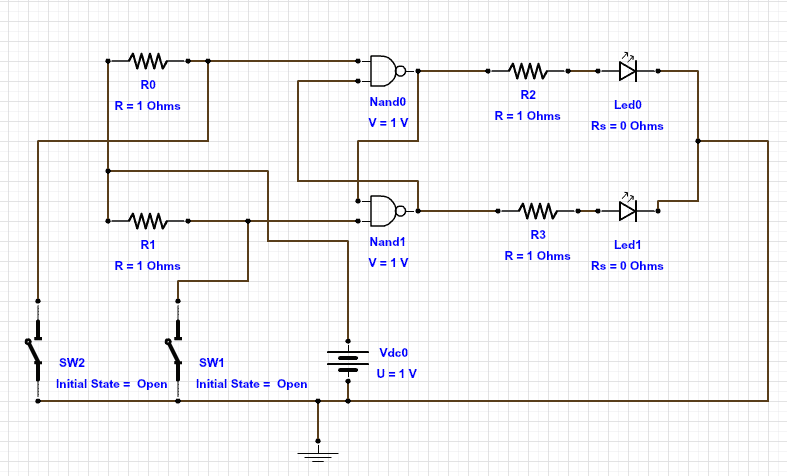
Capture max follow up.PNG
 

Attachments

  • Capture max follow up.PNG
    Capture max follow up.PNG
    7 KB · Views: 781
Last edited by a moderator:
Physics news on Phys.org
So, where is your output? The only place I see where one would assume the output to be, you have tied back to ground.

Also, the left part of your circuit diagram is unnecessarily confusing and should be redrawn.
 
I moved this to a homework forum, which is more appropriate.

In the future, please use the homework forum and fill out the template. You did show us your work but you didn't ask a question.

p.s. Sorry @phinds, I cross posted with you.
 
NYAME EPHRAIM said:
330Ω resistors.
Your resistor values need updating. Also, are you using a 1V power supply rail on purpose?
 
berkeman said:
Your resistor values need updating. Also, are you using a 1V power supply rail on purpose?
Jeez, I was so struck by the lack of an output and the confusing way the circuit is drawn that I didn't even notice that. Glad to see someone here pays attention :smile:
 
  • Like
Likes   Reactions: berkeman
I should also point out that this is an RS-latch, not an RS-Flip Flop. A flip-flop is edge triggered (only changes state on a clock edge) but a latch can change output whenever the inputs change. This may seem like semantics but the different behaviors make a big difference depending on the kinds of circuits you want to build with this. Many arithmetic circuits, for instance, require flip flops to suppress glitches that can wreak havoc on the calculations.

In case you're interested, a common way to make a Flip Flop out of latches (common in school, not so common in practice) is to use two latches clock out of phase (you can generate the negative phase internal to your Flip Flop). That way, even though the two latches are asynchronous, the flip flop as a whole is edge-triggered.
 
  • Like
Likes   Reactions: berkeman
Hi @NYAME EPHRAIM, Welcome to PF.

Yes, your circuit very nearly meets the requirements stated in your first post. The overall wiring looks correct but a couple details need adjusting. The comments about the supply voltage do bring to mind that the supply voltage for the logic gates needs to be at least high enough to drive the output LEDs. I also noticed that you are not using the 330 Ohm resistors; is there a reason?

It seems some folks did not notice the "2 nand gate" requirement. I would truly like to see a flip-flop from the parts list you were given.

These days, most common logic circuits use either 3.3 or 5 Volts, and that is what they were expecting. However, over 15 years ago Texas Instruments came out with logic that works down to 0.8V. (http://www.ti.com/lit/ml/sceb011a/sceb011a.pdf)

Cheers,
Tom
 
I suspect the OP or his tutor meant latch when he wrote flip-flop.
 
This is a neater way to draw the switches...
DRDpI.png


The convention is to put higher voltage nodes (eg VCC or VDD) at the top and lower voltage nodes (gnd, 0V or -ve voltage rails) at the bottom of the drawing.
 

Attachments

  • DRDpI.png
    DRDpI.png
    5.5 KB · Views: 722
  • Like
Likes   Reactions: Tom.G and berkeman

Similar threads

  • · Replies 13 ·
Replies
13
Views
4K