Yo-yo on an accelerating conveyor belt

Click For Summary

Homework Help Overview

The discussion revolves around a yo-yo placed on an accelerating conveyor belt, exploring the dynamics involved in its motion. Participants are examining the implications of the conveyor belt's acceleration on the forces acting on the yo-yo, particularly in relation to Newton's second law and the conditions for rolling without slipping.

Discussion Character

  • Mixed

Approaches and Questions Raised

  • Participants are questioning whether the acceleration of the conveyor belt can be treated as a force and how it affects the forces acting on the yo-yo. There are discussions about the conditions for rolling with or without slipping, and how to relate the linear and angular accelerations of the yo-yo. Some participants are exploring the relationship between the yo-yo's acceleration relative to the wall and the belt's acceleration.

Discussion Status

The discussion is ongoing, with participants providing insights into the relationships between different accelerations and forces. Some have suggested equations relating to the motion of the yo-yo and its interaction with the conveyor belt, while others are clarifying the roles of tension and friction in the system. There is a productive exploration of the dynamics involved, but no consensus has been reached.

Contextual Notes

Participants are navigating the complexities of the problem, including the need to consider both the forces acting on the yo-yo and the kinematic relationships involved. The discussion is constrained by the lack of specific values for tension and friction, which are critical to fully resolving the problem.

sudera
Messages
25
Reaction score
0
Homework Statement
A yo-yo is placed on a conveyor belt accelerating ##a_C = 1 m/s^2## to the left. The end of the rope of the yo-yo is fixed to a wall on the right. The moment of inertia is ##I = 200 kg \cdot m^2##. Its mass is ##m = 100kg##. The radius of the outer circle is ##R = 2m## and the radius of the inner circle is ##r = 1m##. The coefficient of static friction is ##0.4## and the coefficient of kinetic friction is ##0.3##.

Find the initial tension in the rope and the angular acceleration of the yo-yo.
Relevant Equations
##T - f = ma##
##\tau_P = -fr##
##\tau_G = Tr##
##I_P = I + mr^2##
##I_G = I + mR^2##
##a = \alpha R##
First off, I was wondering if the acceleration of the conveyor belt can be considered a force. And I'm not exactly sure how to use Newton's second law if the object of the forces is itself on an accelerating surface.
Also, I don't know whether it rolls with or without slipping.
I thought I could use ##a_C = \alpha R## for the angular acceleration, but the acceleration of the conveyor belt is not the only source of acceleration, since the friction and the tension also play a role.
I can't find a way to combine these equations to get the
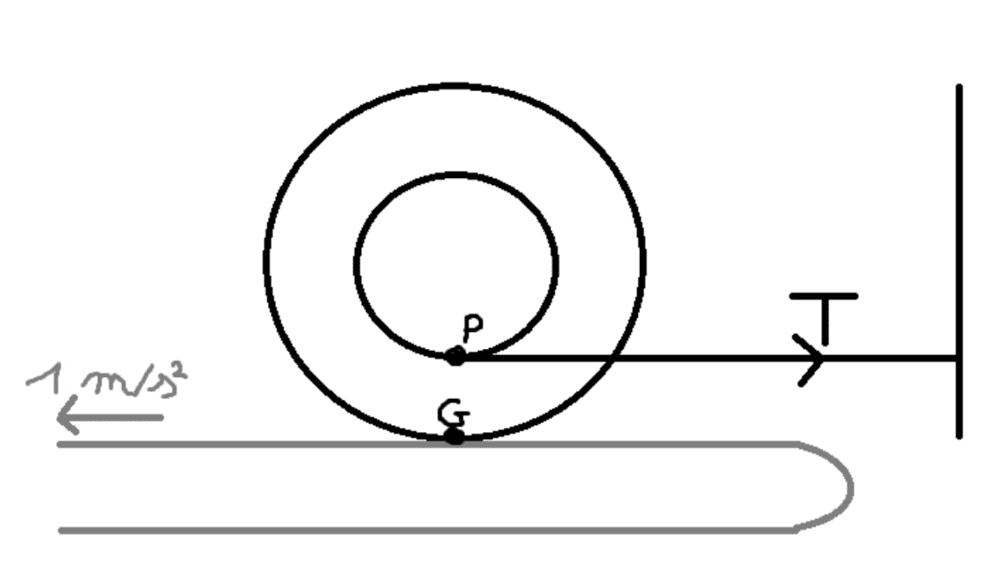
xx.png
 
Physics news on Phys.org
sudera said:
if the acceleration of the conveyor belt can be considered a force
It certainly results in a frictional force, but it is not immediately clear how great that force is.
sudera said:
whether it rolls with or without slipping.
Again, cannot immediately say. Assume it does not slip, calculate the frictional force necessary to keep pace with the belt, then check whether the static frictional force can be that large.
sudera said:
could use aC=αR ... but the acceleration of the conveyor belt is not the only source of acceleration
Quite so. For that equation to represent rolling contact the linear acceleration term needs to be the relative acceleration of the two bodies.
If α is the rotational acceleration, what is the yo-yo's acceleration relative to the wall?
 
haruspex said:
For that equation to represent rolling contact the linear acceleration term needs to be the relative acceleration of the two bodies.
If α is the rotational acceleration, what is the yo-yo's acceleration relative to the wall?
##T-f = ma_F## where ##a_F## denotes the acceleration (to the right) due to the forces. ##a_{total} = a_F - a_c##.
If I'm correct, this would give ##\alpha R = a_{total} = \frac{T-f}{m} - 1 m/s^2##.
However, I still don't know ##T## or ##f##.

Thanks for the help!
 
sudera said:
##T-f = ma_F## where ##a_F## denotes the acceleration (to the right) due to the forces. ##a_{total} = a_F - a_c##.
If I'm correct, this would give ##\alpha R = a_{total} = \frac{T-f}{m} - 1 m/s^2##.
However, I still don't know ##T## or ##f##.

Thanks for the help!
You do not need to consider forces to answer my question - it's a matter of kinematics.
 
haruspex said:
You do not need to consider forces to answer my question - it's a matter of kinematics.
I believe it would be ##a = \alpha R - a_C## then (with ##\alpha## in the clockwise direction). But what can I do with this, exactly?
 
sudera said:
I believe it would be ##a = \alpha R - a_C## then (with ##\alpha## in the clockwise direction). But what can I do with this, exactly?
Forget the belt for a moment. Concentrate on the wall, the string and the yo-yo. If the yo-yo turns through some angle θ, what happens to its distance from the wall?
 
haruspex said:
Forget the belt for a moment. Concentrate on the wall, the string and the yo-yo. If the yo-yo turns through some angle θ, what happens to its distance from the wall?

Its distance would increase/decrease by ##\theta R## if it rolls without slipping.
 
sudera said:
Its distance would increase/decrease by ##\theta R## if it rolls without slipping.
I said to ignore the belt, so whether it slips on that is irrelevant. Focus on the string. Assume that stays taut.
 
haruspex said:
I said to ignore the belt, so whether it slips on that is irrelevant. Focus on the string. Assume that stays taut.
Oh, I think I see what you mean. If it turns an angle ##\theta##, a distance of ##r \theta## of string would wind around the yo-yo, so the yo-yo would move closer to the wall with this distance.
 
Last edited:
  • #10
sudera said:
Oh, I think I see what you mean. If it turns an angle ##\theta##, a distance of ##r \theta## of string would wind around the yo-yo, so the yo-yo would move closer to the wall with this distance.
Right. What can you conclude from that regarding acceleration relative to the wall?
 
  • #11
haruspex said:
Right. What can you conclude from that regarding acceleration relative to the wall?
The acceleration relative to the wall would be ##r \alpha##.
 
  • #12
sudera said:
The acceleration relative to the wall would be ##r \alpha##.
Right.
In terms of r, R and α, what is the linear acceleration of the point of the yo-yo that is in contact with the belt?
 
  • #13
haruspex said:
Right.
In terms of r, R and α, what is the linear acceleration of the point of the yo-yo that is in contact with the belt?

Still ignoring the acceleration of the belt, the linear acceleration of that point would be ##R \alpha##. If you mean without ignoring the belt's acceleration, I think it would be the same if it rolls without slipping.
 
  • #14
sudera said:
Still ignoring the acceleration of the belt, the linear acceleration of that point would be Rα.
No. Remember that the centre of the yo-yo is accelerating towards the wall.
 
  • #15
haruspex said:
No. Remember that the centre of the yo-yo is accelerating towards the wall.
Is it ##-R \alpha## then?
 
  • #16
@sudera :
sudera said:
Is it ##-R \alpha## then?
Be sure to distinguish between the acceleration relative to the center of the yo-yo and the acceleration relative to the wall.

In general, consider any three points A, B, and C that can move relative to each other. Let ##\vec a_{A/B}## be the acceleration of A relative to B, ##\vec a_{B/C}## the acceleration of B relative to C, and ##\vec a_{A/C}## the acceleration of A relative to C. How are these three vectors related?
 
  • #17
TSny said:
@sudera :

Be sure to distinguish between the acceleration relative to the center of the yo-yo and the acceleration relative to the wall.

In general, consider any three points A, B, and C that can move relative to each other. Let ##\vec a_{A/B}## be the acceleration of A relative to B, ##\vec a_{B/C}## the acceleration of B relative to C, and ##\vec a_{A/C}## the acceleration of A relative to C. How are these three vectors related?

Oh, I see. ##\vec a_{A/C} = \vec a_{A/B} + \vec a_{B/C}## so this means that for the point touching the belt, its acceleration is the sum of the acceleration of the center relative to the wall and the acceleration of the point relative to the center. So its linear acceleration is ##r \alpha - R \alpha##?
 
  • #18
sudera said:
Oh, I see. ##\vec a_{A/C} = \vec a_{A/B} + \vec a_{B/C}## so this means that for the point touching the belt, its acceleration is the sum of the acceleration of the center relative to the wall and the acceleration of the point relative to the center. So its linear acceleration is ##r \alpha - R \alpha##?
Yes.
So if it is not slipping, what equation can you write?
 
  • #19
haruspex said:
Yes.
So if it is not slipping, what equation can you write?

Its linear acceleration is also the acceleration of the belt I think, so ##-a_C = r \alpha - R \alpha##?
 
  • #20
sudera said:
Its linear acceleration is also the acceleration of the belt I think, so ##-a_C = r \alpha - R \alpha##?
Right. So what torque is needed for α and what frictional force does that imply?
 
  • #21
haruspex said:
Right. So what torque is needed for α and what frictional force does that imply?
##\tau_C = I_C \alpha##, where ##I = 200 kg \cdot m^2## is the moment of inertia around the center and ##\tau_C## the torque on the center.

##\alpha = \dfrac{a_C}{R-r}## so the magnitude of the torque needed is ##200 \dfrac{a_C}{R-r}##.

I'm not sure what this implies for the frictional force because both the rope and the friction cause the torque.
 
  • #22
sudera said:
##\tau_C = I_C \alpha##, where ##I = 200 kg \cdot m^2## is the moment of inertia around the center and ##\tau_C## the torque on the center.

##\alpha = \dfrac{a_C}{R-r}## so the magnitude of the torque needed is ##200 \dfrac{a_C}{R-r}##.

I'm not sure what this implies for the frictional force because both the rope and the friction cause the torque.
Yes, both the frictional force and the tension in the rope contribute to the torque. They also both contribute to the linear acceleration, so you have two equations available.
 
  • #23
haruspex said:
Yes, both the frictional force and the tension in the rope contribute to the torque. They also both contribute to the linear acceleration, so you have two equations available.
##\tau_c = -T r + f R = \dfrac{a_c}{R-r}##
##m a = T - f = m \alpha r##
I don't know if I should include the belt's acceleration (in the form of ## + m a_C## on the left-hand side) as a force. Does an accelerating surface count as a force? I feel like it should, but on the other hand, if you put something on a slippery conveyor belt, it would stay in place so it would not receive a force.
 
  • #24
sudera said:
Does an accelerating surface count as a force?
No.
So combine your equations to get an expression for f.
What is the maximum static frictional force available?
 
  • #25
The equations give ##f = 300 N## and ##T = 400 N##. The maximum static frictional force is ##\mu_s n = \mu_s m g = 392.4 N## so it rolls without slipping.

I'm just wondering now what I'd have to do if the maximum was less than 300 N. The acceleration of the contact point of the yo-yo on the belt, relative to the wall, wouldn't equal the acceleration of the conveyor belt anymore. Can you still find the unknowns in that case?
 
  • #26
sudera said:
The equations give ##f = 300 N## and ##T = 400 N##. The maximum static frictional force is ##\mu_s n = \mu_s m g = 392.4 N## so it rolls without slipping.

I'm just wondering now what I'd have to do if the maximum was less than 300 N. The acceleration of the contact point of the yo-yo on the belt, relative to the wall, wouldn't equal the acceleration of the conveyor belt anymore. Can you still find the unknowns in that case?
Once you have shown that it slips, you know the frictional force from the kinetic coefficient.
 
  • #27
haruspex said:
Once you have shown that it slips, you know the frictional force from the kinetic coefficient.
Oh, I see. Thank you so much for your elaborate help and your patience! I really appreciate you walking me through the problem step by step.
 
  • #28
sudera said:
Oh, I see. Thank you so much for your elaborate help and your patience! I really appreciate you walking me through the problem step by step.
You are welcome. It was an instructive problem.
 

Similar threads

  • · Replies 8 ·
Replies
8
Views
3K
  • · Replies 6 ·
Replies
6
Views
9K
  • · Replies 8 ·
Replies
8
Views
2K
  • · Replies 78 ·
3
Replies
78
Views
11K
  • · Replies 4 ·
Replies
4
Views
2K
Replies
7
Views
4K
  • · Replies 42 ·
2
Replies
42
Views
4K
  • · Replies 63 ·
3
Replies
63
Views
4K
  • · Replies 97 ·
4
Replies
97
Views
6K
Replies
8
Views
2K