Young's Modulus and the Poisson Ratio of Aluminium

Click For Summary
SUMMARY

This discussion focuses on calculating Young's Modulus and the Poisson Ratio for aluminium using provided data. The diameter of the aluminium rod is specified as 10mm. Participants clarify the distinction between longitudinal strain and axial strain, emphasizing that they are equivalent. The conversation highlights the importance of accurately plotting stress versus strain graphs and the need for raw data to facilitate further analysis.

PREREQUISITES
  • Understanding of Young's Modulus and Poisson Ratio calculations
  • Familiarity with stress-strain graphs
  • Knowledge of longitudinal and transverse strain concepts
  • Ability to interpret raw data for graphing purposes
NEXT STEPS
  • Research how to calculate Young's Modulus from stress-strain data
  • Learn about the Poisson Ratio and its significance in material science
  • Explore methods for plotting stress vs. strain graphs accurately
  • Investigate the relationship between longitudinal and transverse strains in tensile testing
USEFUL FOR

Material scientists, mechanical engineers, and students studying material properties and mechanical testing methods will benefit from this discussion.

EvilMarisa
Messages
4
Reaction score
0
Homework Statement
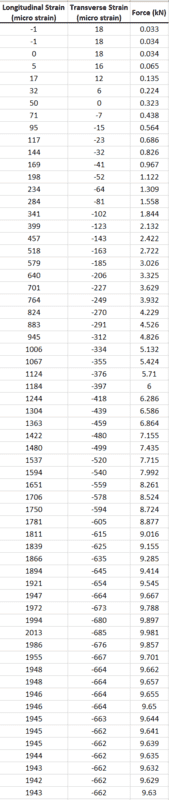
Find Young's Modulus and Poisson Ratio of Aluminium from the set of values below
Relevant Equations
Young Modulus = (Axial Strain)/Tensile Stress
Hi. I've been given these sets of value. How do I calculate Young's modulus and Poisson Ratio from these set of value. I tried to create a stress vs strain graph but the graph does not look like a common stress vs strain graph but instead more of a y=x graph.

The diameter of the rod is 10mm and the material of this rod is aluminium. How do I make the longitudinal strain a value such that I can use it for the axial strain and make the transverse strain a value that can be used for the tensile stress?
Screenshot 2020-09-24 212035.png
 
Physics news on Phys.org
What did you plot against what?
Please post the graph you obtained and explain in what way you think it does not resemble a stress/strain graph.
What distinction are you making between longitudinal strain and axial strain? Aren't they the same thing?

I don't understand your question about using transverse strain for tensile stress. A strain is not a stress. The bar is being placed under tension, as a result of which it lengthens (longitudinal strain) and narrows (transverse strain).

If you can, please post the raw data in a machine readable form so that others can create graphs from them.
What attempt have you made to find the Poisson ratio?
 

Similar threads

  • · Replies 5 ·
Replies
5
Views
2K
  • · Replies 29 ·
Replies
29
Views
8K
  • · Replies 3 ·
Replies
3
Views
2K
  • · Replies 6 ·
Replies
6
Views
3K
  • · Replies 9 ·
Replies
9
Views
3K
  • · Replies 2 ·
Replies
2
Views
2K
  • · Replies 1 ·
Replies
1
Views
2K
Replies
2
Views
3K
  • · Replies 23 ·
Replies
23
Views
5K
  • · Replies 1 ·
Replies
1
Views
2K