Zin of a circuit with independent sources

Click For Summary
To calculate the input impedance (Zin) for a circuit with independent sources, one method involves applying an input voltage (V1) and calculating the input current (Iin), resulting in Zin = V1/Iin. However, to eliminate V1 from the expression, it is suggested to turn off all independent sources, leading to the impedance formula s(Lg + Ls) + 1/(gg + sCgs), where gg is a conductance. To analyze this further, replace 's' with 2πfi, where i is the imaginary unit and f is the frequency in hertz, then solve the complex equation into real and imaginary parts. The input impedance will also depend on the phase relationship between the sources if they are coherent. Utilizing Kirchhoff's laws could provide a solution, but alternative methods may simplify the process.
anhnha
Messages
179
Reaction score
1
Hi,
This is not a homework question. I need to calculate input impedance for a LNA and this is part of it.
How do you calculate input impedance, Zin, for the circuit below?
I tried by applying an input voltage, V1, and calculate Iin.
Input impedance will be V1/Iin. However, the expression still contains V1 and I can't figure out how to
make it independent on V1.

There is another method that I am not sure.
Input impedance will be equal to the impedance as all independent sources are turned off.
This means that Zin in the picture will be equal to s(Lg + Ls) + 1/(gg + sCgs)

gg is a conductance.
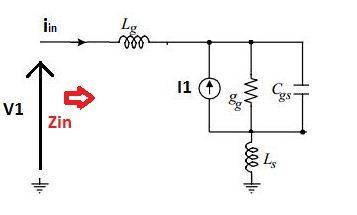
attachment.php?attachmentid=65427&stc=1&d=1389234912.jpg
 

Attachments

  • Zin.JPG
    Zin.JPG
    6.5 KB · Views: 696
Engineering news on Phys.org
Your equation (s(Lg + Ls) + 1/(gg + sCgs)) is the impedance. Someone please confirm, but all you need to do is replace 's' with 2*pi*f*i where i is the imaginary number sqrt(-1) and f is the frequency in hertz. Then solve the resulting complex equation into real and imaginary parts.
 
I don't know what the application could be but, assuming the two sources (V1 I1) are coherent, the input impedance (V12/i(in)) seen by V1 will depend upon the phase of the current I1. Have I read the circuit diagram right?

You could solve this using Kirchoff (as always) but there may be an easier way.
 
I am trying to understand how transferring electric from the powerplant to my house is more effective using high voltage. The suggested explanation that the current is equal to the power supply divided by the voltage, and hence higher voltage leads to lower current and as a result to a lower power loss on the conductives is very confusing me. I know that the current is determined by the voltage and the resistance, and not by a power capability - which defines a limit to the allowable...

Similar threads

  • · Replies 9 ·
Replies
9
Views
2K
  • · Replies 10 ·
Replies
10
Views
2K
  • · Replies 5 ·
Replies
5
Views
2K
  • · Replies 20 ·
Replies
20
Views
3K
  • · Replies 19 ·
Replies
19
Views
3K
  • · Replies 1 ·
Replies
1
Views
2K
  • · Replies 4 ·
Replies
4
Views
2K
Replies
14
Views
2K
  • · Replies 3 ·
Replies
3
Views
2K
Replies
20
Views
4K