Discussion Overview
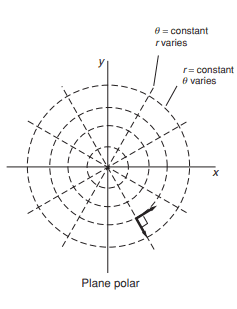
The discussion centers on the relationship between the length of the arm \( r \) in polar coordinates and the angle \( \theta \). Participants explore whether \( r \) can be considered a function of \( \theta \), examining the implications of this relationship in the context of polar coordinates versus Cartesian coordinates.
Discussion Character
- Debate/contested
- Conceptual clarification
- Mathematical reasoning
Main Points Raised
- Some participants assert that \( r \) and \( \theta \) are independent coordinates, similar to \( x \) and \( y \) in Cartesian coordinates, and can only be related when describing specific curves, such as a spiral \( r = a\theta \).
- Others argue that the unit vectors \( \hat{r} \) and \( \hat{\theta} \) depend on \( \theta \), contrasting them with Cartesian unit vectors which remain constant.
- Some participants question why textbooks do not clarify whether \( r \) is a function of \( \theta \), suggesting that in certain contexts, \( r \) can vary independently of \( \theta \).
- A few replies indicate that if \( r \) is treated as a constant, then \( \vec{r}(\theta) = r \hat{r}(\theta) \) does not imply that \( r \) is a function of \( \theta \).
- There is mention of specific cases, such as \( r = a \), where \( r \) is explicitly not a function of \( \theta \), indicating that the relationship can vary based on the context.
- Some participants emphasize the importance of distinguishing between the coordinates \( r, \theta \) and the basis vectors \( \hat{r}, \hat{\theta} \), noting that while \( \hat{r} \) is a function of \( \theta \), \( r \) itself can be independent of \( \theta \).
Areas of Agreement / Disagreement
Participants express multiple competing views regarding the relationship between \( r \) and \( \theta \). There is no consensus on whether \( r \) should be considered a function of \( \theta \), as some argue for independence while others provide examples where they are related.
Contextual Notes
The discussion highlights the potential confusion arising from the definitions and roles of \( r \), \( \theta \), \( \hat{r} \), and \( \hat{\theta} \) in polar coordinates, as well as the implications of treating these variables as independent or dependent.