Stacked blocks & pulley system

  • Thread starter Thread starter stunner5000pt
  • Start date Start date
Click For Summary
SUMMARY

The discussion revolves around solving a physics problem involving stacked blocks and a pulley system, specifically focusing on the formulation of force equations. Participants clarify that since masses m1 and m2 accelerate together, they can be treated as a single unit, negating the need for separate free body diagrams (FBDs). The coefficient of static friction (μs) is deemed irrelevant unless m2 is on the verge of sliding on m1. The problem statement confirms that mass M is heavy enough to cause the masses to slide up the incline, which is crucial for determining the system's behavior.

PREREQUISITES
  • Understanding of Newton's laws of motion
  • Familiarity with free body diagrams (FBDs)
  • Knowledge of static friction and its coefficient (μs)
  • Basic principles of pulley systems and inclined planes
NEXT STEPS
  • Study the application of Newton's laws in multi-body systems
  • Learn about static and kinetic friction in detail
  • Explore advanced pulley system mechanics
  • Practice solving problems involving inclined planes and friction
USEFUL FOR

Students and educators in physics, particularly those focusing on mechanics, as well as anyone involved in solving complex problems related to forces and motion in multi-body systems.

stunner5000pt
Messages
1,447
Reaction score
5
Homework Statement
Consider the diagram given. All surfaces have friction (u(s) & u(k)). When the system is released from rest, the mass M is heavy enough to pull m1 and m2 up the slope. m2 remains at rest with respect to m1. Determine the acceleration of the system in terms of the given variables
M, m1, m2, u(k) and u(s)
Relevant Equations
Newton's 2nd law
Friction = coefficient of friction x normal force
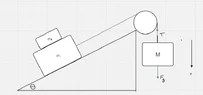
Problem picture.webp

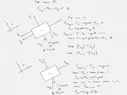
I've posted my attempt at a solution but I haven't gone through the whole process of putting together equations 1 -4 yet as I wanted to clarify if I'm on the right path

My doubt lies in the formulation of equation 4 - the force equation for the stacked block. Since we don't know the acceleration of the masses and we don't know if mass M is heavy enough to cause m2 to slide, do we leave F_{12x} undetermined and not equate this to \mu_{s} F_{N} ?

Are all the equations considering all variables or did I miss anything in my formulation so far? I'm happy to retype all that is written on the solution attempt in tex if the writing is illegible - let me know!

Appreciate all your input in advance & thank you :)
 

Attachments

  • Solution attempt.webp
    Solution attempt.webp
    25.9 KB · Views: 17
Physics news on Phys.org
Since ##m_2## and ##m_1## accelerate as one, you don't need separate free body diagrams (FBDs) for the two masses. Solve the problem as if a single mass ##(m_1+m_2)## is placed on the block. The coefficient of static friction ##\mu_s## is irrelevant because we are not told that ##m_2## is on the verge of sliding on ##m_1##.

You still have to draw the FBD for the hanging mass.
 
stunner5000pt said:
Since we don't know the acceleration of the masses and we don't know if mass M is heavy enough to cause m2 to slide, do we leave F_{12x} undetermined and not equate this to \mu_{s} F_{N} ?
The problem statement explicitly says ##M## is heavy enough to cause the masses to slide up the incline.
 
kuruman said:
Since ##m_2## and ##m_1## accelerate as one, you don't need separate free body diagrams (FBDs) for the two masses. Solve the problem as if a single mass ##(m_1+m_2)## is placed on the block. The coefficient of static friction ##\mu_s## is irrelevant because we are not told that ##m_2## is on the verge of sliding on ##m_1##.

You still have to draw the FBD for the hanging mass.
This is great thank you for the advice here.
 
  • Like
Likes   Reactions: kuruman
vela said:
The problem statement explicitly says ##M## is heavy enough to cause the masses to slide up the incline.
my apologies i should have clarified. We don't know if the hanging mass M is the biggest mass possible to cause the boxes to slide
In fact, is this something that we'd have to solve for before we simplified & treated m1 and m2 are one unit?
 
stunner5000pt said:
my apologies i should have clarified. We don't know if the hanging mass M is the biggest mass possible to cause the boxes to slide
Do you mean, you don’t know if it is the smallest mass that would cause them to slide up?
Why does that matter?
stunner5000pt said:
In fact, is this something that we'd have to solve for before we simplified & treated m1 and m2 are one unit?
What allows you to treat them as one unit is the information that "m2 remains at rest with respect to m1". That is, they behave exactly as if they were glued together.
 
haruspex said:
Do you mean, you don’t know if it is the smallest mass that would cause them to slide up?
Why does that matter?

What allows you to treat them as one unit is the information that "m2 remains at rest with respect to m1". That is, they behave exactly as if they were glued together.
you're right it doesn't matter, I'm overthinking this (as usual)

Thank you again for your help
 
stunner5000pt said:
my apologies i should have clarified. We don't know if the hanging mass M is the biggest mass possible to cause the boxes to slide
Please check the statement of the problem and make sure it matches what you posted.
 
  • Like
Likes   Reactions: nasu

Similar threads

Replies
15
Views
2K
Replies
13
Views
2K
  • · Replies 40 ·
2
Replies
40
Views
5K
  • · Replies 5 ·
Replies
5
Views
1K
  • · Replies 30 ·
2
Replies
30
Views
4K
Replies
6
Views
1K
Replies
4
Views
849
  • · Replies 18 ·
Replies
18
Views
2K
  • · Replies 3 ·
Replies
3
Views
6K
  • · Replies 22 ·
Replies
22
Views
1K