A Is energy really conserved?

  • Thread starter Thread starter Ben tesoriero
  • Start date Start date
Ben tesoriero
Messages
5
Reaction score
0
TL;DR
Do gyroscopic forces allow energy to be destroyed.
I built a device designed to brake angular velocity which seems to work based on below, i used a flexible shaft that could bow up and down so i could visually see what was happening for the prototypes.

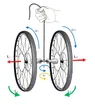
If you spin two wheels in opposite directions each with a magnitude of angular momentum L on a rigid shaft (equal magnitude opposite directions), then rotate the shaft at 90 degrees to the momentum vectors at constant angular velocity omega, then the resulting torques oppose each other causing a defection but no steady state angular velocity in the direction of the resulting torques..

You have energy in, 2 x L x omega^2, but you have no energy out as the resulting torques at steady state have no velocity.. (use the equation/ videos demonstrating gyroscopic precession to understand this). Ignoring any incidental friction losses, The magnitude of angular momentum of the wheels stays constant.

If you wish to test this more simply than i did, bolt two angle grinders back to back using a reasonable length of threaded bar with the heaviest discs you can find. When you try and turn them when running you will feel the resistance to rotation and hopefully see the deflection in the handles, using a less rigid shaft may assist in seeing this, or use two gyroscopic precession demonstration wheels, joined by a spring, hung centrally.

Does this not meet the definition of energy being destroyed?
 
Physics news on Phys.org
The experiment you propose is not clear from your description. It's not clear to me why you think energy is lost from a system of two spinning discs.
 
Gyroscopic forces do not do work. Just by definition because the gyroscopic forces are ##Q_j=\omega_{ij}(t,x)\dot x^i,## where ##\omega_{ij}=-\omega_{ji}## and ##x=(x^1,\ldots,x^m)## are the generalized coordinates
 
Last edited:
  • Like
Likes Demystifier
Ben tesoriero said:
If you spin two wheels in opposite directions each with a magnitude of angular momentum L on a rigid shaft (equal magnitude opposite directions) ...

When you try and turn them when running you will feel the resistance to rotation
Why should there be resistance to rotation, if the total angular momentum of both wheels together is zero?
 
Last edited:
A.T. said:
Why should there be resistance to rotation, if the total angular momentum of both wheels together is zero?
There is resistance to from each wheel being forced to turn, the resulting torques oppose as angular momentum of each is opposite. Same way as if you do an angular procession demonstration changing the wheel spin direction changes the direction of precession
 
Ben tesoriero said:
Same way as if you do an angular procession demonstration changing the wheel spin direction changes the direction of precession
But with two counter rotating wheels (equal but opposite angular momentum) there is no precession and no "resistance" to reorienting their common spin axis. So how is it the same?

As @PeroK said above, your description is very unclear.
 
Last edited:
A.T. said:
But with two counter rotating wheels (equal but opposite angular momentum) there is no precession and no "resistance" to reorienting their common spin axis. So how is it the same?

As @PeroK said above, your description is very unclear.
You are driving the precession so to speak, producing opposing torques.
 
Ben tesoriero said:
You are driving the precession so to speak, producing opposing torques.
Can you provide a clear diagram of your experiment? Or post a video of it?
 
Ben tesoriero said:
You are driving the precession so to speak, producing opposing torques.
If you balanced a double gyroscope about its centre, then a) if the wheels are not spinning, the system will balance; b) if the wheels are spinning, there is no torque and no precession.

The torque on a gyroscope comes from the downward force of gravity on the centre of mass, which would usually cause an object to fall, effectively rotating vertically about the pivot point. The angular momentum of the spinning gyroscope prevents rotation in this direction and leads to precession instead. The spinning wheels themselves do not produce a torque by their rotation. The torque is provided by gravity.
 
  • #10
PeroK said:
If you balanced a double gyroscope about its centre, then a) if the wheels are not spinning, the system will balance; b) if the wheels are spinning, there is no torque and no precession.

The torque on a gyroscope comes from the downward force of gravity on the centre of mass, which would usually cause an object to fall, effectively rotating vertically about the pivot point. The angular momentum of the spinning gyroscope prevents rotation in this direction and leads to precession instead. The spinning wheels themselves do not produce a torque by their rotation. The torque is provided by gravity.
True, but if you drive rotation you generate torque ie the precession equation holds true
 
  • #11
A.T. said:
Can you provide a clear diagram of your experiment? Or post a video of it?
Will do in about 24 hours
 

Similar threads

Replies
2
Views
3K
Replies
4
Views
2K
  • · Replies 0 ·
Replies
0
Views
1K
  • · Replies 60 ·
3
Replies
60
Views
5K
  • · Replies 10 ·
Replies
10
Views
2K
  • · Replies 10 ·
Replies
10
Views
470
  • · Replies 1 ·
Replies
1
Views
2K
  • · Replies 3 ·
Replies
3
Views
3K
Replies
7
Views
1K
  • · Replies 20 ·
Replies
20
Views
2K