Calculating area of an annulus

  • Thread starter Thread starter ShizukaSm
  • Start date Start date
  • Tags Tags
    Area
Click For Summary

Homework Help Overview

The discussion revolves around the calculation of the area of an annulus, specifically addressing the area of a ring with radius R' and width dR'. Participants are examining the derivation of the formula for this area and the implications of infinitesimal quantities in calculus.

Discussion Character

  • Conceptual clarification, Mathematical reasoning, Assumption checking

Approaches and Questions Raised

  • Participants explore the derivation of the area formula, questioning the treatment of infinitesimal quantities, particularly dR'^2. There is discussion on the differential approximation and how it relates to the area of the annulus.

Discussion Status

Several participants have provided insights that clarify the original poster's confusion regarding the area calculation. There is an acknowledgment of the negligible nature of certain terms in the derivation, and alternative visualizations of the problem have been suggested. The discussion appears to be productive, with participants engaging in a collaborative exploration of the concepts.

Contextual Notes

Participants note the importance of understanding the implications of using infinitesimals and how they affect the calculations in this context. There is a recognition of the assumptions made regarding the size of dR in relation to R.

ShizukaSm
Messages
85
Reaction score
0
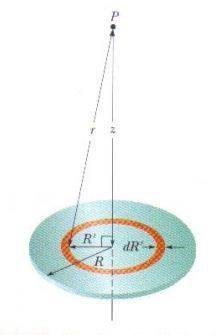
My physics book when providing proof of the electric potential of a disk tells me that the area of a ring with radius R' and width dR' is 2 \pi R'dR'
ringofcharge.JPG

The problem is, I have no idea how he arrives at this conclusion. Here is my attempt:
A = \pi (R'+dR')^2 - PiR'^2\\ A = \pi(R'^2 + dR'^2 + 2R'dR') - \pi R'^2 \\ A = \pi dR'^2 + 2 \pi R' dR'
Which is, of course, different from what my book says:
A = \pi dR'^2 + 2 \pi R' dR' \neq 2 \pi R'dR'
 
Physics news on Phys.org
Notice that dR'^2 is the square of an infinitesimal quantity, which we take to be zero. So your derivation works out.
 
When doing infinitesimal proofs like this any squared terms are negligible - for example your dR'^2 should be thrown out.

An alternate way to see the result is if you cut the ring and lay it out flat it's a rectangle (almost) with side lengths easily calculated.
 
I will drop the primes so as not to confuse with the derivative. What your text is using is the differential approximation to the annulus area. You have a circle of area ##A=\pi R^2##. The approximate change in area when ##R## is changed by an amount ##dR## is the differential ##A'dR = 2\pi R dR## which approximates the exact change, which you have calculated. For small ##dR## you can ignore the ##dR^2## term.

[Edit] Wow! Two other answers just while I was typing. That's life in PF.
 
Ohh, I see ! Thanks to you three, that perfectly cleared my doubt.
 
A disk of radius R has area \pi R^2. A disk of radius R+ dR has area \pi(R+ dR)^2= \pi R^2+ 2\pi RdR+ \pi(dR)^2. The area of the annulus between them is 2\pi RdR+\pi (dR)^2. If dR is much smaller than R, that is approximatelyu 2\pi RdR.
 

Similar threads

  • · Replies 19 ·
Replies
19
Views
3K
  • · Replies 9 ·
Replies
9
Views
2K
Replies
3
Views
2K
Replies
4
Views
4K
  • · Replies 13 ·
Replies
13
Views
6K
  • · Replies 11 ·
Replies
11
Views
2K
Replies
4
Views
1K
  • · Replies 10 ·
Replies
10
Views
6K
  • · Replies 33 ·
2
Replies
33
Views
3K
  • · Replies 8 ·
Replies
8
Views
2K