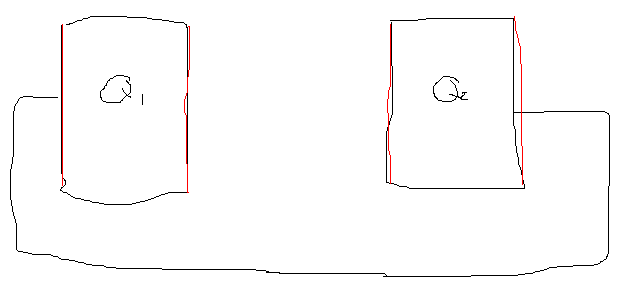
We can consider two cases separately.
In the first case, the charges of q1 and q2 are equal, but one is positive and the other is negative. When connecting with wires, all charges will be neutralized, so there will be no excess charges on the surface of any conductor.
In the second case, the amount of charge has not been completely neutralized, and the distribution of excess charge on the surface of the conductor will be determined according to the geometry and spatial distribution of the conductor. Of course, simulation software is necessary to get accurate answers in complex situations.
However, based on the diagram you provided, I believe that the eight corners of the two cubes and the four right-angle turning positions of the wires will accumulate more charge.