A new space rock to my collection

  • Context: Undergrad 
  • Thread starter Thread starter davenn
  • Start date Start date
  • Tags Tags
    Rock Space
Click For Summary

Discussion Overview

The discussion revolves around the collection of meteorites, specifically focusing on a recent addition to one participant's collection, the Huckitta meteorite. Participants share their experiences, storage methods, and the complexities of collecting meteorites, including considerations of cost and provenance.

Discussion Character

  • Exploratory
  • Technical explanation
  • Conceptual clarification
  • Debate/contested

Main Points Raised

  • One participant describes their latest meteorite addition, the Huckitta meteorite, noting its unique characteristics compared to typical Pallasites.
  • Another participant inquires about storage methods and handling practices for meteorites, suggesting that presentations at schools could engage students.
  • Several participants share their experiences with large meteorites they have seen, including one at the de Young Museum and another at Meteor Crater in Arizona.
  • Discussion arises about the classification of Pallasites and the origins of meteorites, with questions about how to determine their source.
  • Concerns are raised about the cost of meteorites and the potential for scams, with one participant mentioning the high prices for rare types.
  • Participants discuss the market for meteorites, noting that prices can vary significantly based on rarity and type, with some expressing skepticism about the investment potential of meteorites.
  • There is a mention of various meteorite types, including Martian and lunar meteorites, and the abbreviations used for them, leading to a clarification of terms among participants.
  • One participant expresses a desire to specialize in collecting specific types of meteorites, particularly Pallasites, while also aiming to acquire more specimens from Australia.

Areas of Agreement / Disagreement

Participants express a range of views on the investment potential of meteorites, with some agreeing on the risks while others challenge the notion that prices will not drop. The discussion includes multiple competing perspectives on the classification and provenance of meteorites, indicating that there is no consensus on these topics.

Contextual Notes

Participants mention the complexities of meteorite classification and the variability in market prices, but these discussions remain unresolved, with differing opinions on the implications of new meteorite finds on pricing.

davenn
Science Advisor
Gold Member
Messages
9,724
Reaction score
11,804
I just love space rocks :biggrin:

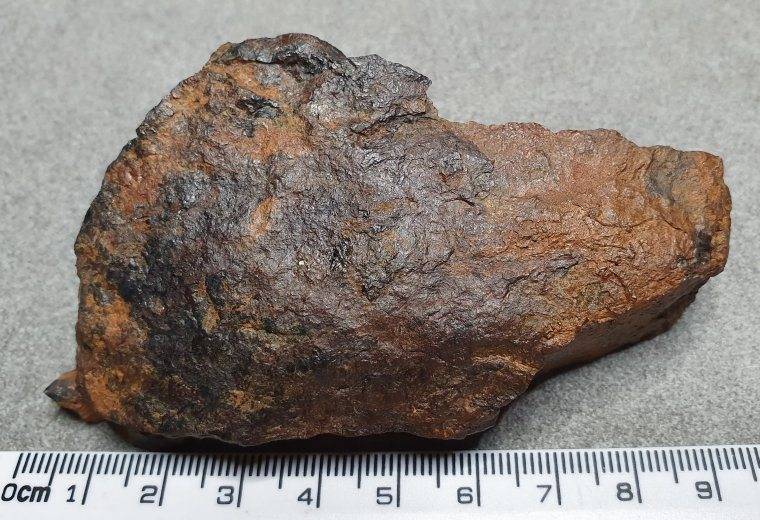
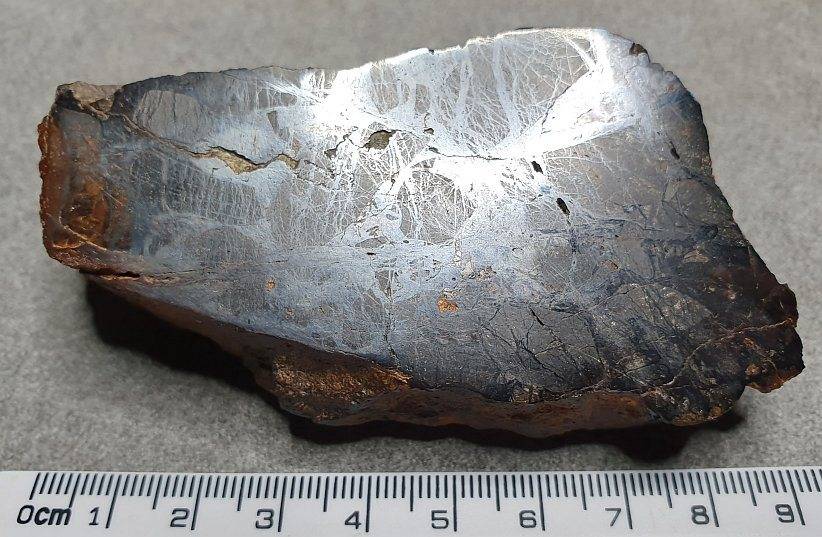
The latest addition to my meteorite collection

NAME (LOCALITY): Huckitta, Huckitta cattle station, NT, Australia

FALL DATE: Unknown, found 1924 (TKW 2300kg)

CLASS: Pallasite, PMG-an
WEIGHT g: 220.1g
METEORITICAL BULLETIN: Never published in the Meteoritical Bulletin

https://www.lpi.usra.edu/meteor/metbull.php?code=11922

Interesting meteorite, it isn't like any of the other "normal" looking Pallasites I have or have seen.
It doesn't have the obvious Olivine "lumps" in it, rather the "stony bits are highly fractured with
fine lines of iron.
A nice end-cut piece.

front and back views
20200307_195908sm.jpg


20200307_195928sm.jpg

cheers
Dave
 
Last edited:
  • Like
Likes   Reactions: Andy Resnick, pinball1970, Klystron and 5 others
Astronomy news on Phys.org
Very cool, Dave. You've probably mentioned it before on the PF, but how do you store them, and do you wear gloves when you handle them? Do you do any presentations at local school science clubs or similar? I'm sure that kids would get pretty excited to actually see and hold them (with or without gloves). :smile:
 
  • Like
Likes   Reactions: davenn
The largest meteorite I have seen in person was exhibited in the de Young Museum where it meets the Asian American Arts Museum in San Francisco's Golden Gate Park. Cannot locate pictures online. While attending university, I volunteered as a docent at the museum and visited 'my' meteorite at every opportunity. If memory serves the meteorite was dark green, brown and black about the size of an early VW bug large enough for children to climb on it.
 
Last edited:
  • Wow
Likes   Reactions: davenn and berkeman
berkeman said:
Very cool, Dave. You've probably mentioned it before on the PF, but how do you store them, and do you wear gloves when you handle them?

Thanks
this is one of 3 storage cases for my meteorites ( I use them for the smaller rock and mineral samples as well) ...

20200308_124553sm.jpg
Yes, cotton gloves do help with the more "delicate" ones. But just not touching them much
is the best for them. Those whose surfaces will oxidise in the air usually already come varnished.

berkeman said:
Do you do any presentations at local school science clubs or similar? I'm sure that kids would get pretty excited to actually see and hold them (with or without gloves)

A couple of local schools ... It's very difficult to get into schools these days with all the regulations and
child safety stuff.
 
  • Like
Likes   Reactions: berkeman
Klystron said:
The largest meteorite I have seen in person was exhibited in the de Young Museum where it meets the Asian American Arts Museum in San Francisco's Golden Gate Park.
ohhh cool, didn't know about that one, was last in San Francisco in 2006.

The largest one I have seen and touched, is the one on display at Meteor Crater, Arizona, USA.
Have been there twice once on my own in 1999 and again with wife in 2006 ...

The Holsinger Meteorite , weighing 639 kilograms (1,409 lb) and about 1.5 m long

060530 (4643) Meteor Crater Winslow AZ sm.jpg
Dave
 
  • Like
Likes   Reactions: Klystron
@davenn Your hobby really rocks!
 
  • Haha
Likes   Reactions: davenn
davenn said:
Pallasite

Pallasite? From Pallas? I know that there are HED types from Vesta (and SNC from Mars), but how can someone tell a C-type was from Pallas and not somewhere else?
 
  • Like
Likes   Reactions: davenn
Vanadium 50 said:
Pallasite? From Pallas? I know that there are HED types from Vesta (and SNC from Mars), but how can someone tell a C-type was from Pallas and not somewhere else?

no, a German guy ….
from wiki

Pallasite
Meteorite is a fantastic Meteorite in which metals and minerals intertwine. It is a kind of "Stony-Iron Meteorite". The half is an alloy of "Iron" and "Nickel". The other half is made of Peridot etc. It was named in the 1700s by "P. Pallas", German scholar. It is often simply called "Pallasite".
 
  • Informative
Likes   Reactions: Vanadium 50
Thanks. (So why did they name the asteroid after him, then? :devil: )
 
  • #10
Vanadium 50 said:
Thanks. (So why did they name the asteroid after him, then? :devil: )
Athenek it's named after someone else... :oldwink:
 
  • Like
Likes   Reactions: davenn
  • #11
Pallas is another name for the Greek goddess Athena.

diogenesNY
 
  • Like
Likes   Reactions: Klystron
  • #12
davenn said:
I just love space rocks :biggrin:

The latest addition to my meteorite collection
It all appeals to me but I always wonder about cost and provenance. Is it a hobby that would potentially leave me very poor / scammed?
 
  • Like
Likes   Reactions: davenn
  • #13
sophiecentaur said:
It all appeals to me but I always wonder about cost and provenance. Is it a hobby that would potentially leave me very poor / scammed?

The costs can be huge for meteorites that have very little material available or are rare types

Avg meteorites typically go for US$1 - 2 / gram, rare or difficult to get ones can sell for up to
US$25 / gram

I'm careful where I buy from as are most of us collectors and the resellers. There's quite a number
of long time and well trusted sellers out there..

The wonderful thing is that they are a good investment, will likely never drop in priceDave
 
  • #14
davenn said:
The wonderful thing is that they are a good investment, will likely never drop in price

I'm a bit puzzled by that statement. New meteors are found all the time.* I would imagine the prices vary by interest. Just looking around on the web "Martian" meteorites go for a lot more than SNCs. :wink:*Taking the canonical 5 tons per day and $1/gram, that's $5M worth per day. (That's a joke...apparently I need to identify them now)
 
  • #15
Vanadium 50 said:
I'm a bit puzzled by that statement. New meteors are found all the time.*

very little of that 5t/day are ever found

order of value, high to low
Martian -- I have the tiniest piece
Lunar -- still on the to acquire list
( those 2 almost swappable)

Carbonaceous Chondrites - quite rare, the Murchison, Australia is one
https://en.wikipedia.org/wiki/Murchison_meteorite
Achrondrites
Pallasites
-- from memory only 51(52) known falls -- I have samples from 5 of them
Irons --
Stony Irons ( High Fe content Chondrite) --
Ordinary Chondrites ( OC's) -- the most commonI think I need to do an insight article on meteorite :smile:
Vanadium 50 said:
I would imagine the prices vary by interest

By type and quantity available for sale.

Vanadium 50 said:
….lot more than SNCs.

SNC ?cheers
Dave
 
  • #17
Vanadium 50 said:
Thanks. (So why did they name the asteroid after him, then? :devil: )

I thought I responded to this the other day ? I don't see my post, sorry

No, the asteroid Pallas is named after
from Wiki …..
Pallas
, third largest asteroid in the asteroid belt and the second such object to be discovered, by the German astronomer and physician Wilhelm Olbers on March 28, 1802, following the discovery of Ceres the year before. It is named after Pallas Athena, the Greek goddess of wisdom.
 
  • Like
Likes   Reactions: Klystron
  • #18
davenn said:
SNC ?

Shergottites, Nakhlites, Chassignites. i.e. Martian.

It's just funny that there are places that charge an outrageous price for "Martian" meteorites charge a slightly less outrageous price for SNCs.

HED = Howardite, Eucrite, Diogenite , i.e. from 4 Vesta
 
  • Like
Likes   Reactions: davenn
  • #19
Vanadium 50 said:
Shergottites, Nakhlites, Chassignites. i.e. Martian.

familiar with those, just hadn't seen them abbreviated to SNC's ... learned something :smile:

The little bit of the Martian one I have is a Shergottite

Vanadium 50 said:
HED = Howardite, Eucrite, Diogenite , i.e. from 4 Vesta

familiar with the HED abbr. tho
Don't think I have a Howardite, have a Eucrite, definitely don't have a Diogenite

It's an interesting hobby. Different collectors aim for different goals
all from a particular country,
all types of pallasites,
all the different chondrites etc

Till recently, I was aiming for just getting a wide variety from worldwide places.
Now I am considering specialising a little more. Maybe get a few more of those 50 odd
Pallasites and possibly increase that existing 5 to around 10 or 15 different locations

One sub-goal is still trying to get as many from my home country of Australia.
That one in the OP was the latest addition to the "Australian family"Dave
 
Last edited:

Similar threads

  • · Replies 3 ·
Replies
3
Views
2K
  • · Replies 84 ·
3
Replies
84
Views
16K