A question about fluids and tubes

  • Context: Undergrad 
  • Thread starter Thread starter RMalayappan
  • Start date Start date
  • Tags Tags
    Fluids
Click For Summary
SUMMARY

The discussion centers on calculating the horizontal distance traveled by water siphoned through a rubber tube, comparing it to an experiment using Torricelli's Law for fluid exiting an orifice. The teacher's experiment aimed to apply the same equations, specifically v=sqrt(2gh), but resulted in a significant discrepancy between calculated and actual distances. Key factors influencing this discrepancy include the differences in flow dynamics between a tube and an orifice, which were not adequately addressed in the calculations. Understanding these differences is crucial for accurate predictions in fluid dynamics.

PREREQUISITES
  • Understanding of Torricelli's Law and its application in fluid dynamics.
  • Basic knowledge of kinematics and projectile motion.
  • Familiarity with fluid flow concepts, particularly the differences between orifice and tube flow.
  • Knowledge of siphoning principles and their effects on fluid behavior.
NEXT STEPS
  • Study the differences between laminar and turbulent flow in tubes.
  • Learn about the Bernoulli's equation and its applications in fluid dynamics.
  • Research the impact of tube diameter and length on flow rate and distance.
  • Explore advanced fluid dynamics simulations to visualize flow behavior in various scenarios.
USEFUL FOR

Physics students, educators, and anyone interested in fluid dynamics, particularly those exploring siphoning techniques and the principles governing fluid flow through different mediums.

RMalayappan
Messages
16
Reaction score
0
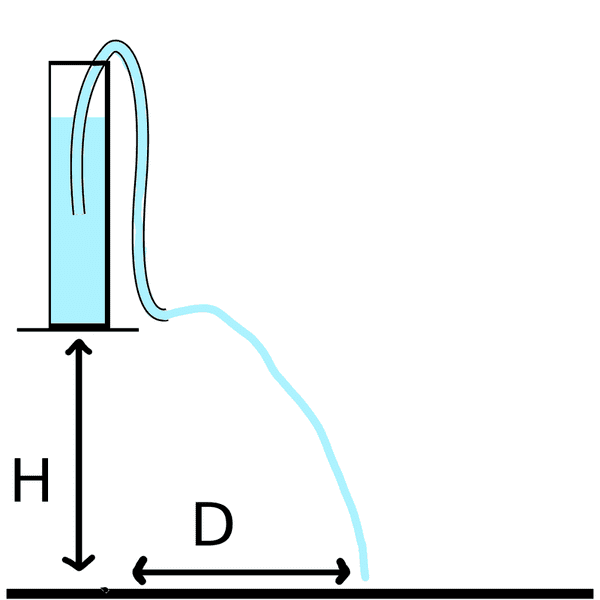
My physics teacher cooked up an experiment today on the fly where we tried to calculate the horizontal distance traveled, D, from a rubber tube through which water was siphoned from a graduated cylinder elevated a certain distance H from the ground:
cP0DqsS.png

He modified an experiment he had found of the same sort but with a hole in the cylinder instead, in which case he could use Torricelli's Law to find that v=sqrt(2gh) for water exiting with the surface a distance of h above the hole and basic kinematics to find the horizontal distance upon impact with the ground. We tried the same equations with h being the height of the tube above the opening and the calculations gave a distance that was much farther than the actual distance. What is the proper way to go about this problem and why did the application of the same equations give such a gross overshoot?
 
Physics news on Phys.org
RMalayappan said:
tube through which water was siphoned
How does flow through a tube differ from flow through an orifice?
 
RMalayappan said:
We tried the same equations with h being the height of the tube above the opening and the calculations gave a distance that was much farther than the actual distance
So what you are saying is that if you move the top curve of the siphon higher or lower, using the "same equations" the distance d should vary?
Seems that you have forgotten something about the hose.
 
Evidently I have forgotten something, but I don't know what it is. I'm not exactly sure what is different between flow out of an orifice and a tube.
 

Similar threads

Replies
0
Views
2K
Replies
31
Views
4K
Replies
4
Views
3K
  • · Replies 14 ·
Replies
14
Views
3K
  • · Replies 17 ·
Replies
17
Views
5K
Replies
10
Views
3K
  • · Replies 5 ·
Replies
5
Views
2K
  • · Replies 4 ·
Replies
4
Views
3K
Replies
6
Views
2K
  • · Replies 11 ·
Replies
11
Views
4K