A Question about the Double Atwood Machine

Click For Summary
SUMMARY

The discussion centers on the analysis of a Double Atwood Machine, specifically addressing the equations of motion and tensions involved. Key equations include the acceleration of mass m3, given by $$a_3=\frac{m_3-m_{\text{eff.}}}{m_3+ m_{\text{eff.}}}g$$ and the tension equations $$F_{T_3}=\frac{2m_3~ m_{\text{eff.}}}{m_3+ m_{\text{eff.}}}g$$ and $$F_{T_1} = \frac{2m_2~ m_1}{m_2+ m_1}(g+a_3)$$. The conversation emphasizes the importance of correctly applying these equations to avoid common mistakes, particularly in understanding the effective mass and acceleration in the system. The use of Lagrangian mechanics is also introduced as a more advanced method for analyzing the system.

PREREQUISITES
  • Understanding of Newton's laws of motion
  • Familiarity with Atwood machines and their dynamics
  • Basic knowledge of Lagrangian mechanics
  • Ability to solve systems of equations involving multiple variables
NEXT STEPS
  • Study the derivation of equations for single and double Atwood machines
  • Learn about effective mass and its implications in mechanical systems
  • Explore Lagrangian mechanics and its application to complex systems
  • Practice solving problems involving multiple pulleys and masses
USEFUL FOR

Students of physics, mechanical engineers, and anyone interested in advanced mechanics and the dynamics of pulley systems.

Minming
Messages
9
Reaction score
6
Homework Statement
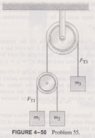
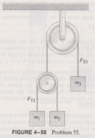
The double Atwood machine shown in Fig. 4-50 has frictionless, massless pulleys and cords. Determine (a) the acceleration of masses m1, m2 and m3, and (b) the tensions FT1 and FT3 in the cords.
My answer is different from the book‘s!
Please to see the attach file.
Relevant Equations
F=ma
1705240892707.png


Solution:
1705240794099.png

1705240824688.png

1705240840872.png

1705240853563.png

1705240863011.png
 

Attachments

  • question55.docx
    question55.docx
    1.2 MB · Views: 84
  • 附图55.png
    附图55.png
    52.2 KB · Views: 126
  • 附图55.png
    附图55.png
    52.2 KB · Views: 99
  • Like
Likes   Reactions: PeroK and Delta2
Physics news on Phys.org
Hello @Minming
:welcome:

Check your eq (4)

##\ ##
 
You equation for ##a_s## doesn't look correct to me. It should involve ##F_{T_1}## and ##F_{T_3}## and not the masses m1,m2 and g, at least not directly.
 
  • Like
Likes   Reactions: Lnewqban and Steve4Physics
An easier way to assemble the equations would be to consider that the acceleration of an Atwood machine pulley on the right does not depend on whether there is another Atwood machine on the left side of its cord or an effective mass ##m_{\text{eff.}}##. Assuming that ##m_3## is accelerating and moving down, the known equations for the acceleration and tension of a single Atwood machine hanging from a fixed support are $$a_3=\frac{m_3-m_{\text{eff.}}}{m_3+ m_{\text{eff.}}}g~;~~F_{T_3}=\frac{2m_3~ m_{\text{eff.}}}{m_3+ m_{\text{eff.}}}g.$$The left pulley is accelerating up with acceleration ##a_3## which means that it can be treated as a fixed Atwood machine in an effective gravitational field ##g_{\text{eff.}}=(g+a_3).## So we write $$F_{T_1} = \frac{2m_2~ m_1}{m_2+ m_1}(g+a_3).$$ We also have that ##F_{T_1}=\frac{1}{2}F_{T_3}##. This gives a second equation and hence a system of two equations and two unknowns, ##a_3## and ## m_{\text{eff.}}## $$\begin{align}
& a_3=\frac{m_3-m_{\text{eff.}}}{m_3+ m_{\text{eff.}}}g \\
&\frac{2m_2~ m_1}{m_2+ m_1}(g+a_3)=\frac{1}{2}\times \frac{2m_3~ m_{\text{eff.}}}{m_3+ m_{\text{eff.}}}g \\
\end{align}$$ Having obtained ##a_3## and ## m_{\text{eff.}}##, one can find ##F_{T_3}## and ##F_{T_1}.## Knowing ##F_{T_1},## accelerations ##a_1## and ##a_2## can be found through the usual free body diagrams. I think this method is more transparent and easier to implement without the use of MATLAB.

Edited to fix typo in equation (2) where ##\frac{1}{2}## was on the wrong side.
 
Last edited:
  • Like
Likes   Reactions: Minming, MatinSAR, Delta2 and 1 other person
Hi @Minming. It might be worth saying a little more about the mistake in ‘equation 4’. It's worth you understanding why it's wrong.

Consider ##m_1, m_2## and ##s## as forming a separate body, X (which internally is a simple Atwood machine).

That’s what you did when incorrectly applying ‘a = F/m’ to X to give ##a_s = \frac {F_{T3} – (m_1+m_2)g} {m_1+m_2}##.

The right-hand side is actually the acceleration of X’s centre of mass, ##a_{XCoM}##. But X’s centre of mass is not stationary relative to ##s## because of the ‘internal’ motion of ##m_1## and ##m_2## inside X. So ##a_s \neq a_{XCoM}## (except in the special case when ##m_1 = m_2##).
 
  • Like
Likes   Reactions: Delta2 and SammyS
BvU said:
Hello @Minming
:welcome:

Check your eq (4)

##\ ##
Hi, BvU
I take the pulley, m1 and m2 as a box.
This box's mass is (m1+m2), and ΣF=FT3-(m1+m2)g.
 
kuruman said:
An easier way to assemble the equations would be to consider that the acceleration of an Atwood machine pulley on the right does not depend on whether there is another Atwood machine on the left side of its cord or an effective mass ##m_{\text{eff.}}##. Assuming that ##m_3## is accelerating and moving down, the known equations for the acceleration and tension of a single Atwood machine hanging from a fixed support are $$a_3=\frac{m_3-m_{\text{eff.}}}{m_3+ m_{\text{eff.}}}g~;~~F_{T_3}=\frac{2m_3~ m_{\text{eff.}}}{m_3+ m_{\text{eff.}}}g.$$The left pulley is accelerating up with acceleration ##a_3## which means that it can be treated as a fixed Atwood machine in an effective gravitational field ##g_{\text{eff.}}=(g+a_3).## So we write $$F_{T_1} = \frac{2m_2~ m_1}{m_2+ m_1}(g+a_3).$$ We also have that ##F_{T_1}=\frac{1}{2}F_{T_3}##. This gives a second equation and hence a system of two equations and two unknowns, ##a_3## and ## m_{\text{eff.}}## $$\begin{align}
& a_3=\frac{m_3-m_{\text{eff.}}}{m_3+ m_{\text{eff.}}}g \\
&\frac{2m_2~ m_1}{m_2+ m_1}(g+a_3)=\frac{1}{2}\times \frac{2m_3~ m_{\text{eff.}}}{m_3+ m_{\text{eff.}}}g \\
\end{align}$$ Having obtained ##a_3## and ## m_{\text{eff.}}##, one can find ##F_{T_3}## and ##F_{T_1}.## Knowing ##F_{T_1},## accelerations ##a_1## and ##a_2## can be found through the usual free body diagrams. I think this method is more transparent and easier to implement without the use of MATLAB.

Edited to fix typo in equation (2) where ##\frac{1}{2}## was on the wrong side.
Thank you, kuruman
I have a misstake in the knowledge in pully.
And your advice about effective mass and effective acceleration is very useful for me.
Thanks.
 
  • Like
Likes   Reactions: Delta2 and Lnewqban
Steve4Physics said:
Hi @Minming. It might be worth saying a little more about the mistake in ‘equation 4’. It's worth you understanding why it's wrong.

Consider ##m_1, m_2## and ##s## as forming a separate body, X (which internally is a simple Atwood machine).

That’s what you did when incorrectly applying ‘a = F/m’ to X to give ##a_s = \frac {F_{T3} – (m_1+m_2)g} {m_1+m_2}##.

The right-hand side is actually the acceleration of X’s centre of mass, ##a_{XCoM}##. But X’s centre of mass is not stationary relative to ##s## because of the ‘internal’ motion of ##m_1## and ##m_2## inside X. So ##a_s \neq a_{XCoM}## (except in the special case when ##m_1 = m_2##).
Hi, Steve4
I get it ,thinks.
 
  • Like
Likes   Reactions: Steve4Physics
BvU said:
Hello @Minming
:welcome:

Check your eq (4)

##\ ##
Thanks. I get it.
 
  • Like
Likes   Reactions: BvU
  • #10
Minming said:
Thanks. I get it.
As an exercise, I decided to hit this with some Lagrangian mechanics:

I took ##x_1, x_2, x_3## as the (downward positive) displacements of the masses, and ##X_1, X_2## as the displacements of ##m_1, m_2## relative to the pulley over which they slide. We have the constraints:
$$x_1 = X_1 - x_3, \ x_2 = X_2 - x_3, \ X_2 = -X_1$$Which leads to$$x_2 = -x_1 -2x_3$$This leads to the Lagragian:$$L = KE - PE$$$$L = \frac 1 2 m_1 \dot x_1^2 + \frac 1 2 m_2(\dot x_1 + 2x_3)^2 + \frac 1 2 m_3\dot x_3^2 + \big (m_1x_1 - m_2(x_1 + 2x_3) + m_3x_3 \big ) g$$Then we use the Euler-Lagrange equations (##i = 1, 3##):
$$\frac{\partial L}{\partial x_i} = \frac d {dt}\frac{\partial L}{\partial \dot x_i}$$The first equation is:
$$\frac{\partial L}{\partial x_1} = \frac d {dt} \frac{\partial L}{\partial \dot x_1}$$$$\Rightarrow (m_1 - m_2)g = \frac d {dt} \bigg (m_1\dot x_1 + m_2(\dot x_1 + 2\dot x_3) \bigg )$$$$\Rightarrow (m_1 + m_2)\ddot x_1 + 2m_2 \ddot x_3 = (m_1 - m_2) g$$Similarly, the second Euler-Lagrange equation is:
$$2m_2 \ddot x_1 + (4m_2 - m_3)\ddot x_3 = (m_3 - 2m_2)g$$Eliminating ##\ddot x_1## gives:
$$(m_1m_3 + m_2m_3 + 4m_1m_2)\ddot x_3 = (m_1m_3 +m_2m_3 - 4m_1m_2)g$$Eliminating ##\ddot x_3## gives:$$(m_1m_3 + m_2m_3 + 4m_1m_2)\ddot x_1 = (4m_1m_2 + m_1m_3 - 3m_2m_3)g$$You can then get the tension from ##T_i = m_i(g - \ddot x_i)##.

The quickest way to get ##\ddot x_2## is to note that by symmetry it must be the same as ##\ddot x_1## with ##m_1## and ##m_2## interchanged.

Tough problem and not much easier using Euler-Lagrange.
 
  • Informative
  • Like
Likes   Reactions: PhDeezNutz, Minming, MatinSAR and 1 other person
  • #11
Thank you.
The Lagrangian mechanics seems difficult....
 
  • #12
Minming said:
Thank you.
The Lagrangian mechanics seems difficult....
It's beautiful. You'll learn it at some stage in your degree. All modern physics (QM, QFT, GR) is based on Lagrangian or Hamiltonian mechanics, as Newton's laws themselves do not generalise.
 
  • Like
Likes   Reactions: Delta2 and PhDeezNutz
  • #13
Minming said:
Thank you.
The Lagrangian mechanics seems difficult....

If your major is physics you will find out just how beautiful it is and how it makes Newtonian mechanics EASIER.

I was going to do a Lagrangian approach for this problem but @PeroK beat me to it.

Might still do it for fun.
 
  • #14
PhDeezNutz said:
If your major is physics you will find out just how beautiful it is and how it makes Newtonian mechanics EASIER.

I was going to do a Lagrangian approach for this problem but @PeroK beat me to it.

Might still do it for fun.
You could do a double-double Atwood machine with four masses on three pullies.
 
  • #15
PeroK said:
You could do a double-double Atwood machine with four masses on three pullies.
Don’t tempt me. I might. Let me first do the one with 2 pullies to see if I get the same answer as you. Then I might try the second scenario.

@Minming when you learn Lagrangian, Hamiltonian mechanics you will come to prefer it.
 
  • #16
For the double-double Atwood machine, if we let ##p_1## be the displacement (downwards positive) of the first pulley, supporting masses ##m_1## and ##m_2##; and ##p_2## likewise supporting masses ##m_3## and ##m_4##, then the constraints are:
$$x_2 = -x_1 + 2p_1, \ x_4 = -x_3 - 2p_1$$The Euler-Lagrange equations are:
$$(m_1 + m_2)\ddot x_1 - 2m_2 \ddot p_1 = (m_1 - m_2)g$$$$(m_3 + m_4)\ddot x_3 + 2m_4 \ddot p_1 = (m_3 - m_4)g$$$$-m_2\ddot x_1 + m_4\ddot x_3 +2(m_2+m_4) \ddot p_1 = (m_2 - m_4)g$$Solving for ##\ddot x_1## gives:
$$\ddot x_1 = \frac{m_1\big(m_2(m_3 + m_4) + m_3m_4\big) - 3m_2m_3m_4}{(m_1 + m_2)m_3m_4 + (m_3 + m_4)m_1m_2}g$$By symmetry, the others can be obtained from this. E.g.
$$\ddot x_3 = \frac{m_3\big(m_4(m_1 + m_2) + m_1m_2\big) - 3m_1m_2m_4}{(m_1 + m_2)m_3m_4 + (m_3 + m_4)m_1m_2}g$$Finally, if we let ##m_3 = m_4 = \frac 1 2 M##, then we recover the solution for the double Atwood machine above, with ##M## replacing the original ##m_3##:
$$\ddot x_1 = \frac{m_1\big(m_2M + \frac 1 4 M^2\big) - \frac 3 4 m_2M^2}{(m_1 + m_2)\frac 1 4 M^2 + Mm_1m_2}g$$$$\ddot x_1 = \frac{4m_1m_2 + m_1M - 3m_2M}{(m_1 + m_2)M + 4m_1m_2}g$$$$\ddot x_3 =\frac{\frac 1 2 M\big(\frac 1 2 M(m_1 + m_2) + m_1m_2\big) - \frac 3 2 m_1m_2M}{(m_1 + m_2)\frac 1 4 M^2 + Mm_1m_2}g$$$$\ddot x_3 =\frac{M(m_1 + m_2) - 4m_1m_2}{(m_1 + m_2)M + 4m_1m_2}g$$And all is good!
 
  • Love
Likes   Reactions: PhDeezNutz
  • #17
As it turns out, this is an example problem in Marion and Thornton.
 

Similar threads

Replies
25
Views
2K
Replies
3
Views
2K
Replies
2
Views
2K
Replies
1
Views
2K
  • · Replies 2 ·
Replies
2
Views
5K
Replies
1
Views
4K
  • · Replies 10 ·
Replies
10
Views
4K
  • · Replies 7 ·
Replies
7
Views
4K
  • · Replies 4 ·
Replies
4
Views
2K
  • · Replies 6 ·
Replies
6
Views
4K