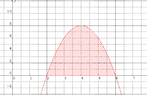
A simple area calculation, where is the mistake ?

Click For Summary
SUMMARY

The discussion centers on calculating the area under the curve of the function f(x) = 0.5x² within a rectangle ABCO, where BC is twice the length of OC. The correct area, as confirmed by integration, is 21.3333, while the initial incorrect calculation yielded 10.666667 due to a multiplication error. The area under the curve for any parabola of the form y = ax² within a rectangle defined by the vertices (0,0) and (b, ab²) is consistently 2/3 of the rectangle's area. The integration used was ∫₀⁴ (8 - 0.5x²) dx to derive the correct area.

PREREQUISITES
  • Understanding of definite integrals in calculus
  • Familiarity with the properties of parabolas
  • Knowledge of area calculation under curves
  • Basic algebra for manipulating equations
NEXT STEPS
  • Study the application of definite integrals in area calculations
  • Learn about the properties of parabolas and their geometric interpretations
  • Explore integration techniques for calculating areas under various functions
  • Investigate the relationship between geometric shapes and their areas in calculus
USEFUL FOR

Students studying calculus, educators teaching integration techniques, and anyone interested in geometric interpretations of functions and areas.

Yankel
Messages
390
Reaction score
0
Hello all

I have solved a problem, and my answer differ from the one in the book from where it's taken. I think I did it correctly, can you assist ?

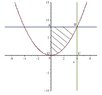
In the attached photo we have the graph of f(x)=0.5x^2
(half of x squared)

In the rectangle ABCO, BC is twice the size of OC. Calculate the dashed area.

View attachment 1186

The answer in the book is 21.3333
My answer is 10.666667

I think that 21.3333 is the area that complete to the whole rectangle. Am I right ?

Thanks !
 

Attachments

  • area.JPG
    area.JPG
    10.8 KB · Views: 136
Physics news on Phys.org
Your textbook is correct. Are you given a formula, or are you supposed to use integration? I ask because you posted in the Pre-Calculus forum, so I didn't know exactly what pre-calculus technique would be used.
 
Integration.

How can the area be 21.333 ?
 
Yankel said:
Integration.

How can the area be 21.333 ?

What definite integral did you use to represent the area?
 
Yankel said:
Integration.

How can the area be 21.333 ?

Doesn't it look like about 2/3 of the area of rectangle ABCO.

Well, it turns out that it is exactly 2/3 of that area.
 
M R said:
Doesn't it look like about 2/3 of the area of rectangle ABCO.

Well, it turns out that it is exactly 2/3 of that area.

Interestingly, it turns out to be 2/3 of the rectangular area for any parabola of the form $y=ax^2$ and for any rectangle having the opposing vertices $(0,0)$ and $\left(b,ab^2 \right)$. :D
 
MarkFL said:
Interestingly, it turns out to be 2/3 of the rectangular area for any parabola of the form $y=ax^2$ and for and rectangle having the opposing vertices $(0,0)$ and $\left(b,ab^2 \right)$. :D

It's more general than that. It'2 2/3 for every parabola.View attachment 1187
 

Attachments

  • parabola.png
    parabola.png
    3.8 KB · Views: 127
I used:

\[\int_{0}^{4}\frac{1}{2}x^{2}dx\]

to do the area under the function, in the normal way, I got 21.333
and then I subtracted is from 32, the area of the rectangle.

Edit: Found my mistake, stupid one actually. My way was perfect, I "forgot" to multiply by 0.5...and got opposite result.

Sorry guys :o
 
To find the area directly, you could use:

$$A=\int_0^4 8-\frac{x^2}{2}\,dx$$

which as you can see is equivalent to what you did. :D
 

Similar threads

  • · Replies 3 ·
Replies
3
Views
3K
  • · Replies 24 ·
Replies
24
Views
4K
  • · Replies 5 ·
Replies
5
Views
3K
  • · Replies 8 ·
Replies
8
Views
3K
  • · Replies 2 ·
Replies
2
Views
2K
  • · Replies 7 ·
Replies
7
Views
2K
  • · Replies 29 ·
Replies
29
Views
5K
  • · Replies 3 ·
Replies
3
Views
2K
  • · Replies 4 ·
Replies
4
Views
2K
  • · Replies 8 ·
Replies
8
Views
2K