A simple pulley two mass system

Click For Summary
SUMMARY

The discussion centers on solving for acceleration in a simple one pulley-two mass system, specifically comparing two methods. The first method, assuming m2 has the greater mass, yields the correct acceleration formula: a = (m2g - m1g) / (m1 + m2). The second method, which incorrectly assumes the direction of acceleration, leads to an erroneous equation T - m2g = m2a. The consensus is that maintaining a consistent coordinate system is crucial for accurate calculations.

PREREQUISITES
  • Understanding of Newton's Second Law of Motion
  • Familiarity with basic pulley systems in physics
  • Knowledge of vector representation in physics
  • Ability to manipulate algebraic equations
NEXT STEPS
  • Study the application of Newton's Laws in multi-body systems
  • Learn about vector analysis in physics
  • Explore advanced topics in dynamics, such as tension and acceleration in pulley systems
  • Investigate the implications of directionality in physics problems
USEFUL FOR

Physics students, educators, and anyone interested in understanding dynamics in mechanical systems will benefit from this discussion.

Sho Kano
Messages
372
Reaction score
3
In a simple one pulley-two mass system I have two ways of solving for acceleration, but am not sure which one is the correct or proper way.
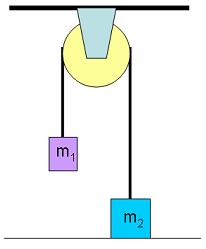
61673?db=v4net.jpg


#1)
assume m2 has the greater mass of the two
T-m1g = m1a
m2g - T = m2a
a = (m2g - m1g) / (m1+m2)

#2)
direction of up is positive, down is negative
T-m1g = m1a
T-m2g = m2a
a = (m1g - m2g) / (m2-m1)

The two accelerations are different. Which one is correct, and why?
 
Physics news on Phys.org
The rope has a fixed length. If m1 goes up, m2 goes down with the same speed. So ##v_1 = -v_2## and thereby ##a_1 = -a_2## . You only use one a in your second set. Apart from that, the second set is more clear (more consistent in signs of T and mg)
 
BvU said:
The rope has a fixed length. If m1 goes up, m2 goes down with the same speed. So ##v_1 = -v_2## and thereby ##a_1 = -a_2## . You only use one a in your second set. Apart from that, the second set is more clear (more consistent in signs of T and mg)
Accelerations are equal to zero when summed up,
m1 is moving up at a1
m2 is moving up at -a2

a1 + -a2 = 0
a1 = a2
 
Sho Kano said:
Accelerations are equal to zero when summed up
Yes. A consequence of $$y_1+y_2={\rm \ constant} \Rightarrow v_1+v_2= 0 \Rightarrow a_1+a_2= 0 $$
It is not wise to avoid negative numbers by redefining/assuming directions. Much better to keep one coordinate system definition and conclude directions from the signs of the calculated variables.
 
BvU said:
Yes. A consequence of $$y_1+y_2={\rm \ constant} \Rightarrow v_1+v_2= 0 \Rightarrow a_1+a_2= 0 $$
It is not wise to avoid negative numbers by redefining/assuming directions. Much better to keep one coordinate system definition and conclude directions from the signs of the calculated variables.
I'm confused as to whether the second set is correct or not. Can you check the other part of post #3?
 
#1 would work fine. If the acceleration came negative, then you know that your assumption that m2>m1 is wrong, and it would accelerate with -a in the direction opposite to what you assumed
#2 is incorrect.
 
Sho Kano said:
#1)
assume m2 has the greater mass of the two
T-m1g = m1a
m2g - T = m2a
a = (m2g - m1g) / (m1+m2)
this is correct!
Sho Kano said:
#2)
direction of up is positive, down is negative
T-m1g = m1a
T-m2g = m2a
a = (m1g - m2g) / (m2-m1)
this is wrong
specifically the equation
Sho Kano said:
T-m2g = m2a
is wrong because 'a' denotes mag of acceleration of m2 and mag of a vector is always positive
since you already know that m2 has accln downwards , so it is known that m2g must be greater than T
so since right side of eqn is +ve , so left side must also be +ve , so it must be (m2g-T) (since m2g > T)
it is always better to use vectors
T*j + mg*(-j)= m2a* (-j) j is unit vector in upward dir
 
Last edited:
It all seems obvious now. These should be the equations paired with the second set.
T\quad -\quad { m }_{ 1 }g\quad =\quad { m }_{ 1 }{ a }_{ 1 }\\ T\quad -\quad { m }_{ 2 }g\quad =\quad { m }_{ 2 }{ a }_{ 2 }\\ { a }_{ 2 }\quad =\quad { -a }_{ 1 }\\ \\ { a }_{ 1 }\quad =\quad \frac { { m }_{ 2 }g\quad -\quad { m }_{ 1 }g }{ { m }_{ 1 }\quad +\quad { m }_{ 2 } }
Which gives the correct answer! Thanks guys.
 

Similar threads

  • · Replies 5 ·
Replies
5
Views
2K
  • · Replies 2 ·
Replies
2
Views
5K
  • · Replies 5 ·
Replies
5
Views
5K
  • · Replies 1 ·
Replies
1
Views
2K
  • · Replies 2 ·
Replies
2
Views
2K
  • · Replies 13 ·
Replies
13
Views
2K
  • · Replies 9 ·
Replies
9
Views
6K
  • · Replies 5 ·
Replies
5
Views
5K
  • · Replies 4 ·
Replies
4
Views
2K
  • · Replies 3 ·
Replies
3
Views
2K