A string over a pulley with two hoops wound like spools on each end

Click For Summary
SUMMARY

This discussion focuses on the dynamics of a system involving two hoops wound on a pulley, where the equations of motion are derived using torque and force analysis. The key equations are τ - M1g = M1(a1t - a1R) for hoop 1 and M2g - τ = M2(a1t + a2r) for hoop 2, with the moment of inertia for a thin hoop being debated as either MR² or ½MR². The participants clarify the relationship between linear and rotational accelerations and emphasize the importance of defining positive directions for clarity in the equations. Ultimately, the solution involves correcting the moment of inertia used in the equations to achieve the correct expression for τ.

PREREQUISITES
  • Understanding of Newton's Laws of Motion
  • Familiarity with rotational dynamics and torque
  • Knowledge of moment of inertia concepts, specifically for hoops
  • Basic principles of kinematics related to linear and angular motion
NEXT STEPS
  • Study the derivation of torque equations in rotational dynamics
  • Learn about the moment of inertia for different shapes, focusing on thin hoops
  • Explore the relationship between linear and angular accelerations in rotating systems
  • Investigate the Atwood machine and its applications in physics problems
USEFUL FOR

Physics students, educators, and anyone interested in understanding the dynamics of rotating systems, particularly in the context of pulley systems and torque analysis.

pleasantresult
Messages
4
Reaction score
0
Homework Statement
This is question 1.3 from Fetter and Walecka.

A massless string is placed over a massless pulley, and each end is wound around and fastened to a vertical hoop. The hoops have masses M1, M2 and radii R1, R2. The apparatus is placed in a uniform gravitational field g and released with each end of the string aligned along the field. Show that the tension in the string is tau = g*M1*M2*(M1+M2)^(-1).
Relevant Equations
tau = g*M1*M2*(M1+M2)^(-1)
I have seen the solution to this problem but I don't understand it.

Here is my drawing of the problem.
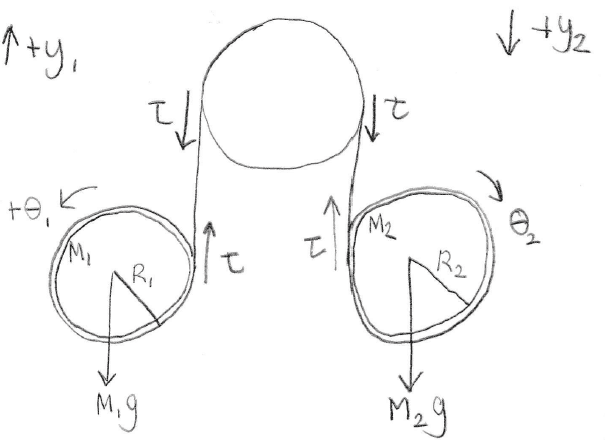
1589927184485.png


Apparently I should do the sum of the forces and sum of the torques for both hoops like this:
hoop 1:
(1) τ - M1g = M1(a1t-a1R)
(2) τR1 = ½M1R12a1r/R1
hoop 2:
(3) M2g - τ = M2(a1t+a2r)
(4) τR2 = ½M2R22a2r/R2
Where a1t and a2t are the translation accelerations up or down of hoops 1 and 2.
Where a1r and a2r are the rotational tangential accelerations of hoop 1 and hoop 2.
In the sum of the forces equations, the total linear accelerations are found by subtracting the tangential rotational acceleration for hoop 1 and adding the tangential rotational acceleration for hoop 2 based on the chosen orientations of positive linear and angular directions for the hoops.
In the third equation, you can sub in a1t where you would expect a2t because without rotation, the distance that hoop 2 drops will be the same as the distance that hoop 1 rises.
Then you have four equations with the four unknowns τ, a1t, a1r, and a2r which you can solve to get the result that τ = gM1M2/(M1+M2)-1
Everything about this setup makes sense to me except the moments of inertia that are used in equations 2 and 4. Isn't the moment of inertia of a thin hoop about its center MR2 not ½MR2?
 
Physics news on Phys.org
pleasantresult said:
(1) τ - M1g = M1(a1t-a1R)
Where a1t and a2t are the translation accelerations up or down of hoops 1 and 2.
Where a1r and a2r are the rotational tangential accelerations of hoop 1 and hoop 2.
Are you sure about eqn 1? On the left you have the net upward force on the hoop. Why should the right hand side not just be M1a1t? Do you perhaps intend that a1t is a relative acceleration?
And it is too vague to say the accelerations are "up or down". You need to say which (i.e. which way is to be taken as positive) or it is not possible to know what the signs should be in the equations.
 
Thank you for your response.

haruspex said:
Are you sure about eqn 1? On the left you have the net upward force on the hoop. Why should the right hand side not just be M1a1t? Do you perhaps intend that a1t is a relative acceleration?
I am sure about equation 1 because I have seen the solution and these four equations can be solved together to determine the correct expression for τ. I thought it made sense that the actual acceleration of the hoop would be the difference between the acceleration due to being pulled and the tangential acceleration of rotating back down. But I see your point and I'm not sure why this equation is justified. Would relative accelerations explain it like you suggested?
haruspex said:
And it is too vague to say the accelerations are "up or down". You need to say which (i.e. which way is to be taken as positive) or it is not possible to know what the signs should be in the equations.
I tried to indicate the positive directions. I put that the position for hoop 1, y1, is positive pointing up. Then the acceleration would also be positive pointing up. I put that the position for hoop 2, y2, is positive pointing down. Then the acceleration would also be positive pointing down. And I used θ1 and θ2 to indicate the positive rotational directions for hoops 1 and 2.

Do you have any thoughts about the moment of inertia of a thin hoop? Why would the solution have it as ½MR2 and not MR2?
 
Lnewqban said:

Thank you for your response.

So why does the solution I have seen for this problem look like it uses ½MR2? I don't think it makes sense to apply the parallel axis theorem in this situation. The hoops are rotating about their centers right? And applying the parallel axis theorem can only make the moment of inertia bigger than its moment about center.
 
pleasantresult said:
Thank you for your response.

So why does the solution I have seen for this problem look like it uses ½MR2? I don't think it makes sense to apply the parallel axis theorem in this situation. The hoops are rotating about their centers right? And applying the parallel axis theorem can only make the moment of inertia bigger than its moment about center.
I dropped the spurious axR terms from equations 1 and 3, and used MR2 instead of half that. Remarkably, I got the target expression for ##\tau##. So it looks like a case of two errors cancelling.
 
  • Like
Likes   Reactions: etotheipi
haruspex said:
I dropped the spurious axR terms from equations 1 and 3, and used MR2 instead of half that. Remarkably, I got the target expression for ##\tau##. So it looks like a case of two errors cancelling.

Thank you.

Great! I'm going to try that because that would make more sense to me, too.
 
haruspex said:
Are you sure about eqn 1? On the left you have the net upward force on the hoop. Why should the right hand side not just be M1a1t? Do you perhaps intend that a1t is a relative acceleration?
pleasantresult said:
I am sure about equation 1 because I have seen the solution and these four equations can be solved together to determine the correct expression for τ.

@haruspex is right, if ##a_{1t}## is the acceleration of the centre of mass of the hoop in the lab frame then ##T - M_1 g = M_1 a_{1t}##. This is an application of one of Euler's Laws of Motion.

You can denote the velocity of the part of the disk currently just in contact with the string (taking ##\hat{y}## pointing upward) as ##v = r_1 \omega_1 - v_1##. It follows that ##a = r_1 \alpha_1 - a_1## and you can do the same for the second mass.

The key part is to understand how the two accelerations are related!
 
Last edited by a moderator:
  • Like
Likes   Reactions: Lnewqban
pleasantresult said:
(1) τ - M1g = M1(a1t-a1R)

The only context in which this relation would make sense would if if ##a_{1t}## were the acceleration of the edge of the disk w.r.t. the lab frame. But that doesn't appear to be how you've defined it.
 
  • #10
pleasantresult said:
Thank you for your response.

So why does the solution I have seen for this problem look like it uses ½MR2? I don't think it makes sense to apply the parallel axis theorem in this situation. The hoops are rotating about their centers right? And applying the parallel axis theorem can only make the moment of inertia bigger than its moment about center.
I have no idea, and I am not sure about the solution, but it is an interesting situation.
This problem combines an Atwood machine with two spinning falling rings of different masses and radii (two yo-yo's basically).

https://en.wikipedia.org/wiki/Atwood_machine

https://physics.stackexchange.com/questions/518729/simple-yo-yo-work-problem

The solution would be simpler if the rings were statically (not spinning) hanging from the string, just like regular masses do in this type of problems.
Then the string would be moving with certain acceleration proportional to the difference between the masses only.

The radii and the two angular accelerations introduce additional complication.
It seems to me that tension of the string should be lower with spinning rings than with non-spinning bodies of equivalent masses.
 

Similar threads

  • · Replies 1 ·
Replies
1
Views
2K
Replies
8
Views
14K
  • · Replies 5 ·
Replies
5
Views
2K
Replies
7
Views
3K
  • · Replies 5 ·
Replies
5
Views
3K
  • · Replies 5 ·
Replies
5
Views
5K
  • · Replies 15 ·
Replies
15
Views
6K
Replies
46
Views
5K
  • · Replies 30 ·
2
Replies
30
Views
4K
  • · Replies 4 ·
Replies
4
Views
2K