Accelerating electromagnetic system

Click For Summary

Discussion Overview

The discussion revolves around the dynamics of an accelerating electromagnetic system, specifically examining the interactions between a current-carrying wire and magnets. Participants explore concepts related to electromagnetic forces, momentum transfer, and the implications of Newton's laws in this context.

Discussion Character

  • Exploratory
  • Debate/contested
  • Technical explanation
  • Mathematical reasoning

Main Points Raised

  • One participant suggests that a wire carrying current in a magnetic field should experience a force, leading to acceleration of the entire system, but acknowledges this conclusion seems bizarre.
  • Others argue that the system will not accelerate as the forces are internal, similar to a magnet held in front of a wagon, and that no mass is being ejected as propellant.
  • Some participants discuss the concept of momentum transfer via electromagnetic fields, comparing it to solar sails that utilize momentum from photons.
  • There is a mention of equal and opposite forces acting on the wire and magnets, with one participant questioning the source of the counteracting force on the magnets.
  • Several participants reference Newton's third law and the conservation of momentum, with some expressing uncertainty about how momentum is conserved in the context of the Lorentz force.
  • One participant notes that the electromagnetic field can carry momentum, but questions how this applies to the forces experienced by the wire and magnets.
  • There is a discussion about the potential failure of Newton's third law in certain electrodynamic scenarios, particularly when considering time delays in force interactions.

Areas of Agreement / Disagreement

Participants express multiple competing views regarding the acceleration of the system and the nature of forces involved. There is no consensus on the implications of Newton's laws in this context, and the discussion remains unresolved.

Contextual Notes

Participants highlight limitations in understanding the interactions, particularly regarding the assumptions about forces and momentum in electrodynamics versus electrostatics. The discussion reflects a range of interpretations of fundamental principles without reaching definitive conclusions.

DynastyV
Messages
10
Reaction score
0
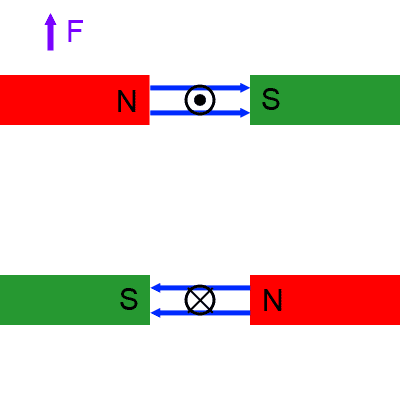
Here is a picture of a situation I thought of:
mLr3Q.png


The circles between the magnets indicate a wire with current flowing in the direction given. This picture is a cross section of a loop of wire, looking down. Not included in this picture is the battery and non-conductive connecting materials linking the magnets and wire together.

Since the current in the wire goes through a magnetic field, it should experience a force in the direction given by the right hand rule. If the magnets and wire are held together, then it seems that the entire system should accelerate as long as the current keeps on flowing.

This seems like a bizarre conclusion, but I can't think of any way to disprove this conclusion.
 
Physics news on Phys.org
It will not. The force is from the device back onto itself. Since it isn't exerting a force on anything not part of itself, and it isn't ejecting any mass as propellent, it will not accelerate. It's like connecting a magnet to the end of a stick and holding in front of a wagon, you aren't going to accelerate.
 
Drakkith said:
It will not. The force is from the device back onto itself. Since it isn't exerting a force on anything not part of itself, and it isn't ejecting any mass as propellent, it will not accelerate. It's like connecting a magnet to the end of a stick and holding in front of a wagon, you aren't going to accelerate.

The electromagnetic field can be used to transfer momentum. Could this explain what is happening here?

For example, a solar sail uses momentum from photons (electromagnetic disturbances) to accelerate.

Could this be what is happening here?

Edit: Also what is the source of the force that counteracts the force on the wire? Where is it felt?
 
Last edited:
There is a force upward on the wire, but there is also a force downward on the magnets. If you imagine the magnetic field lines created by the current in the wire, they are forcing the magnets downward.

Edit: it is an example of equal and opposite forces, as Drakkith was implying.
 
DynastyV said:
The electromagnetic field can be used to transfer momentum. Could this explain what is happening here?

For example, a solar sail uses momentum from photons (electromagnetic disturbances) to accelerate.

Could this be what is happening here?

No, a solar sail works because the Sun has already emitted the light. The recoil from emission is felt on the Sun, and the photons transfer momentum into the sail through absorption and reflection.

Edit: Also what is the source of the force that counteracts the force on the wire? Where is it felt?

On the magnets. The coil feels a force in one direction, and the magnets feel the force in the opposite direction. They cancel out.
 
Drakkith said:
No, a solar sail works because the Sun has already emitted the light. The recoil from emission is felt on the Sun, and the photons transfer momentum into the sail through absorption and reflection.
On the magnets. The coil feels a force in one direction, and the magnets feel the force in the opposite direction. They cancel out.

Could you explain the origin of the force back on the magnets in more detail? The wire feels a force due to the Lorentz Force. I've never seen anything saying that the Lorentz force causing an equal but opposite force back on the origin of the magnetic field.

Thanks!

Edit: I would also like to point out that this construction is somewhat similar to a simple electric motor.
 
Last edited:
magnetic forces always come in equal and opposite pairs, just like gravity and electrostatic forces. It can be less obvious, because often, we don't specify the exact form of the magnet.
 
BruceW said:
magnetic forces always come in equal and opposite pairs, just like gravity and electrostatic forces. It can be less obvious, because often, we don't specify the exact form of the magnet.

Can you link me to a website that has information about an equal but opposite force to the Lorentz force? I've never heard of this before.
 
DynastyV said:
Can you link me to a website that has information about an equal but opposite force to the Lorentz force? I've never heard of this before.

Newton's third law.
http://en.wikipedia.org/wiki/Newtons_laws
 
  • #10
  • #11
Then where is the momentum for the coil coming from? It's got to come from somewhere, it can't just appear. The EM field can transfer momentum but it cannot create it.
Per the third law, the coils feel a force due to the magnetic field of the magnets. In turn the magnets feel a force from the magnetic field of the coil in the opposite direction.

Edit: Whoops, momentum of course can be created, but it is conserved. Not sure what I was thinking here.
 
Last edited:
  • #12
Drakkith said:
Then where is the momentum for the coil coming from? It's got to come from somewhere, it can't just appear. The EM field can transfer momentum but it cannot create it.
Per the third law, the coils feel a force due to the magnetic field of the magnets. In turn the magnets feel a force from the magnetic field of the coil in the opposite direction.

There is no change in total momentum. The system gets some momentum, the electromagnetic field gets some momentum, and everybody is happy and Newton's third law is satisfied.

In response to your first two sentences: where does the momentum from an exploding bomb "come from"?
 
Last edited:
  • #13
DynastyV said:
There is no change in total momentum. The system gets some momentum, the electromagnetic field gets some momentum, and everybody is happy and Newton's third law is satisfied.

I'm sorry, momentum CAN be created, but it is conserved. Not sure what I was thinking.
However, the force exerted on the coil MUST have an equal and opposite force exerted on the magnet.
 
  • #14
It is totally possible that some instrument gives off EM energy, which causes the instrument to be accelerated, as you have said. And yes, this doesn't disobey any laws. But specific to the picture you drew in the first post, there is a force up on the wire and down on the magnets. You mentioned that your picture is similar to a simple electric motor. This is true. And in a simple electric motor, you can have a fixed magnet and a spinning wire, or you can have a fixed wire with a spinning magnet. This is because there is a force on the magnet too.
 
  • #15
Drakkith said:
I'm sorry, momentum CAN be created, but it is conserved. Not sure what I was thinking.
However, the force exerted on the coil MUST have an equal and opposite force exerted on the magnet.

Sorry, but Newton's Third Law doesn't always hold. The conservation of momentum on the other hand, does.

D H said:
That is the electrostatic force, static being the key word here. It implicitly assumes an action at a distance (i.e., infinitely fast) kind of force and it is not a complete description of the electromagnetic interactions when the particles are in motion.

Newton's Third Law can fail in a number of cases:
  • There is a time delay in the equations of motion, such as is the case for electrodynamics (as opposed to electrostatics). What is happening here is that the field that mediates the interaction is itself storing momentum. There is no room for such in Newton's 3rd. As mentioned before, this can be reconciled by observing that momentum is still conserved. Newton's 3rd law is conservation of momentum in the special case that forces are instantaneous and central in nature.

  • The force is not central in nature, which once again is the case for electrodynamics. In the strong form of Newton's third law, third law force pairs must be equal but opposite in nature and the force must be directed along or against the line connecting the pair of particle. This form of Newton's third law conserves both translational and angular momentum. Translational and angular momentum can still be conserved in the case of non-central forces if the mediating field stores these momenta, but Newton's third does not apply in such cases.

  • The underlying interaction inherently involves three or more particles. Newton's third demands that forces be resolvable down to pairs of particles. There are some multi-body interactions in quantum mechanics where the interactions only appears when three or more particles are present. These interactions cannot be isolated down to pairs, and once again Newton's third law fails.

In more advanced physics, it is the conservation laws that reign supreme. Newton's third law derives from the conservation laws with the assumption that forces act in pairs, act instantaneously, and act along the line connecting particle pairs. Drop those assumptions and you have to drop Newton's third law. You do not have to drop the conservation laws, however. In even higher level physics, the conservation laws themselves can be derived from the very nature of space and time.
 
  • #16
In this case, and in many of the simplest EM problems, magnetic forces come in 'near-instantaneous' pairs.
 
  • #17
BruceW said:
In this case, and in many of the simplest EM problems, magnetic forces come in 'near-instantaneous' pairs.

Can you explain the force on the magnets in more detail? What is the cause of the force?
 
Last edited:
  • #18
The current in the wire creates a magnetic field. This magnetic field causes a force on the magnet.

If you imagine the magnetic field lines from the wire and the magnetic field lines from the magnet, you can see what direction is the force on the wire and on the magnet. (a general quick and easy rule of thumb is that the magnetic field lines like to be as uniform as possible).
 
  • #19
for example, on the lower part of your picture, the current is going into the page, so in the space just above the 'north' pole, the magnetic field lines from the magnet are going against the field lines created by the wire. And in the space just below the north pole, the field lines are almost matching up. Therefore, this magnet will be pushed downwards, so that the field lines will become less steeply curved.
 
  • #20
Another way to work it out is if we give our magnets a specific form. For example, the magnets might be made of solenoids. In this case, you can work out the Lorentz force on the charged particles in the wire of the solenoid, and you can work out the force on the 'magnet' (i.e. solenoid), which gives the same answer as the other method.
 
  • #21
BruceW said:
Another way to work it out is if we give our magnets a specific form. For example, the magnets might be made of solenoids. In this case, you can work out the Lorentz force on the charged particles in the wire of the solenoid, and you can work out the force on the 'magnet' (i.e. solenoid), which gives the same answer as the other method.

I took a look at your solenoid example and found that all the forces on the solenoids cancel out. Here is a picture of the top part of the loop. A similar picture can be drawn for the bottom part of the loop.

OoS9c.png


Edit: The effect is similar to a compass needle aligning with Earth's magnetic field
 
Last edited:
  • #22
The green arrows (the force on the wire) is almost horizontal, but not. Because the wire is not exactly horizontal to the central wire, all the green arrows will be pointing downward slightly. This is the force on the magnets.
 

Similar threads

  • · Replies 1 ·
Replies
1
Views
2K
  • · Replies 7 ·
Replies
7
Views
2K
  • · Replies 61 ·
3
Replies
61
Views
6K
  • · Replies 14 ·
Replies
14
Views
2K
  • · Replies 14 ·
Replies
14
Views
3K
  • · Replies 6 ·
Replies
6
Views
2K
  • · Replies 20 ·
Replies
20
Views
5K
  • · Replies 42 ·
2
Replies
42
Views
4K
  • · Replies 3 ·
Replies
3
Views
921
  • · Replies 5 ·
Replies
5
Views
2K