Advice on building very primitive phased array radar

Click For Summary

Discussion Overview

The discussion revolves around the feasibility and design considerations for building a primitive phased array radar system intended for short-range applications (1m to 100m). Participants explore various technical challenges, including pulse generation, antenna design, and signal processing, while addressing the cost constraints associated with the project.

Discussion Character

  • Exploratory
  • Technical explanation
  • Debate/contested
  • Mathematical reasoning

Main Points Raised

  • One participant suggests using a 2.4GHz RF ASK transmitter to generate pulses for range and velocity detection, but expresses concerns about the pulse duration needed for short ranges.
  • Another participant emphasizes the need for a high pulse repetition frequency (PRF) to effectively measure short distances, proposing a PRF of over 30kHz.
  • There is a discussion about the distinction between transmit frequency and PRF, with clarification that PRF refers to how often the 2.4GHz signal is pulsed.
  • Some participants argue that 2.4GHz may be too high for effective radar operation, suggesting lower frequencies like 80MHz could be more suitable.
  • Concerns are raised about the power requirements for radar systems, with one participant noting that a high power transmitter is necessary to obtain significant reflections from targets.
  • Several participants mention the complexity of building a true phased array system, with suggestions that simpler alternatives, such as a time of arrival system with two antennas, might be more feasible.
  • One participant highlights the challenges of detecting weak signals from small biological targets at higher frequencies due to absorption issues.
  • There are recommendations for exploring existing resources and courses to gain foundational knowledge in phased array radar systems.
  • Participants discuss the need for a clear specification of the radar system's requirements, including target characteristics and desired performance metrics.

Areas of Agreement / Disagreement

Participants express a range of opinions on the feasibility of the project, with some suggesting that building a radar system from scratch may be overly complex and costly, while others encourage the exploration of the project as a learning opportunity. There is no consensus on the optimal frequency or design approach, indicating multiple competing views remain.

Contextual Notes

Participants note limitations related to the power requirements, pulse width, and the need for specialized components, which may complicate the DIY approach. The discussion also highlights the importance of understanding radar cross-section and material properties when designing the system.

Who May Find This Useful

This discussion may be of interest to hobbyists, students, or professionals exploring radar technology, particularly those considering DIY projects in radar system design or seeking to understand the complexities involved in phased array radar systems.

Shploop
Messages
24
Reaction score
0
Hi, I am interested in building a very primitive phased array radar for short ranges(1m to 100m).
I thought it's possible to use a simple 2.4GHz RF ASK transmitter, and by just sending a single '1' bit I could generate a pulse and then use a simple RF receiver for that frequency and analyze the time it took the pulse to return to find range and the frequency shift(doppler) to find the velocity of the object I am tracking.


My problems are:
1)I want this to be as cheap as possible(the RF transmitters/receivers are cheap). This way I get a very simple way to generate a 2.4GHz pulse without building a whole circuit with oscillators etc... but the problem is that I need to send a very small pulse to make this work for such a short range, in the order of nano-seconds.

2)Phase shifters are expensive, although I think I can make variable phase shifter with an all-pass filter.

3)I have little knowledge of antennas(I think a dipole will fit my needs).
and If I am correct, in phased array I need to use the same antenna for RX and TX so I also need some RF switch or Circulator to isolate my RX circuit from the TX circuit so I won't fry it.

4)I need to use minimal amount of array elements to lower cost but still get a decent resolution(like detecting a 20cm(diameter) object.

5)I want to find both range and velocity of an object so I can track it as long as it is in range.

I know all these requirement are insane and if I do make this radar it's going to be nothing like I expect, so if you think this is impossible please stop me before I waste my time :).
But if you have solutions for my problems I would be glad to hear.

Basic diagram of project:
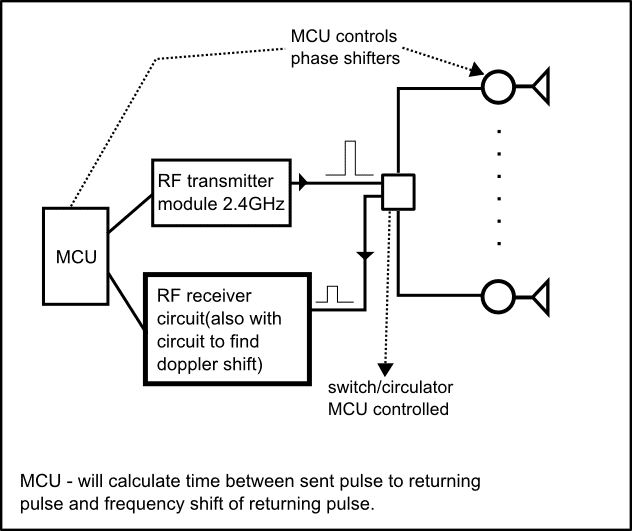
diagram.png
 
Last edited:
Engineering news on Phys.org
you will need a very high prf to do short distances.
 
i would say over 30Khz
 
Do you mean pulse repetition frequency when you say PRF?
well the 2.4GHz module has a 2MBPS speed so 30KHz PRF is possible but others problems appear, I need to switch the antenna array between transmit and receive quickly enough to receive the echo of an object from such a close range.

Any basic guidelines on short range phased array from an expert in the field :) ?
 
You have a transmit frequency which you have established is 2.4 GHz. The prf is separate to the transmit frequency. The prf is how many times you pulse the 2.4 ghz so if your prf is 30Khz that would be pulsing the 2.4 Ghz 30,000 times a second.
 
2.4 is way to high
 
i would say 80Mhz with a prf of 30Khz
 
If you want an interesting project, on which you could learn an awful lot, then go ahead. Otoh, if you want Radar then you may be better to buy a unit for a few hundred quid. There are a lot of non-DIY parts needed, each of which would cost more to buy individually (it's a bit like trying to build a £10k car from available spare parts - it could cost you ten times that much.)
Radar needs a high power transmitter (MWs peak) to give any chance of a significant reflection from a target. That means you need to protect the receiver from the transmitted pulse (proprietary switch I think). The pulse needs to be very short (20cm corresponds to about 1ns) so you would need a magnetron ( which everyone uses for simple radar, afaik)
PRF is not a problem. It's a problem for long distances, when there can be confusion about which pulse you are looking at. You could send pulses once and hour if you wanted to. More frequent just means you improve your signal to noise ratio.
If you use a low frequency (like the suggested "80MHz") the echo from a 20cm target would be far too weak..
What's wrong with a rotating / reciprocating antenna? Phased array is another can of worms for you to tackle. If you need help from an "expert" it means that it will probably be too hard for you. Hardware would cost a lot at 2.4GHz, I think. What angular resolution do you need?
If the target you are tracking could have a transponder on board, life could be a lot easier.
Perhaps giving us a clue about the application details / required spec would help.
 
A true phased array is going to be difficult; maybe a simple time of arrival system with two antennas would be simpler. Also if the target is biologic the return signal from a target 20 cm is going to be very low as the absorption will be high. Metal would be less of a problem at 2.4 GHz. Do the path loss calculations to see what kind of signal will return for our target. Using a simple UWB chirp and a simple, fast detector should work if you keep your pulse width under 1 ns. CW-FM might work for you but detecting the Doppler down in the noise is always a problem. See patent US 7551703 to understand how to achieve sub mm resolution with an uwb system you can build for under 50$US. It is a very clever design but the devil is in the details to hit .1 inches at 300 feet.

For somebody very skilled and experienced this is a 500 man hour problem. That looks to be a real commitment.

Cram
 
  • #10
I cannot know what your level of expertise is regarding phased array radar from your post. If you are just starting out, I’d recommend this to get you launched:
http://www.radartutorial.eu/06.antennas/an14.en.html

From MIT’s Lincoln Laboratory, here’s a great overview of Phased Array Radar basics, including the new F-35’s airborne fire control radar set.
http://www.ofcm.gov/mpar-symposium/2009/presentations/workshop/W1_Herd%20Basics.pdf

For specifics on F-35 radar, you might start here:
http://www.northropgrumman.com/Capabilities/ANAPG81AESARadar/Pages/default.aspx

Here’s a course you could take if you can be in Cambridge, Massachusetts this June and have $3,800. to spend:
BUILD A SMALL PHASED ARRAY RADAR SENSOR
Date: June 24-28, 2013 | Tuition: $3,800 |
COURSE SUMMARY
Are you interested in learning about phased array radar systems by building and testing your own?
MIT Professional Education is offering a unique course in the design, fabrication, and testing of a laptop-based digital phased array radar sensor capable of ground moving target imaging (GMTI).
http://web.mit.edu/professional/short-programs/courses/phased_array_radar_sensor.html

Lots of info and pictures from last year’s MIT program for same project:
http://www.glcharvat.com/Dr._Gregory_L._Charvat_Projects/IAP_phased_array.html

If these sites do not satisfy your quest, I agree with sophiecentaur: give a detailed equipment specification for each desired function. You could work up a cost estimate once you have a clear set of requirements. Better yet, your questions could be addressed here on P.F. in a more utilitarian manner. If you think this will be “cheap” you may find that it will not be.

You’ve said you want to detect a 20 cm (diameter) object. Would that be a baseball, or a metal disc or what? Every material object has a “radar cross-section”. It is roughly the target’s “reflectivity”, so you would need to know this in advance to choose your transmitted power requirement and also, your receiver sensitivity. Other considerations to examine would be what factors determine your transmitting frequency, if and when you will vary the PRF (pulse repetition frequency) at various range bins, the scheme for and resolution of target doppler measurement, beam steering control algorithm for angle tracking (phase shifters), transmitter PW (pulse width) determination for close-in targets (this from basic radar: What factors determine the minimum range?), method for and accuracy required for target range measurement, operator controls, display functions, etc. As for “duplexing”, that is, using the same antenna for both receiving and transmitting, I can tell you that few, if any phased array radars utilize this scheme. Normally there is a plethora of individual receiving and transmitting modules.

The easiest way to create a technical equipment specification is to acquire a real-world example and model yours on it. Often they contain a functional block diagram of the system and a dedicated detailed description of the performance characteristics desired for each block.

Note: just read Cram2000’s comments, posted while I was writing the above. All that he said makes good sense.
 
Last edited by a moderator:
  • #11
Thanks for all your replies, I am focusing the phased array idea because it's something that's not been done so much before and I can explore different ways to do it and not just copy someone design because it's not as interesting.

techtribes, I choose 2.4ghz because it is available and phased array radars I know use 10GHz or even more. It's a relatively high frequency for these simple RF modules, so I'll get more resolution than a 434MHz RF receiver which is also widely available(higher frequency has smaller wavelength - can't detect and object that is smaller than your wavelength).

Bobbywhy, I already read all these articles(although not thoroughly)and when I mean a 'cheap' radar I meant cheaper than MIT's radar. That radar is really cool but they don't specify any electronics about it and I am not in USA to take that course...

I want to use circuits I make or simple circuits you can buy and connect them so they perform a new function and maybe use new approaches to old problems instead of just buying ready made components that do a certain function and in the process to learn how it all works.

cram thanks for the patent reference, I took a look but it's complex to add something like this to an already complex system.

I've seen real-world examples and they are way too complex and way to expensive.

Lets start simple, if I have these requirements:
*)It needs to be phased array and not SAR/rotating dish.

*)I want to detect both range and doppler.

*)small amount of elements (about 5-12 elements) in the array.

*)Use a 2.4GHz module something like this(use only to transmit):
nRF24L01 module
Other simple replacements will gladly be accepted

*)use an all-pass filter with a digitally controlled variable resistor for variable phase shift:
example of the circuit
Other simple replacements will gladly be accepted

*)range of maximum 30m(minimum 1m) and able to detect 20cm diameter ball(has the same cross section from every angle) - the ball is let's say made of plastic or leather, if too difficult let's say it has metallic surface.

*)can be same antennas transmit or receive or some transmit while others receive(in a way that won't damage the receiver).

I thought about using multiple wi-fi antenna modules like in MIT's project but can't think of a way to change the phase between these modules as I know they work with ASK/FSK/etc and phase has less meaning them and it will be difficult to synchronize phase between these modules to get the "phased array" beam-steering.

by the way, I found a method that might help me - FM ranging as described here:
http://www.eetimes.com/design/programmable-logic/4216419/Radar-Basics---Part-2--Pulse-Doppler-Radar

also found this:
Intro to phased array - I am in interested in the "Passive" phase array as I think it is cheaper and easier to build.
 
Last edited:
  • #12
If you are looking at using the Doppler effect, you might think about a laser device instead of radar. That would take the complications of GHz transmitters and receivers out of the design problem and let you start by solving the signal processing problems. A device using a low power (legal) laser pointer as a transmitter should work OK at range of a few meters.

Google for "laser doppler vibrometer" to get some ideas.
 
  • #13
My understanding is you want to detect the velocity and rough direction of an object using a phased antenna. Doing this will also give you a rough position like a ground to air ILS. Using two antenna will give you x and y space telemetry, Z of course would be the planes altimeter. I still say a low frequency at a high amplitude with a high PRF because there will be interference assuming your using it around buildings and trees. And also if the antenna are close to the radio propagation.
 
  • #14
Of course ILS uses two radio frequencies instead of a phased antenna. but the same thing applies as the plane will use two antenna tuned to both frequencies to plot its position. You want to read phase difference in one frequency. Which won’t be that good.
 
  • #15
Well my main requirement is that the radar is NOT a rotating dish because of it's scanning speed limitations, so phased array is the way to go...
I have never thought of using waves in the near-visible/visible part of the spectrum and I know IR light is used to detect range but I don't know if it is used to detect doppler and I need it to be agile enough to detect and track a moving object without mechanical steering...

And I plan on using it in a less cluttered space(like and open field) and directed mostly at the sky, let's say to track something like a football(not really going to track footballs...)
 
  • #16
Strongly suggest you learn something about a) radar, b) antennas, c) phased arrays, d) microwave electronics and e) digital signal processing before starting this project. Based on your postings, your current state of knowledge is not up to the job in these areas. To give just a single example, your 1 ns pulse requires a 1 GHz bandwidth for all system components (transmitter, antenna, receiver, sampler and processor) making this an extremely challenging and sophisticated system.

Bobbywhy gave you a good list. Here are other suggestions:
  • Stimson, Intro to Airborne Radar (2nd ed.) A gentle but very thorough introduction to radar with many diagrams and pictures.
  • Skolnik, Intro to Radar Systems (3rd ed.) Standard undergrad text
  • Antenna books by Kraus or Balanis cover antenna and phased array basics
  • Mailloux, Phased Array Handbook gives nitty gritty details of phased array design
  • Oppenheim and Schafer, Discrete Signal Processing or anyone of dozens of similar texts to learn DSP
 
Last edited:
  • #17
Thanks for the books list, I was looking for some recommendations on good books on the subject, I have a book about Antennas I just started reading "Antenna theory".

Well my whole idea was to make something known from different components - kind of a "hack" that 2.4ghz module for different purpose but I guess it's too complex to do it without a big budget and an MIT course...

Thank you all for your replies.
 

Similar threads

Replies
5
Views
2K
  • · Replies 17 ·
Replies
17
Views
3K
  • · Replies 34 ·
2
Replies
34
Views
5K
Replies
24
Views
2K
  • · Replies 17 ·
Replies
17
Views
2K
  • · Replies 15 ·
Replies
15
Views
4K
Replies
10
Views
15K
  • · Replies 5 ·
Replies
5
Views
2K
Replies
5
Views
5K
  • · Replies 22 ·
Replies
22
Views
769