Timtam
- 40
- 0
I have a question about the following scenario involving a flow separation issue in a pipe expansion
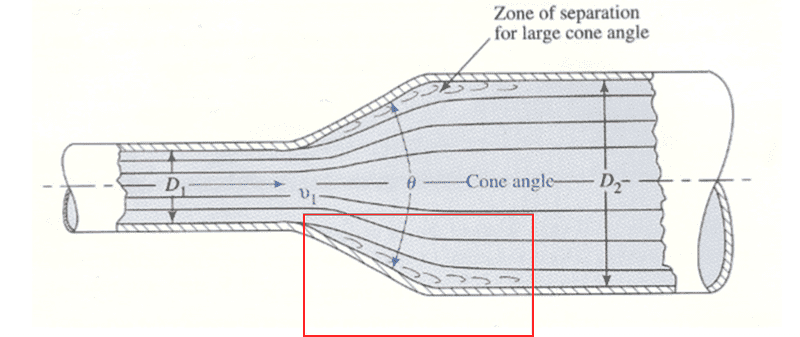
The angle of the expansion is 30* - doubling the diameter from 1D to 2D
We can consider this flow fully developed with a Reynolds of 5000+
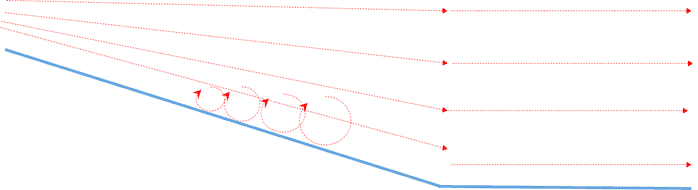
Associated with this expansion is a head loss caused by localised flow separation converting flow to eddies and vortices which I understand to then cascade down to the Kolmogorov length scale where they are dispersed as heat.
If I was to zoom in the localisation might look like this
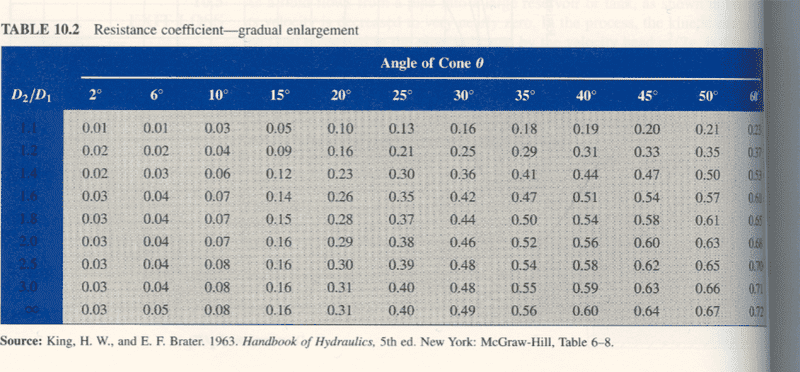
The K factor resistant coefficient associated with this configuration is 0.46
Current tables
In aerodynamics they use boundary layer control suction (removing Boundary Layer Static Pressure) or re-energizing the flow adding Dynamic Pressure) to reduce drag associated with flow separation
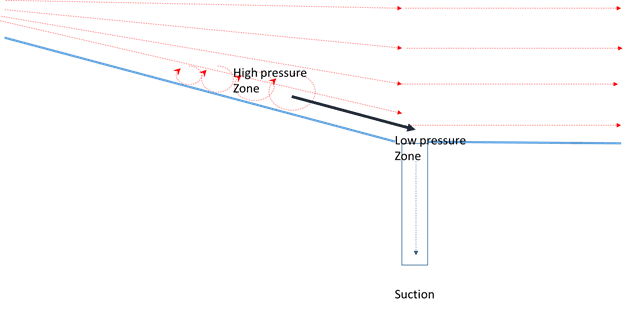 I am similarly interested in using boundary layer suction in my pipe (by reducing pressure at the start of the expansion to reduce the head loss**) but I am unsure I understand the actual mechanism that achieves this
My attempt at an explanation Suction creates a localized low pressure zone ( ahead of the localized high pressure zone created by the stagnated flow within the boundary). This creates a new gradient with which this high pressure can disperse . As this gradient is in the streamwise direction this allows the energy to rejoin the flow as DPMy Question
Is this correct ? Would my resistance coefficient be lower than the 0.46 the pressure loss the expansion experiences without suction ?
**I am aware that adding suction will cost energy which will be more than the flow recovered: therefore will be energy deficit. I am only concerned with lowering the Resistance coefficient
The angle of the expansion is 30* - doubling the diameter from 1D to 2D
We can consider this flow fully developed with a Reynolds of 5000+
Associated with this expansion is a head loss caused by localised flow separation converting flow to eddies and vortices which I understand to then cascade down to the Kolmogorov length scale where they are dispersed as heat.
If I was to zoom in the localisation might look like this
The K factor resistant coefficient associated with this configuration is 0.46
Current tables
In aerodynamics they use boundary layer control suction (removing Boundary Layer Static Pressure) or re-energizing the flow adding Dynamic Pressure) to reduce drag associated with flow separation
My attempt at an explanation Suction creates a localized low pressure zone ( ahead of the localized high pressure zone created by the stagnated flow within the boundary). This creates a new gradient with which this high pressure can disperse . As this gradient is in the streamwise direction this allows the energy to rejoin the flow as DPMy Question
Is this correct ? Would my resistance coefficient be lower than the 0.46 the pressure loss the expansion experiences without suction ?
**I am aware that adding suction will cost energy which will be more than the flow recovered: therefore will be energy deficit. I am only concerned with lowering the Resistance coefficient
Attachments
